
The Boy Who Drew Doors
After losing his father, a young boy finds a way to grieve through magical drawings that open more than just imagination—they open the heart.
No one knew when Eli started drawing the doors.
They first appeared as chalk outlines on the brick wall behind his school. At first, they were just scribbles, wobbly rectangles with mismatched handles. But within weeks, they grew detailed—ornate hinges, weathered textures, little brass knobs that caught the sun just right. He never explained what they were, not even when his classmates asked why he never opened them. “They’re not for here,” he’d mutter, eyes drifting somewhere far beyond the playground.
At home, Eli didn’t talk much. His mother tried—soft questions over dinner, books slid gently across the table, warm arms waiting by the door. But ever since his dad died last spring, Eli had folded into himself like origami—tight, unreadable, paper-thin. He spent hours with his colored pencils, sketching door after door on every surface he could find: in the margins of his notebooks, the insides of cereal boxes, even on the walls of his closet.
His mother once caught him whispering to a drawing in the hallway: a narrow green door set in ivy-covered stone. “Eli?” she asked gently, trying not to startle him. He blinked, almost as if waking up. “He’s not in this one,” he said, and walked away.
That night, she cried in the bathroom while Eli drew three new doors under his bed.
Eli had always loved his dad’s stories. His father, a quiet man with kind eyes and calloused hands, used to sit by Eli’s bed and make up tales about “the in-between”—a place where doors led to dreams, memories, and everything that could never be said aloud. “Some doors,” he would whisper with a wink, “open only when you’re ready.”
So when Eli’s father didn’t come home from the hospital, the stories didn’t stop—they just shifted. Now, they were Eli’s. And he drew them with desperate precision, not just imagining worlds, but looking for something. He was sure if he drew the right one, he could find his father again.
The breakthrough came on a rainy Thursday.
Eli had been sent to the counselor’s office for drawing on his desk—again. As the rain clattered on the windows, he pulled a stub of charcoal from his pocket and began sketching on the counselor’s wall while she was on the phone. This door was different—rounded like a hobbit hole, with tiny stars carved into the frame. He didn’t know why, but it felt right.
He stood in front of it, heart pounding.
“Open,” he whispered.
And the wall…hummed. Just for a moment. Just long enough to make Eli’s breath catch. The air thickened like a held note. Then it was gone.
When the counselor returned, she found Eli staring at the wall with tears running down his cheeks. She didn’t say anything. Just sat beside him and waited.
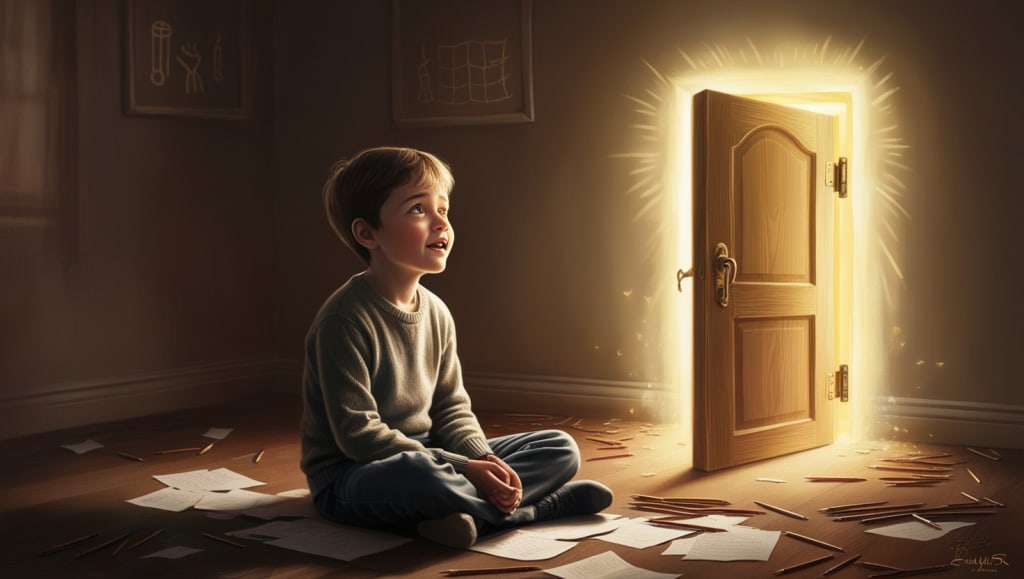
That weekend, Eli locked his bedroom door, turned off the lights, and drew again. This time, he added details he remembered from his father’s study—old books, the scent of cedar, a lamp shaped like a moon. He drew with purpose, a trembling prayer in every line.
And this time, the door opened.
Just a crack.
Enough for a scent to slip through—leather and lavender and old wood. Enough for a sound to rise—his father’s laugh, faint and fading. Eli fell to his knees and pressed his ear to the drawing, trembling.
“I’m here,” he whispered. “Please... I need to say goodbye.”
No reply. Only the warmth of memory folding around him, like a blanket pulled over a sleeping child.
Over the weeks that followed, the doors began to change. They no longer led only to grief. Some opened into joy—the lake where he learned to skip stones, the corner bakery where his father let him choose anything he wanted. Others held pain, and he let those stay closed for now.
Each door became a way through the tangle inside him. A way to feel without drowning.
One night, his mother walked past his room and paused. His door was open, and he was sitting on the floor, sketchbook in his lap. He looked up and smiled—a real smile, small and crooked, but there.
“I drew one for you,” he said softly. “It goes to the day you met Dad. I thought you might want to visit.”
She didn’t know how to respond, so she sat down beside him, her hand trembling as she traced the drawing with her fingertips.
Eli never stopped drawing. But he no longer searched with desperation.
He had learned that some doors didn’t open to bring things back. They opened so you could let them go.
And sometimes, the bravest thing you could do was draw a door and walk through it—alone, but not unloved.
About the Creator
Asim Ali
I distill complex global issues ranging from international relations, climate change to tech—into insightful, actionable narratives. My work seeks to enlighten, challenge, encouraging readers to engage with the world’s pressing challenges.



Comments
There are no comments for this story
Be the first to respond and start the conversation.