
“The Letters in the Wall”
Some messages aren't meant to be found—but they find you anyway.
M Mehran
When I bought the old farmhouse on Millers Ridge, I wasn’t looking for magic. I wanted peace. Something simple. I was thirty-three, freshly divorced, and ready to forget that the city had ever swallowed me whole.
The house had been empty for years. The floors creaked like they were sighing, and the wallpaper peeled like it was tired of pretending. But I loved it immediately—its quietness, its secrets.
It was on the second week of fixing up the place that I found the letters.
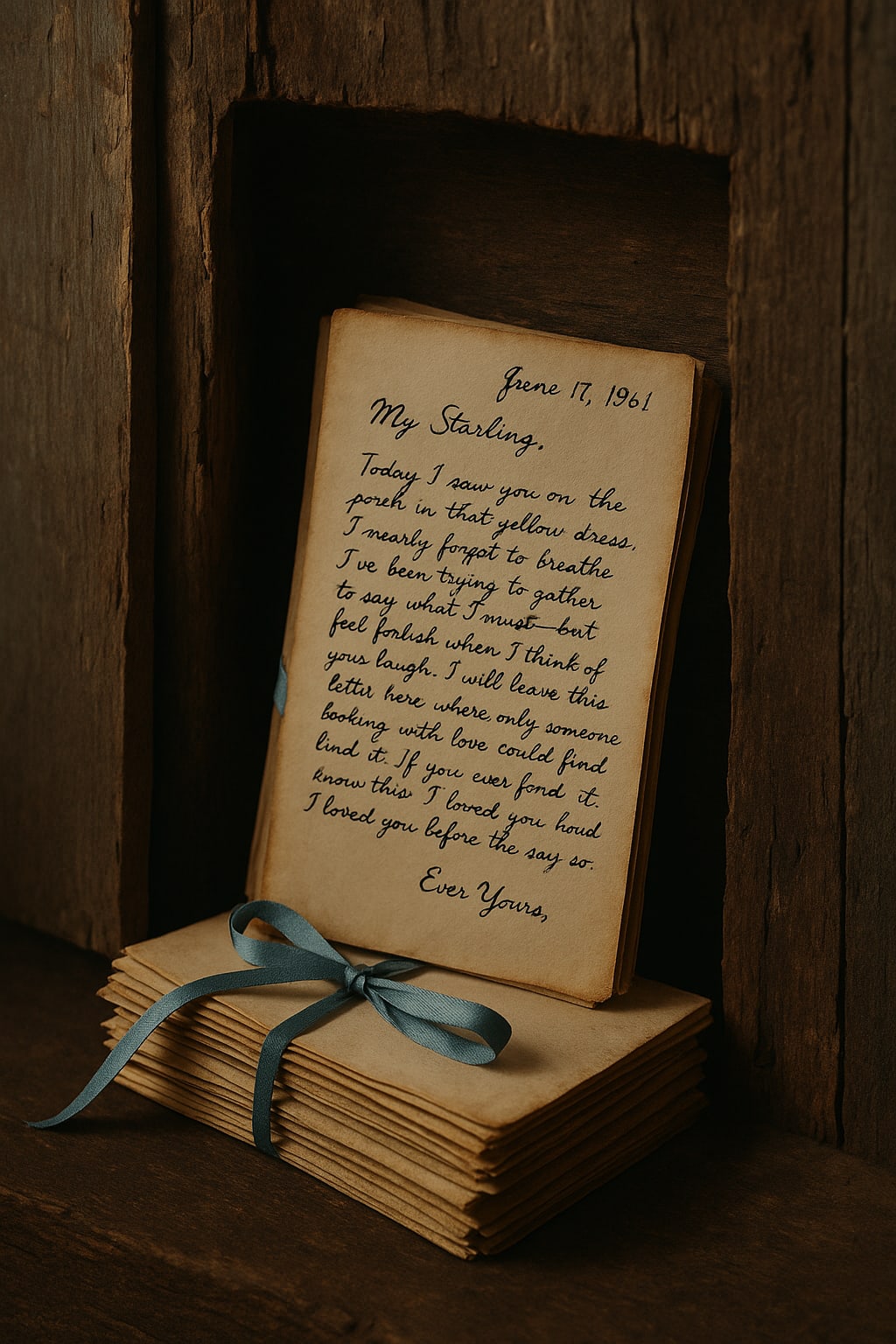
They were behind a loose wooden plank in the hallway wall. Just above eye level, where you’d never think to look. Tied in a pale blue ribbon, yellowed with time, and smelling faintly of lavender and dust.
There were thirteen letters. All addressed to “My Starling.”
The handwriting was neat. Careful. The kind of script people don’t write in anymore. I told myself I wouldn’t read them.
I read the first one that night.
---
June 17, 1961
My Starling,
Today I saw you on the porch in that yellow dress. I nearly forgot to breathe. I’ve been trying to gather the courage to say what I must—but words feel foolish when I think of your laugh. I will leave this letter here, where only someone looking with love could find it. If you ever find it, know this: I loved you long before I had the right to say so.
Ever Yours,
E.
---
I read all thirteen that night. They weren’t love letters in the usual sense—not poetic declarations or dramatic pleas. They were soft. Intimate. Full of tiny details.
How “E” liked the way Starling hummed while sweeping the porch. How her absence made the walls feel empty. How he was building a small music box for her, in secret, just in case.
The final letter, dated November 1962, was different.
---
My Starling,
You’re gone. They say time will pass, but no one tells you what to do with the hours that don’t. I sit by the fire and pretend you’ll come through the door again. I’ve sealed the others away, where only a soul who’s searching might find them. If you’re reading this, maybe in another life, leave me a sign.
I’ll wait.
E.
---
It felt wrong, having read them. Like trespassing. But also… like something sacred had passed into my hands.
I asked around town about the house. Most people didn’t remember much. Some whispered about a woman named Lydia Harrow, a schoolteacher who’d lived there in the early ’60s. No one knew what had happened to her.
The next week, I found the music box.
It was tucked inside a broken drawer in the basement. Carved with tiny stars. And inside—taped to the lid—was a photo.
A man with dark eyes and a crooked smile. Holding a woman in a yellow dress. Her laugh was frozen in the frame.
Written on the back:
E & L. Ridgeview County Fair, August 1961.
I took the photo and pressed it against the wall where I found the letters. It felt right. Like putting something back in place.
That night, the music box played for the first time. I hadn’t wound it. The sound was faint. Like a lullaby from another room.
---
I live in the house still. I never told anyone about the letters. Not really. Some things feel too alive to share.
But every now and then, I light a candle in the hallway. I place the music box by the wall.
And I whisper:
"He waited."
About the Creator
"Hear Me Out"
"Hear me out, what if we ran away together?" "Where do you want to go?" "Anywhere but here. We could move to a new city or to Canada, or we could disappear from society to live in the middle of the woods. Maybe a combination of two of those things would be good. What do you say?"
By Kay Husnick7 days ago in Fiction
The Mediation, Friday, November 9th, 2012
Anton sat at the large oak table in the mediation services office. He had already been there for twenty minutes. He was fifteen minutes early and eager to get this over with. He already knew that she wasn’t going to agree to anything. If Karin thought he killed it at the first court date, wait until she sees what’s about happen here.
By Anton Mathias Heft 3 days ago in Fiction




Comments
There are no comments for this story
Be the first to respond and start the conversation.