
The Letter She Never Sent
Some words are too heavy to speak, yet too important to forget.


The Letter She Never Sent
Nora had always believed in writing things down. From grocery lists to unsent love letters, her life was inked in journals and forgotten scraps of paper. Words were safer that way—silent, controlled, trapped between margins where they couldn’t betray her. She had written hundreds of letters over the years, but there was one letter she could never bring herself to send.
It was to him.
Elliot.
They met in autumn, in a coffee shop that smelled of cinnamon and wet leaves. Nora was reading The Alchemist with her usual furrowed brows, lost in a world where destiny felt tangible. Elliot, a stranger then, interrupted her solitude with a question that would carve a space in her memory forever.
“Do you really think we find our destiny, or does it find us?”
Startled, she looked up. His voice was calm, yet there was a curiosity in his eyes that felt rare. Nora, who never entertained strangers, closed her book and answered, “I think destiny leaves signs. Most people are just too busy to notice them.”
He smiled, pulled out a chair without asking, and sat across from her. That’s how it began.
Over the next seven months, Elliot became her closest companion. They didn’t label their connection. They just existed in it—talking about books, life, fear, and what-ifs. He had this reckless way of chasing sunsets, of believing in things Nora had trained herself to avoid.
He made her believe, too.
For a while.
But Elliot was always half-in, half-gone. He’d disappear for days, sometimes weeks, sending her cryptic texts like “Some birds aren’t meant to be caged.” Nora would wait, knowing he’d return, but always afraid one day he wouldn’t.
And then, one day, he didn’t.
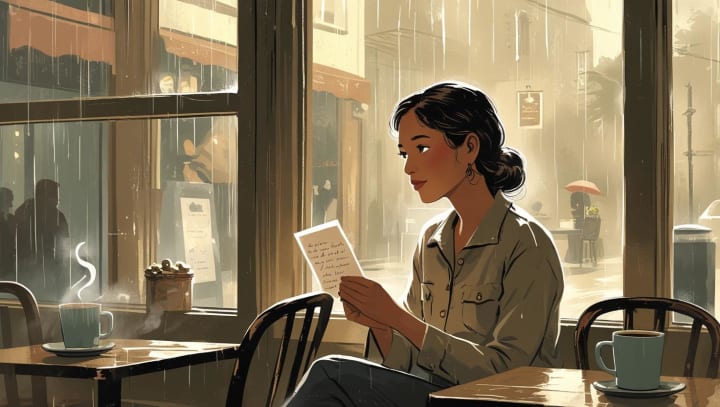
It was a rainy Thursday when the final silence arrived. No calls. No texts. No more coffee shop conversations about destiny. Nora sat by her window, her journal open, her pen trembling over the paper.
She began writing the letter that night.
Dear Elliot,
You once told me that words, when left unspoken, haunt us more than those we regret saying. I guess that’s why I’m writing this now—to silence the ghosts you left behind.
I should hate you for leaving. For vanishing without a goodbye. But I can’t. Because even now, I find myself defending you in my head, telling myself you were just chasing your freedom.
Maybe I was just a stop on your map. Maybe you never meant to stay. I don’t know.
What I do know is that you changed me. I look at the sky differently now. I pay attention to signs. I believe, even when I don’t want to.
I just wish you had stayed long enough to see me become the version of myself you helped create.
But maybe you already knew. Maybe that was your purpose all along—to wake me up and then leave me standing.
Thank you for that. Even if you’ll never read this.
Goodbye, Elliot.
She folded the letter, slid it into an envelope, and wrote his name on the front. She didn’t know where he was. She didn’t know if he would ever come back. But she kept the letter on her desk for weeks, as if part of her was waiting for a sign.
The sign never came.
Two Years Later
Life moved on in the way it always does—quietly, ruthlessly. Nora got a new job at a publishing house. She moved to a different apartment, far from the coffee shop where they met. She even dated someone else, though no one quite filled the empty spaces the way Elliot did.
And then, a letter arrived.
There was no return address. Just her name, written in handwriting she would recognize anywhere.
Her hands trembled as she opened it.
Dear Nora,
If you’re reading this, it means I finally had the courage to send it. I’ve written a thousand versions of this letter. All of them felt wrong. All of them felt like they weren’t enough.
I’m sorry I left.
The truth is, I was sick. I didn’t know how to tell you. I didn’t want you to watch me fade.
I’ve always been a runner, Nora. Not because I didn’t care. God, I cared more than I ever let on. But I was terrified of being seen as weak, of being remembered as broken.
You made me feel safe, and that terrified me, too. Because when you find something that feels like home, the idea of losing it becomes unbearable.
So I left before you could watch me fall apart.
It wasn’t fair to you. I know that now.
I’ve been getting treatment. Some days are better. Some days aren’t. But I think about you every time I see a sunset. You were right, by the way—destiny leaves signs. I just didn’t know how to read them back then.
I hope you’re happy. I hope you found the life you deserve.
If you ever want to meet again, I’ll be waiting at the old coffee shop. Sundays, 4 PM. No pressure.
Always, Elliot.
Nora’s chest tightened, her mind a storm of memories and questions. She read the letter again, and again, as if the words might disappear if she blinked too long.
Was this real?
Was it too late?
The following Sunday, she went to the coffee shop. Not because she forgave him. Not because she expected him to be there.
But because some words—spoken or unspoken—deserve to find their way home.
The bell above the door chimed as she stepped inside. The same cinnamon scent. The same worn-out tables. She sat by the window, clutching Elliot’s letter.
Minutes passed. Then an hour.
Just as she was about to leave, the door opened.
There he was.
Older, thinner, but undeniably Elliot.
He saw her. He smiled.And in that moment, Nora realized—some letters don’t need stamps.They just need the courage to be sent.
About the Creator
Shohel Rana
As a professional article writer for Vocal Media, I craft engaging, high-quality content tailored to diverse audiences. My expertise ensures well-researched, compelling articles that inform, inspire, and captivate readers effectively.
Keep reading
More stories from Shohel Rana and writers in Fiction and other communities.
Harmony in Time
The old theater in Savannah smelled of polished wood and history, its velvet curtains heavy with stories of performances long past. At twenty-seven, Lily Harper stood on its stage, her alto voice curling through the empty seats as she rehearsed for the annual Lowcountry Choral Festival. She was a music teacher by day, shaping young voices at a local high school, but by night, she was a soloist with the Savannah Songweavers, a community choir that felt like family.
By Shohel Rana7 months ago in Fiction
The Devil's Cut
“Comrade, finally you’re awake.” The voice was smooth, sensual. A flickering incandescent bar was all that lit the white, sterile room. All Vladimir remembered was everything going black. He tried to move his arms and found them strapped to the gurney.
By Matthew J. Fromm7 days ago in Fiction


Comments
There are no comments for this story
Be the first to respond and start the conversation.