
The Legend of the Bermuda Triangle: One of the Few Mysteries We Still Can't Solve
"Unraveling the Enigma of the Bermuda Triangle: Mysterious Disappearances and Intriguing Theories"
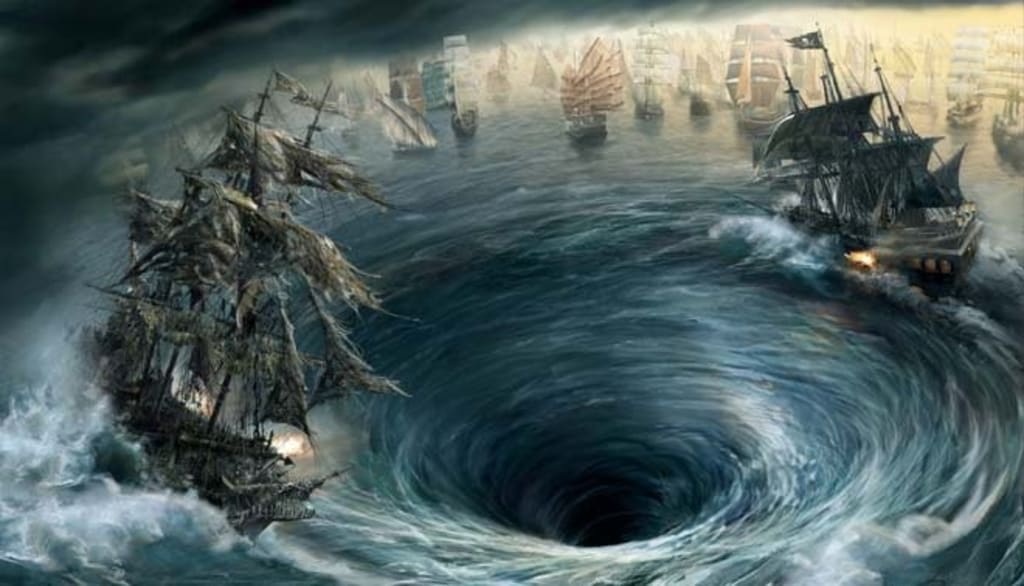
Let's rewind back about 600 years. The story begins with an Italian man who wanted to sail across the ocean to reach Asia, a continent rich with spices, silk, minerals, and all sorts of valuable treasures. Getting there by land would take an incredibly long time, so he had a bold idea: why not build sturdy ships, gather a crew of sailors, and set off to Asia by sea? What could possibly go wrong?
That man was Christopher Columbus, and in 1492, with a little help from Spain's royal family, he embarked on his historic journey. Everything was going well, apart from the fact that he was totally going the wrong way. As he reached the end of his voyage, he noticed something very strange. Little did he know, he was sailing through the infamous Bermuda Triangle, also known as the "BT" or the "point of no return" – a mysterious area between Bermuda, Puerto Rico, and Florida.
The Bermuda Triangle has been the setting for countless stories of ships, boats, and planes disappearing without a trace. Some were eventually found, while others seemed to vanish off the face of the Earth, remaining undiscovered at the bottom of the ocean. One thing is for sure: we still have no clue about what's going on in that perplexing region.
People have been trying to unravel the secrets of the Bermuda Triangle for years, but it remains an enigma. So, what was it that Christopher Columbus saw on that fateful evening that left him so bewildered?
According to his logs, Columbus reported seeing a huge flash in the sky. Imagine sailing without any modern navigation equipment, not knowing where you are, and suddenly witnessing a massive flash right in front of you. Most of us would probably find ourselves hiding below deck, chewing on a lemon or something similar.
But the strange occurrences in the Bermuda Triangle don't stop there. There are tales of the Kraken, a giant squid capable of swallowing an entire ship. Picture yourself on a ship, wind in your hair, hands on your hips, just like those old pirate movies, and then, out of the deep, dark water emerges a colossal squid, wrapping its tentacles around your vessel, ready to drag it to the ocean's depths. Thankfully, you remembered to pack a life raft.
Then there's the legend of the Leviathan, a colossal sea serpent, chasing your boat at full speed, looking for a midday snack. It's best to hope that this creature isn't real.
While sirens are beautiful but sinister creatures of the sea, luring sailors to their doom by singing melodies, mermaids, on the other hand, are often portrayed as benevolent beings who also enjoy karaoke, but they aren't into smashing ships. Mermaids are a different story altogether, but that's a debate for another day.
Now, back to Christopher Columbus. Did he really witness a thunderstorm, or was there more to his experience? The weird thing is that he never mentioned encountering huge waves, heavy rain, or strong winds. Instead, all he reported was a single flash in the sky. Could it have been some kind of natural phenomenon or even extraterrestrial activity?
In recent times, scientists have proposed a theory to explain Columbus's experience. They suggest that an asteroid crashed into the ocean, causing the unusual events he observed. But what about the compass behaving strangely? Well, asteroids come in various shapes and sizes, and they're like chocolate eggs – the best parts are on the inside, packed with valuable minerals and metals worth trillions of dollars. Some scientists are even exploring the idea of landing on and mining these asteroids.
However, for this theory to work, the asteroid would need to have a magnetic field, making it easier for Columbus's compass needle to go haywire. Scientists believe that the magnetic fields around certain asteroids can last for millions of years, which could explain the compass's erratic behavior. So, maybe Christopher Columbus's compass went wild because an asteroid crashed right in front of him.
But that's not the end of the mysteries in the Bermuda Triangle. There are many more puzzling incidents, from ships like the SS Cotopaxi disappearing without a trace to planes vanishing into thin air. While some of these mysteries have been solved, others continue to baffle us, leaving us to wonder if there truly is something extraordinary happening in this perplexing region of the world.
About the Creator
Keep reading
More stories from chahinez chouigui and writers in Fiction and other communities.
"Grandma Maggie's Cookies: A Recipe for Nostalgia"
In a cozy little house on the outskirts of a quiet town, there lived a remarkable woman named Margaret, affectionately known as Grandma Maggie. Her home was always imbued with a warm and inviting aroma, and the source of this delightful scent was her legendary homemade cookies.
By chahinez chouigui2 years ago in Families
So You Decided To Become a Nurse Practitioner:
So you decided to become an "Advanced Practice" nurse. Congratulations!... is what I would say if this was a good idea. Grad school? In this economy? What were you thinking? Likely it was something along the lines of either 1) “I've seen these other chucklefucks do it— Why can't I?” or even 2) “I've got a nice career, I should shake it up. I miss feeling like I have no clue what I'm doing.”
By Sandor Szabo3 days ago in Fiction
Rage
Content Warning: Domestic Violence, Assault Rage D. A. Ratliff “Who did this?” My voice echoed through the house. All I wanted was a cup of tea, but one of the twins, running through the house like maniacs, knocked it over. My nerves tingled, and every muscle in my body felt coiled like a spring. Survival seemed out of reach.
By D. A. Ratliffabout 11 hours ago in Fiction




Comments (1)
this is so great you can also read what i have just prepared for you