
"The Last Library on Earth"
"Where Forgotten Books Hold the Secrets to Humanity’s Future"
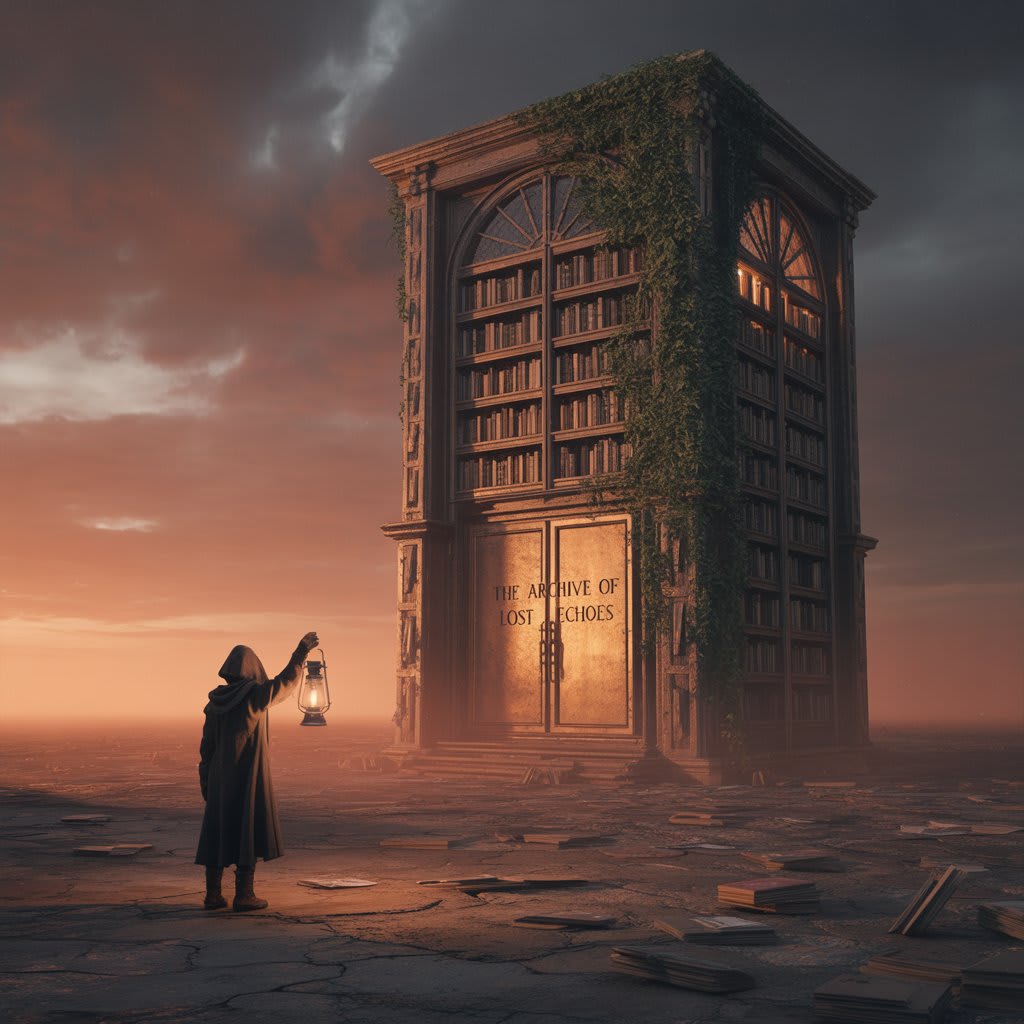
In the year 2197, Earth was quiet—not peaceful, but emptied. Cities lay buried under dunes of ash and sand. Forests, once thick and alive, were skeletal or gone. Towers leaned like broken teeth against a gray sky, and silence ruled the air like a dictator.
The wars had come and gone. Plagues followed. Then came the Collapse, a slow unraveling of governments, systems, and human connection. When it was over, only scattered tribes remained—nomads with no past, farmers with no future, children with no stories.
But there were still stories. Some whispered across firelight, some scrawled on ruins, and one in particular—about a place of impossible wonder.
They called it The Last Library.
Most laughed at the name. In a world that had forgotten even how to write, books were myths. But to Amira, it was a beacon. Her grandmother, one of the last true storytellers, had spoken of it often—a place in the wastelands where all knowledge waited, guarded by silence and time.
“No door opens for those who come only for power,” her grandmother once said. “But the library listens. If your heart remembers the world, it will find you.”
And it had.
Amira now stood before a mountain of stone and ivy, rising from the barren Dead Plains. A cracked plaque above the doorway read only one word, faded but intact: Bibliotheca.
She pushed the great wooden doors open. They groaned with a sound like thunder, echoing into the vast interior. Dust floated in golden shafts of light that pierced through broken glass above. And inside—shelves. Miles of shelves. Tall, crooked, and filled.
Books.
Bound in leather, cloth, or strange materials she couldn’t name. Stacked in towers. Lying in piles. Hanging from ropes, wrapped in cloth, hidden in drawers. Every corner held something precious—something forgotten.
Her breath caught in her chest.
This wasn’t just a building. It was a memory. A monument to what humanity once knew.
She lit a lantern and wandered the aisles. Some books crumbled at her touch, but others pulsed faintly with a strange warmth. Symbols flickered on their spines—languages she couldn’t read but felt she somehow understood.
Then, deep within the heart of the library, she found it.
A single pedestal bathed in light, though no sun reached this far. On it rested a thick, black book with a golden spine. No title.
She opened it.
Words lifted from the pages like smoke and swirled around her. They spoke—not aloud, but directly into her mind—in many voices: old, young, human, machine.
The book told her the truth.
The Collapse had not been a single event, but a long chain of forgetting. As people turned to convenience, they stopped writing. When machines failed, no one remembered how to fix them. Crops died. Cities fell. And books—those silent keepers of memory—were burned, buried, or ignored.
But a group of visionaries had built this place in secret. Scientists, librarians, monks, coders, gardeners—all united by one belief: that knowledge could save the future, if only it survived.
They had hidden the library and locked it—not with keys, but with intention. Only someone who sought truth, not power, could awaken it.
And Amira had.
The library accepted her.
Over the following weeks, she explored deeper chambers—ones that opened only as she grew in understanding. She found guides on medicine, engineering, history, agriculture, languages, and art. There were holograms of extinct animals, 3D-printed tools powered by solar light, and seeds—thousands of seeds.
But the library also held warnings. It showed her what had been lost through arrogance, war, and neglect. It asked her not to repeat it.
So, Amira made a vow.
She would not keep this place for herself.
She carved signs in stone and wood, placed them along trails and rivers, marked them with symbols she learned from the books. “Come if you seek truth. Come if you wish to heal.”
People began to arrive.
First a few—travelers, elders, the curious. Then dozens. Then hundreds.
The library responded. It opened slowly, sharing only what each person was ready for. The building itself began to change—growing warmer, cleaner, brighter—as if it were waking up.
Soon, a settlement formed around the base. They called it Libris.
Amira became its steward, but never its ruler. “This place doesn’t belong to me,” she often said. “It belongs to the past—and to those willing to learn from it.”
Years passed.
Libris grew into a beacon of hope in a broken world. Children learned to read again. Engineers rebuilt water systems. Healers grew herbs once lost. Stories returned.
And at the center of it all stood the Last Library—not just a building of books, but a living memory of what humanity could be, if it chose to remember.
And somewhere, deep beneath it, a quiet book on a golden pedestal waited for the next seeker.
Because knowledge, once forgotten, waits to be found.
Always.
About the Creator
Keep reading
More stories from Maqbool Kusar and writers in Fiction and other communities.
An Advice of Lion to His Son
The sun was setting over the great savannah, casting golden light across the grasslands. A warm breeze whispered through the trees, and the sky turned shades of orange and purple. On the highest rock of the hill, the great lion, King Zaraf, sat with his son, a young lion cub named Leo.
By Maqbool Kusar9 months ago in Motivation



Comments
There are no comments for this story
Be the first to respond and start the conversation.