
The Last Letter from Kashmir
One woman’s memory, one war-torn village, and a secret that could change everything.
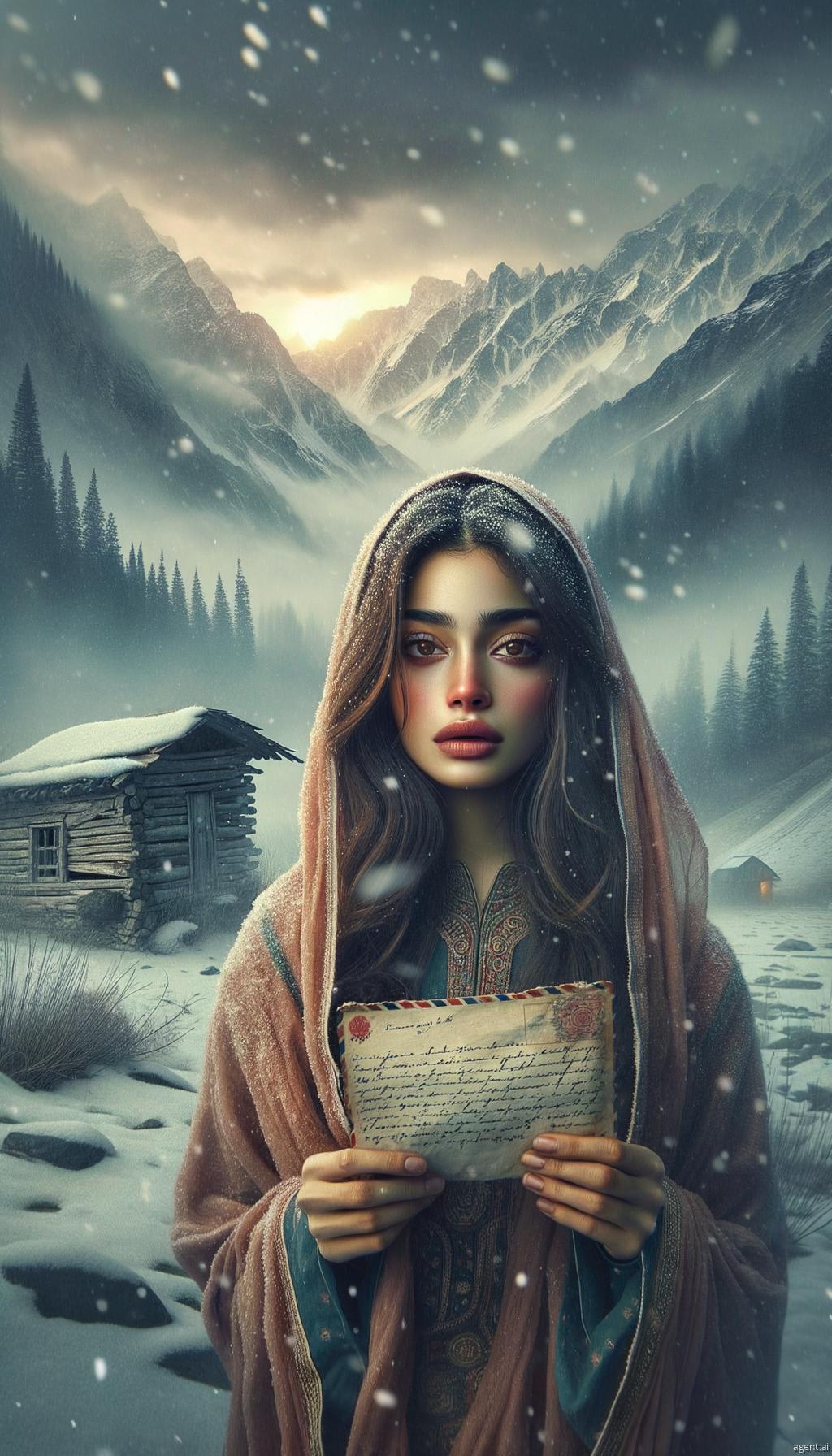
The letter had yellowed with time. Its edges were curled, and the ink had bled into the fibers of the paper, but the handwriting was still hers — delicate, deliberate, filled with aching sincerity.
Aaliya held it close, as if the warmth of her palm could breathe life back into it.
It was the last letter she ever wrote to Farhan.
The year was 1999, and the war had reached their village of Uri, nestled like a fragile bird between the wings of Himalayan cliffs. It started with whispers: soldiers in the mountains, helicopters overhead, ration trucks that never returned. Then came the gunshots — loud, sharp reminders that life as they knew it was over.
Farhan had left just two weeks before the violence erupted. He was a young journalist, determined to tell the story of Kashmir from the inside — not from the polished offices of Delhi or Lahore, but from the bloodied soil he called home.
He kissed her forehead at the station. “I’ll come back for you,” he had said.
She had laughed then. “You always say that.”
“And I always do, don’t I?” he smiled, his eyes crinkling in that way that made her forget everything else.
But he didn’t come back.
Twenty-six years later, Aaliya was now a teacher in Srinagar. The lines on her face told stories no pen could. The world had moved on, rebuilt its towers and treaties, but part of her still lived in that war-torn village with its fractured silence and empty dinner tables.
One rainy afternoon, while sorting through an old trunk in her late mother’s home, she found the letter.
Unsent. Unstamped. Forgotten.
She didn’t remember writing it, yet every word was unmistakably hers. The paper was folded into a neat square and slipped inside a faded book of Ghalib’s poetry.
She read:
My dearest Farhan,
The snow has begun to fall. I watched it through the cracked window and thought of your stories — how you always said snow was like truth: cold but beautiful. I hope you are somewhere safe, warm, and writing.
I miss you. Every night I hear gunfire, and I pretend it's the sound of your typewriter. Foolish, I know.
If you return, and I am not here — follow the apricot tree. It remembers us.
Yours always,
Aaliya
Her hands trembled as she reread it.
The apricot tree.
She closed her eyes and remembered.
In their childhood, the tree stood behind her family’s cottage. It was where they carved their names into the bark. Where they shared their first kiss under moonlight. Where Farhan promised to marry her once he’d written something that mattered.
The last she heard, the tree was cut down by militants for firewood during the siege. But maybe…
Just maybe…
Aaliya returned to Uri after twenty-six years.
The village looked different, yet the mountains were the same — eternal witnesses to the stories below.
Her family home was a skeleton now, half-swallowed by weeds and time. The walls were scarred by bullet holes and moss. But behind it, in the garden once blooming with daffodils…
The tree stood.
Not as tall. Bent at one side. But alive.
Her heart skipped. She walked slowly to it, as if afraid it would vanish if she moved too fast.
And there — etched faintly into the bark, still visible beneath a patch of moss:
A + F
She traced it with her fingers.
Then, something odd caught her eye.
There, at the base of the tree, was a hollow. Inside, wrapped in oilcloth and sealed with string, was a box.
Her breath caught. She opened it.
Inside were letters — dozens of them — all addressed to her.
All from Farhan.
The first one was dated April 12, 1999 — two days after he left.
Aaliya,
I couldn’t get the story. I couldn’t even get out of the valley. They shut everything down. I’m hiding in the mountains with two others. I think about you every hour. I’m leaving these letters in the tree. I don’t know if you’ll ever read them. But I have to write anyway.
The next was from June.
They burned the school. I saw boys barely older than us carrying rifles like toys. The world has forgotten us, but I haven’t forgotten you. The apricot tree still blooms. That means something, doesn’t it?
And then, a final one, dated September 1999:
They’ve found me. I don’t have time to run anymore.
If you ever read this, know this much:
I loved you in silence and in storm. I died not as a reporter, but as a man who kept a promise — to return to you, if not in body, then in words.
Aaliya sat at the foot of the tree, the letters spread around her like petals. The wind howled through the valley, but she didn’t shiver.
Farhan hadn’t broken his promise.
He came back — not in the way she hoped, but in the only way he could.
She spent the night under the stars, the letters pressed to her chest, tears tracing lines down her cheeks. In the morning, she gathered them all, tied them with a red thread, and walked back to the village.
She would share his story now — not just as a teacher, but as a witness.
Aaliya published his letters under the title “Apricot Sky: Letters from the Valley”. The book became a quiet success, translated into five languages, taught in classrooms from Islamabad to Istanbul.
Every spring, when the apricot tree bloomed again, she returned to Uri.
And each year, she left behind a new letter.
The End
About the Creator
Atif khurshaid
Welcome to my corner of the web, where I share concise summaries of thought-provoking articles, captivating books, and timeless stories. Find summaries of articles, books, and stories that resonate with you
Keep reading
More stories from Atif khurshaid and writers in Fiction and other communities.
The Day I Decided the Universe Was Listening
For most of my life, I thought positive thinking was a polite way of denying reality. People who said “you attract what you believe” seemed to live in a fantasy world. Meanwhile, I was stuck in mine — overworked, underpaid, and constantly anxious. I wasn’t unhappy because I lacked things; I was unhappy because I believed I didn’t deserve more.
By Atif khurshaid5 months ago in Fiction
Becca
"Everything is so... flat." Denille said stupidly as she looked around her new neighborhood. She looked around at the muted desert where even the smallest sign of life seemed to have given up. The plant life was shrubs that were half cooked by the heat and where there should have been a lawn, a mess of white rocks laid glistening in the sun. Even the sky looked stretched thin, like the sun had ironed it smooth. She’d moved from Riverside, where at least there were hills, but here in Barstow, everything felt baked and brittle.
By Sara Wilson2 days ago in Fiction
The Mundane Murders
It was a small town in Massachuttes, named Seaside, where the waves broke on the shores of this coastal town which was nestled between two larger cities. It seemed quiet for the most part, but there was darkness looming in the salty air, of this otherwise righteous town.
By Susan Payton6 days ago in Fiction



Comments
There are no comments for this story
Be the first to respond and start the conversation.