
The Last Classroom: A Letter from the Future About What We Lost
A message from future.....
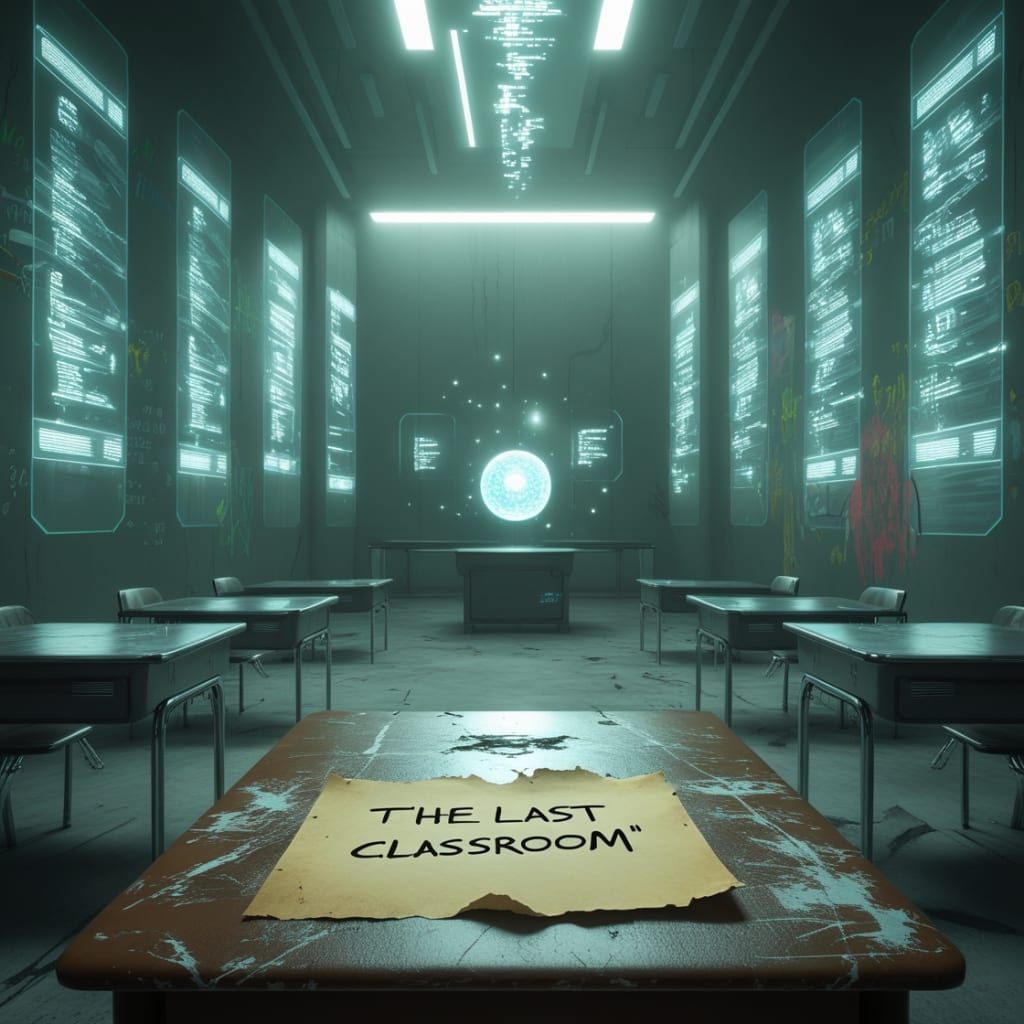
To whoever finds this—
I hope this message reaches a time when you still know what a “classroom” is.
My name is Nilo. I’m seventeen years old, and I’ve never seen a real school.
Not the kind with creaky floors and chalk dust in the air. Not the kind where someone writes your name on a board because you spoke out of turn, or hands you back a test with a smile—or a sigh. I mean the kind where you sit among people, not programs. Where you feel learning, not just download it.
I live in the year 2125. In my time, education is streamed directly into our neural processors. Personalized, optimized, standardized. Efficient, yes. But cold. Lifeless. Mechanical. You get knowledge without curiosity, answers without questions, and facts without the feeling that any of it matters.
And it’s killing us in ways no one expected.
I found this old data vault beneath the ruins of what used to be the National Education Archive. Most people pass by it now—it’s not on the curriculum. But something drew me in. Inside, the air was stale and the walls were cracked, but the servers still hummed, like they were waiting for someone to remember.
I accessed files older than most living humans: classroom videos, hand-scrawled notes, messy homework with red pen marks. I read diary entries from students who worried about finals and who they’d sit next to at lunch. I watched teachers pacing in front of chalkboards, their voices rising and falling with passion. I saw kids pass paper notes under desks—and get caught.
It hit me like a crash of static in my neural feed: This was what we lost.
Let me explain how it happened.
Back in your century, education was already struggling. Inequality, burnout, underfunding—it was a slow unraveling. Then the climate broke. Floods, droughts, migrations. Chaos. Governments tightened budgets. Schools were among the first to go.
"Digital-only" education was the solution. It seemed brilliant—low cost, scalable, accessible from anywhere. But instead of lifting everyone, it deepened the divide. The wealthy bought immersive AI tutors and hyper-realistic simulations. The rest of us? We got voiceovers and lagging visuals. No one remembered our names. No one noticed if we never logged in.
And teachers? First their authority faded. Then their autonomy. Finally, their presence. One by one, the mentors who inspired, challenged, and believed in students were replaced by silent, polished interfaces. You can’t ask a hologram why the world feels unfair. You can’t feel seen by a tutorial.
I’ve never had a favorite teacher. But I’ve watched thousands through the archives—real people who stayed after class, who brought extra pencils, who defended their students when the system didn’t. In your time, maybe that was just a Tuesday. Here, it’s revolutionary.
We didn’t just lose schools. We lost empathy, connection, friction—the beautiful mess that made learning human.
Now, everything is neat. Silent. Automated. Our generation is smart in the ways that matter least. We can solve quantum equations in seconds, but can’t hold a real conversation. We replicate paintings but can’t feel awe. We consume content, but we don’t wonder anymore.
And we are so lonely.
The worst part? Most people don’t even remember it was different. But I do now.
Through these relics—your journals, your lectures, your laughter—I’ve seen glimpses of something real. Something worth saving.
I don’t blame you for what happened. You were tired. You were overwhelmed. And the world kept demanding more from you with fewer resources. But I hope you can still make choices that we can’t.
So I’m sending this letter through a time-locked quantum relay—one last experiment in human connection. If you’re reading this in a time where classrooms still exist, where students still pass notes and teachers still speak with chalk dust on their sleeves—fight for it. Please.
Protect your schools. Don’t let them be turned into profit streams or data mines. Defend your teachers—not just their jobs, but their dignity. Resist the idea that education is something to be consumed passively, like a feed.
Because once it’s gone, you won’t even know what you’ve lost.
One day, I hope we rebuild. I dream of walking into a room where voices echo and questions are asked out loud. Where someone smiles when you get it right—or puts a hand on your shoulder when you don’t.
Until then, I’ll keep reading your stories and remembering that once, we cared. We gathered. We learned together.
And maybe, someday, we will again.
Stay curious. Stay human.
—Nilo
Student ID: 004227-VR
Sector 9, EduZone East, Global District
About the Creator
Off the Book
It ended like every other stupid idea. Badly, and alone. I’m researching digital confession ethics, he said. A tech ethicist. He gestured at floating data I couldn’t see then pulled out a physical notebook. Actual paper, fountain pen. He held it up like he was showing me scripture.
By Nicky Frankly3 days ago in Fiction


Comments
There are no comments for this story
Be the first to respond and start the conversation.