
The Last Book on Earth
A dystopian fiction piece where books no longer exist—until one is found. What story does it tell, and why was it hidden?
By [saad shah]
In the year 2179, knowledge didn’t live in pages—it floated in data clouds, downloaded in seconds, filtered by algorithms, and watched through screens implanted behind retinas. Libraries were ruins, bookstores converted into memory clinics, and writing—real, physical writing—had become a forgotten art.
Lena was a Restoration Technician in Zone 9, one of the last climate-stable domes left on Earth. Her job was to catalog what remained of the old world: broken tech, scraps of clothing, melted glass. Nothing ever surprised her anymore.
Until the day she found the book.
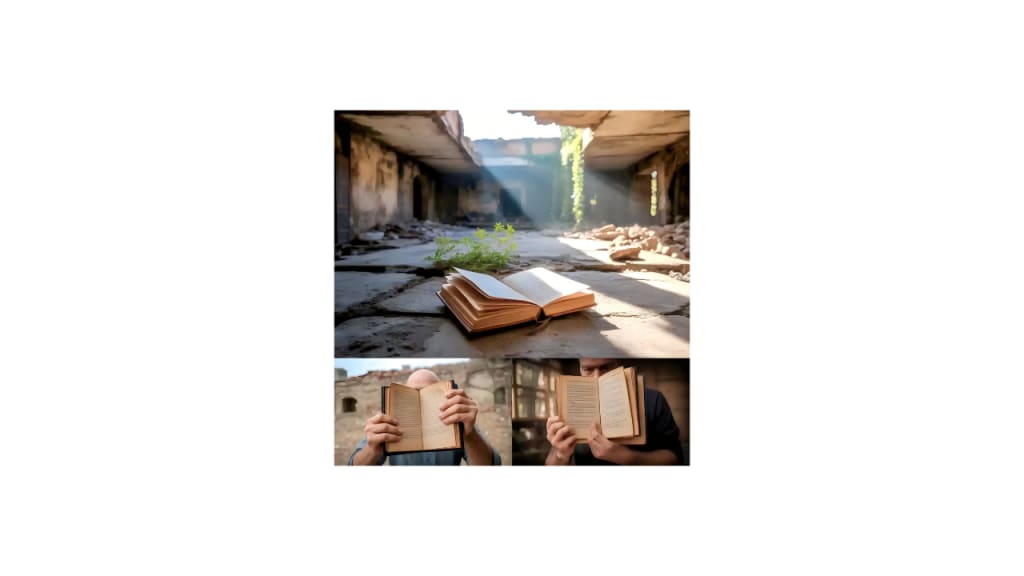
It was buried beneath the rubble of a collapsed museum wall—wrapped tightly in cracked leather, sealed in what looked like a plastic case lined with foil. When she pried it open, she saw pages. Real pages. Yellowed, but intact. Words etched in ink, sentences aligned like soldiers.
Her breath caught.
She wasn’t supposed to keep it. Any artifact found in the field was to be logged and submitted to the Central Archive. But Lena didn’t. Something in her hands told her not to.
She smuggled it back to her pod.
---
For days, she read the book under the dim glow of her solar lamp. It was called "The Memory of Trees." A novel—fiction. The story of a young boy in a village where trees could talk, sharing the wisdom of centuries through whispers only children could hear. The trees were being cut down by those who believed progress meant silence, not listening. The boy tried to save them. He failed.
It was beautifully written—tragic, poetic, honest.
Lena cried. Not just for the boy, but for the fact that no one she knew had ever cried from reading a story.
---
The more she read, the more she began to understand why books had been erased.
After the Energy Collapse, when the planet fell into chaos, people blamed misinformation, division, “false” history. Leaders sought order, so they eliminated subjectivity. "No more books," the Chancellor had declared in the early 2100s, “only data.” Knowledge became transactional. Objective. Controlled.
But The Memory of Trees wasn’t about data—it was about feeling.
It made her feel guilty. And hopeful. And angry.
Lena scanned the first page again. There, scrawled in fading handwriting, was a message:
"If you're reading this, you still have a choice. Words remember what systems forget."
---
She knew she had to share it.
But in Zone 9, unauthorized possession of text was an act of subversion—punishable by exile or worse. Still, she couldn’t keep it to herself.
She took photos of each page using a banned lens mod she had salvaged from old tech. Then she began to share them, one image at a time, slipping them into forgotten data tunnels—fragments of the story hidden inside code strings that only rogue archivists knew how to read.
At first, nothing happened.
Then came the message:
“More.”
Followed by another:
“I read it. I remembered what sadness feels like.”
Soon, dozens of hidden replies flowed through the same network, anonymous voices whispering back across the dark.
They called it “the treebook.”
Some thought it was real. Others thought it was legend. No one knew Lena was the source. She didn’t care. What mattered was that they were reading again.
---
But the system noticed.
Alerts spread across Zone 9. Firewalls tightened. Archivists went dark. Rumors spread of “The Page Purge”—a directive to erase any unauthorized story data and trace the source.
Lena had only one choice left.
She returned to the ruins where she’d found the book. She dug a hole beneath the old museum, wrapped the book again in foil and cloth, and buried it beneath a slab of stone.
On the wall, she carved a single line with the broken tip of a stylus:
“This is not the end.”
---
Years later, after Lena vanished, children in the outskirts found the slab. One was a girl who had never seen a real page, never touched ink or smelled old paper. She opened the foil. She read the first line of The Memory of Trees.
And for the first time in her life, she cried.
She didn’t know why. But she kept reading.
And through her tears, something bloomed—something long forbidden, something stronger than fear.
Hope.
About the Creator
Saad shah
"A storyteller at heart, I write not just to be heard—but to be felt. Each word is a doorway, each story a new world. Join me as I turn thoughts into journeys and emotions into art."
Affection and Healing for Yourself
During the night of the last quarter moon, I gathered my ritual supplies. I carefully handled the chunk of black tourmaline that would protect me from your overall negative and narcissistic energy. I carefully walked the house with my stick of selenite in hand, asking the universe to cleanse our working space.
By Alisha Wilkins ✒️🦋🖋️6 days ago in Fiction


Comments
There are no comments for this story
Be the first to respond and start the conversation.