
The Lantern Keeper
A tale of light and loss in a forgotten coastal town

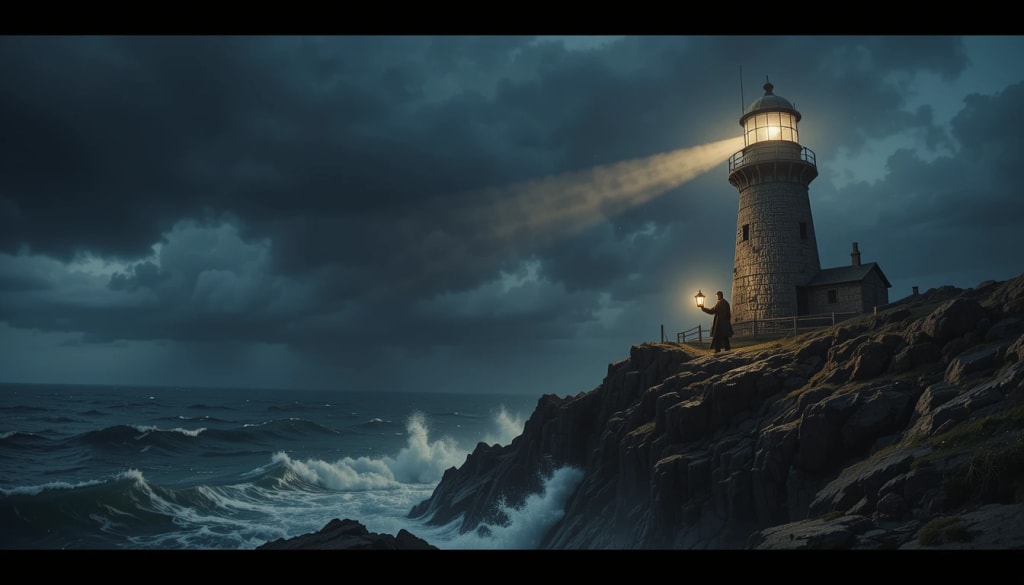
The town of Greyhaven clung to the edge of the world, where the land dropped into the sea like a broken promise. Its cliffs were sharp, its winds sharper, and its people the sharpest of all—worn down by salt and time into something unyielding. They didn’t talk much, the folk of Greyhaven, but when they did, it was about the lanterns.
Every night, as the sun bled into the horizon, a string of lanterns flickered to life along the coast. Not electric, not even gas, but old oil lanterns, their glass smudged with soot, their wicks trimmed by careful hands. They lined the cliffs, the docks, the crooked paths that wound through town, glowing like stars that had fallen and decided to stay. No one could say exactly when the tradition began, only that it was older than the lighthouse, older than the church, older than the graves that dotted the hill. The lanterns were Greyhaven’s heartbeat, and the Lantern Keeper was its soul.
Elias Wren was the last Lantern Keeper, though he’d never asked for the title. It had been his mother’s before him, and her father’s before her, passed down like a curse you couldn’t outrun. He was forty-three, with hands rough as driftwood and eyes the color of the sea before a storm. His hair, once black as coal, was streaked with gray, and he wore it tied back with a leather cord. He lived alone in a stone cottage at the edge of town, where the grass gave way to rock and the world felt like it might slip away entirely.
Each evening, Elias walked the coast with a sack of lanterns slung over his shoulder. He’d light them one by one, his fingers steady as he struck the match, his breath mingling with the smoke. The townsfolk watched from their windows, their faces pale in the gloaming, but they never spoke to him. Not anymore. Not since the night the lighthouse failed.
It had been ten years ago, during the worst storm in memory. The lighthouse beam, which had guided ships through Greyhaven’s treacherous waters for a century, went dark. No one knew why—some said the bulb shattered, others that the wiring frayed—but the result was the same. A fishing boat, the Mary Dawn, smashed against the rocks. Twelve men drowned, their bodies washing ashore for weeks. The town blamed Elias, though he’d been nowhere near the lighthouse that night. He’d been tending the lanterns, as always, his hands slick with oil, his heart heavy with a premonition he couldn’t name.
“They think I cursed it,” he told the sea one night, years later, as he lit the last lantern. The waves hissed back, offering no comfort. Elias didn’t believe in curses, but he believed in guilt. It clung to him like damp, seeping into his bones.
The lanterns were his penance. He lit them for the dead, for the living, for the ships that still braved the coast. He lit them because no one else would. The town had tried, after the wreck, to replace the lanterns with electric lights—bright, sterile things that buzzed like insects. But the bulbs burned out in days, the wires corroded by salt, and the lanterns returned, as if the coast itself demanded them.
Elias’s days were quiet, filled with small rituals. He’d wake at dawn, brew coffee black as tar, and walk the cliffs to check the lanterns. He’d mend broken glass, refill oil, trim wicks. In the afternoons, he’d carve driftwood into shapes—birds, fish, waves—though he never sold them. They piled up in his cottage, a silent menagerie. At dusk, he’d begin his rounds again, the weight of the lanterns familiar as his own heartbeat.
But something was changing in Greyhaven. The town was shrinking, its young leaving for cities where the air didn’t taste of salt. The fishing boats dwindled, replaced by cargo ships that hugged the horizon, too far to need the lanterns. The church closed, its pews carted off to the mainland. Even the lighthouse, its beam long since repaired, felt like a relic, its light too harsh against the soft glow of the lanterns.
One evening, as Elias lit the first lantern, a girl appeared. She was maybe sixteen, with hair red as a sunset and eyes too old for her face. She wore a patched coat and boots too big for her, and she stood watching him, hands shoved deep in her pockets.
“You’re the Lantern Keeper,” she said, not a question.
Elias nodded, striking another match. “And you’re new.”
“Clara,” she said. “My ma moved us here last week. Says it’s cheaper than the city.” She kicked a pebble, watching it skitter toward the cliff’s edge. “Why do you do it? The lanterns, I mean. Nobody cares.”
Elias paused, the flame burning close to his fingers. “Somebody has to.”
Clara followed him that night, uninvited, her footsteps soft behind his. She asked questions—why oil, not gas? Why glass, not plastic? Why him, not someone else? Elias answered in grunts or not at all, but she didn’t leave. The next night, she was there again, and the night after that. By the fourth night, he handed her a match.
“Careful,” he said. “Don’t let the wind take it.”
Clara lit the lantern, her face glowing in the flicker. “It’s warm,” she said, almost to herself. “Like it’s alive.”
Elias didn’t reply, but he felt something shift, like a tide turning.
Clara became his shadow, trailing him each evening. She talked about the city, about her mother’s new job at the dockside bar, about the brother she’d lost to a fever years ago. Elias listened, his silence a kind of permission. In return, she helped with the lanterns, her small hands quick and sure. She learned to trim wicks, to clean glass without streaking, to carry the sack when Elias’s shoulder ached.
One night, as they lit the last lantern, Clara pointed to the lighthouse. “Why don’t you fix it? Make it yours again?”
Elias’s throat tightened. “It’s not mine to fix.”
“But you could,” she pressed. “You know how, don’t you?”
He did. He’d studied the lighthouse as a boy, fascinated by its gears and lenses, its beam that could pierce the dark. But that was before the Mary Dawn, before the town turned its back. “It’s not that simple,” he said, turning away.
0lara didn’t ask again, but her eyes stayed on the lighthouse, thoughtful.
Winter came, and with it, another storm. The wind howled, tearing shingles from roofs and snapping branches like bones. The sea churned, waves crashing so high they licked the cliffs. Elias and Clara fought to keep the lanterns lit, shielding each flame with their bodies, their breath ragged.
On the second night, the lighthouse went dark again. The beam stuttered, then stopped, leaving only the lanterns to hold the coast. Elias stared, his heart a fist in his chest. He thought of the Mary Dawn, of the screams no one heard. He thought of Clara, too young to carry that kind of ghost.
“We have to go,” she said, tugging his sleeve. “It’s not safe.”
Elias shook his head. “The lanterns—”
“Will hold,” she said fiercely. “But the ships won’t. You know it.”
She was right. The lanterns were for Greyhaven, but the lighthouse was for the world beyond. Elias ran, Clara at his side, their lanterns swinging wildly. The lighthouse door was unlocked, its hinges groaning as they pushed inside. The air was cold, sharp with rust and salt. The spiral staircase was still there, its steps slick with damp. Elias climbed, his legs burning, Clara’s flashlight bobbing behind him.
At the top, the lens was a giant eye, dark and lifeless. Elias’s hands moved before his mind could stop them, checking wires, testing switches. The generator was old, its hum faint, but it lived. Clara handed him tools from a rusted box, her face set with purpose.
“It’s the relay,” Elias muttered, prying open a panel. The wires were a snarl, frayed and brittle. He worked fast, fingers numb, splicing and taping, while the storm screamed outside. Clara held the flashlight steady, her breath a soft counterpoint to the wind.
When he flipped the switch, the beam flared to life, cutting through the dark like a blade. Clara whooped, her voice echoing in the tower. Elias didn’t smile, but he felt the weight lift, just a little.
They returned to the lanterns, soaked and shivering, but alive. The town was quiet, its windows dark. No one came to thank them. No one ever would. But Clara looked at Elias, and something passed between them—something warm, like a lantern’s glow.
The next night, Clara didn’t come. Elias waited, but the path stayed empty. He lit the lanterns alone, his hands steady, his heart heavy. He thought of her red hair, her questions, her fierce light. He wondered if she’d left, drawn back to the city, or if the storm had scared her away.
A week later, he found a lantern at his door, its glass etched with a bird in flight. A note was tucked inside, in Clara’s scrawl: Keep lighting.
Elias kept the lantern on his table, unlit, a reminder. He walked the coast each night, the sack heavy on his shoulder, the matches warm in his pocket. The town dwindled, the ships grew fewer, but the lanterns burned on, a string of stars against the dark.
And sometimes, on clear nights, Elias looked to the lighthouse, its beam steady now, and thought he saw a girl with red hair standing at its base, holding a lantern, her light joining his.
About the Creator
Shohel Rana
As a professional article writer for Vocal Media, I craft engaging, high-quality content tailored to diverse audiences. My expertise ensures well-researched, compelling articles that inform, inspire, and captivate readers effectively.
Keep reading
More stories from Shohel Rana and writers in Fiction and other communities.
The Starling’s Song
In the heart of Cindersky, a city of soot-stained spires and cobblestone alleys, silence was a law. The bells of the great cathedral had not rung in a century, and music—once the city’s soul—was forbidden. The elders claimed it was for protection, that songs carried a power that had nearly destroyed Cindersky long ago. The people obeyed, their voices hushed, their lives gray as the ash that fell from the sky. But in the shadows, whispers spoke of the Starling, a figure whose melodies could wake the city or break it.
By Shohel Rana8 months ago in Fiction
Second Shadow
I noticed it by accident, which is how most bad ideas introduce themselves. I was cutting through the square at lunch, phone in one hand, iced coffee sweating down my wrist. The sun was a bully, straight up, no cloud cover, every edge of everything carved into the pavement. I walked past the sundial because I like proof that time is meaningful in more than one medium.
By Milan Milic8 days ago in Fiction


Comments
There are no comments for this story
Be the first to respond and start the conversation.