
The Labyrinth Beneath My Skin
I walked through corridors made of memory, only to find the version of me I left behind.
The pain didn’t start all at once—it crept in like fog, curling into my joints, settling behind my eyes, whispering in my ears when I tried to sleep. Doctors called it many things. Fibromyalgia. Neuropathic. Psychosomatic. They tossed me labels like lifebuoys, but none of them floated.
Eventually, they stopped trying. And so did I.
I spent most of my days curled into the couch, tracing cracks in the ceiling with my eyes and wondering if they matched the ones in my spine. I hadn’t gone outside in weeks. Maybe months. The concept of time had become elastic, like everything else. My name, my body, my reality—all stretched and distorted until they no longer felt mine.
Then the knocking began.
It came softly at first—just once, at dawn. A single, deliberate tap at the door. I didn’t answer. I assumed it was a delivery or a dream. But the next morning, the knock returned. Louder. Rhythmic. Not a package, not a hallucination. Something—or someone—was calling.
On the third day, I opened it.
There was no one there. Only an envelope on the doormat, sealed with red wax. No address. No name. Just a symbol etched deep into the wax—something circular, like a spiral, or a maze.
Inside, a single card read:
“The way out is through. The labyrinth awaits.”
I should’ve dismissed it. Tossed it into the bin. But curiosity had always been my last surviving instinct. So I turned it over, and on the back, in the same neat handwriting:
“Midnight. Bedroom mirror.”
I didn't set an alarm. I didn't need to. At 11:59 PM, my body woke without hesitation. I stood in front of the full-length mirror in the bedroom, heart hammering. I felt stupid. But I waited.
And then the glass rippled.
It was like watching a pond touched by wind. The reflection shimmered, warped, and twisted—not in a way mirrors should. I reached out, and instead of cool resistance, my hand passed through. No pain. No heat. Just an invitation.
I stepped in.
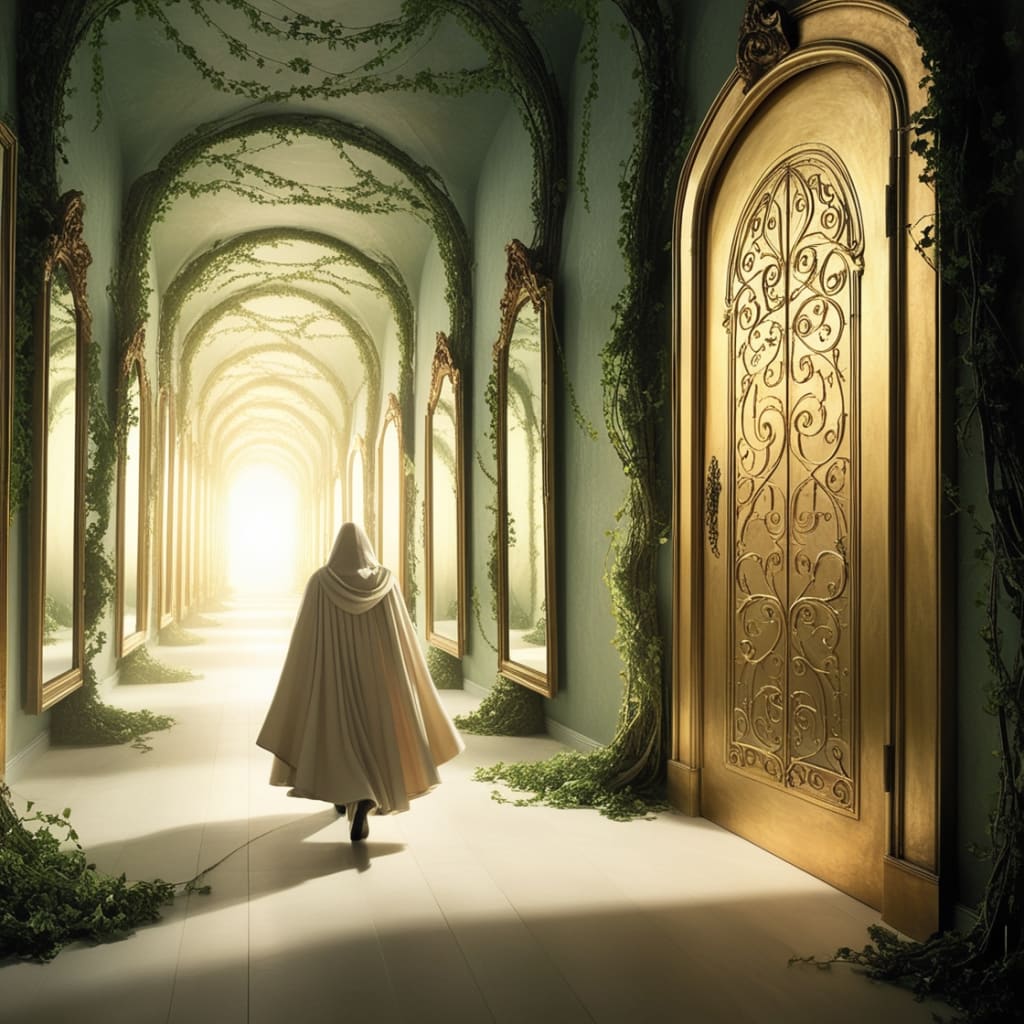
The labyrinth was not made of stone or hedges, but memory.
The first corridor was lined with flickering lights, like a hallway in a hospital. The walls pulsed with colorless images: me at five, hiding under a blanket from the thunder; me at sixteen, the razor glinting near my wrist. My breath caught.
A voice echoed through the passage. My voice—but younger, terrified, desperate.
"No one is coming for you."
I ran.
The second corridor smelled like antiseptic and disappointment. A doctor’s office. Clipboard. A diagnosis scrawled too quickly, as if writing it faster would make it more believable.
"It's all in your head."
"Have you tried yoga?"
"You're just anxious."
With each word, a chunk of the floor fell away behind me. I kept walking, afraid to look back.
The third corridor was quieter. Narrower. Warmer. Photographs lined the walls—friends who’d left, partners who’d stayed too long, laughter that sounded hollow in memory.
At the end of that hallway stood a figure.
I knew her instantly. Same nose, same eyes, but fuller. Glowing. She looked how I imagined I might’ve looked if I’d never gotten sick. If I’d finished school, gone hiking, held babies, danced.
She smiled softly.
"Hello," she said. "I’ve been waiting."
My throat tightened. "Who are you?"
"I’m the version of you that kept going. The one who believed in healing. Who didn’t give up."
I stared at her. "So... I failed?"
"No," she said, stepping closer. "You survived. In a body made of storm. You kept walking, even when no one believed you. That’s not failure. That’s endurance."
I wanted to hug her, but I didn’t. I didn’t want to see if my arms would pass through.
"Why am I here?"
She pointed behind me. I turned. The path I had walked now stretched like a glowing string, leading forward—not out, but deeper.
"The labyrinth isn’t punishment," she said. "It’s navigation. Grief carved these halls. Pain paved them. But they’re yours. You can choose how to move within them."
"Is there a way out?"
She nodded. "But not the way you think. The goal isn’t escape. It’s understanding."
I swallowed hard. “How do I know I’m not just dreaming?”
“You don’t,” she replied. “But pain builds worlds, and if this is one, then walk it anyway. You don’t need a cure to live. You only need a compass.”
"And where is it?"
She smiled and placed her hand on my chest. “You’re standing in it.”
I walked for hours. Or maybe years.
Each room gave me something: an old laugh, a forgotten song, the scent of my grandmother’s kitchen. Some rooms screamed. Some whispered. Some were empty, and I wept for their silence.
At the end of the final hallway stood a door. On it, etched in gold, was my full name.
I opened it.
And I woke up.
The pain was still there. Of course it was. But something had shifted. Like I had grown roots in the place I had once collapsed. My body was still broken, maybe. But it felt inhabited. Owned.
I pulled open the closet and found the mirror. No ripple. No shimmer. Just me, blinking back.
But taped to the corner was the card.
"The labyrinth awaits."
And underneath it, in handwriting I didn’t recognize—yet somehow did:
“Come back anytime. You're never lost here.”
About the Creator
Keep reading
More stories from Abuzar khan and writers in Fiction and other communities.
A Dystopian Escape into Hope
In the not-too-distant future, the world as we know it collapses. A once-thriving civilization, perched at the peak of technological advancements and power, crumbles under the weight of its own excesses. Greed, war, and environmental destruction ravage the Earth. What remains is a haunting, desolate world where only one city stands as the last bastion of human survival. But even this sanctuary, surrounded by decaying ruins and the remains of former glories, is on the brink of falling apart. The story of The Last Human City is a haunting narrative of survival, hope, and the resilience of the human spirit in the face of overwhelming odds.
By Jhon smith6 days ago in Fiction
My First Time Skiing and I Got Lost, Alone, in the French Alps
Looking back, I can trace some of my life’s biggest adventures to a simple action from my sister. She’d introduced me to Tommy (a very long time ago), a colleague of hers, who had overshared his penchant for Italian-looking women, and I ticked that box.
By Chantal Christie Weissa day ago in Humans



Comments
There are no comments for this story
Be the first to respond and start the conversation.