
“The Teacups Still Turned Toward Her Seat”
“The Teacups Still Turned Toward Her Seat”
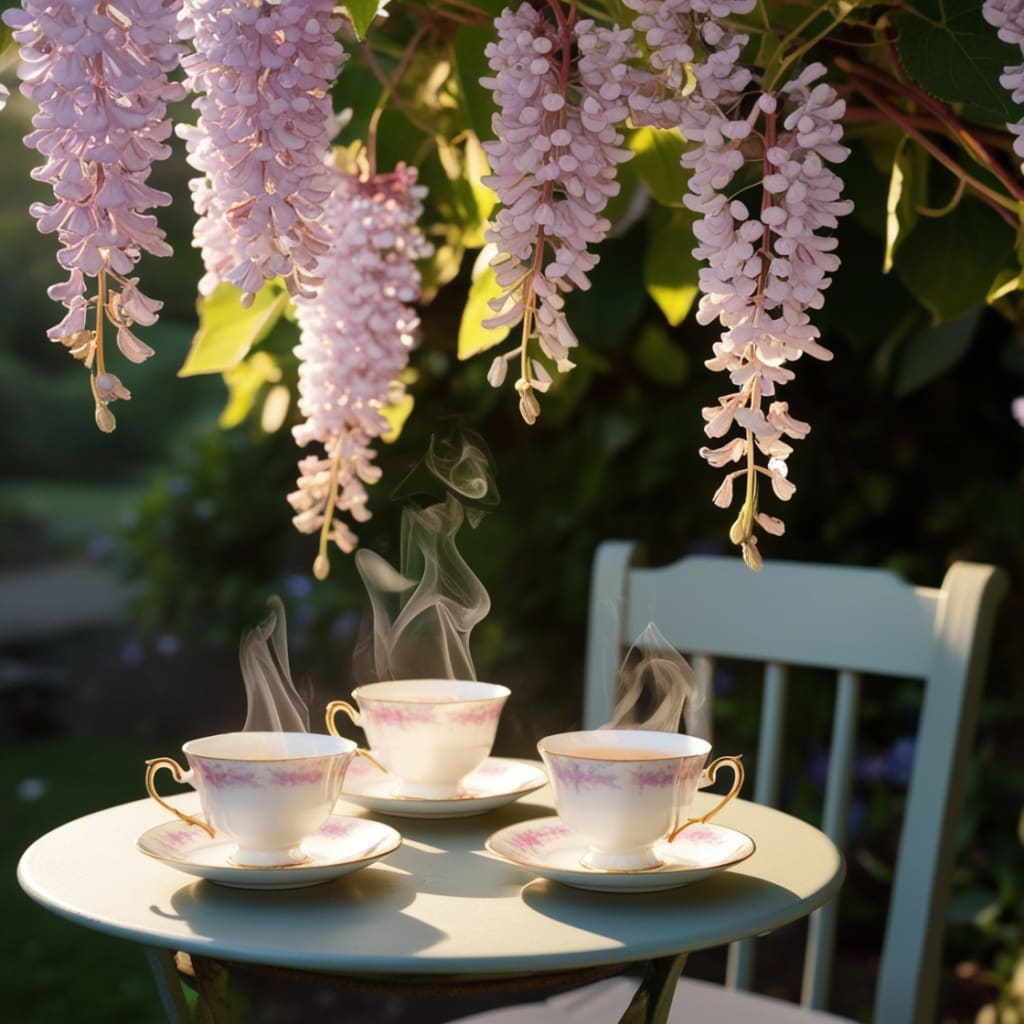
In the quiet corner of the garden, under a canopy of wisteria and fading afternoon sun, the table remained untouched.
Three porcelain teacups.
Three worn chairs.
And a fourth seat — empty. Always empty.
Yet the teacups still turned toward her seat.
No one dared move them.
Not even when the seasons changed. Not when the wisteria fell in lavender waterfalls, or when the frost curled around the saucers like a breath held too long.
“She’ll come back,” Aunt Lottie would say, stirring air instead of sugar into her tea. “Ghosts always return to the places where they were most loved.”
She meant it with love. With hope. With superstition. But mostly, with silence.
Because no one really spoke about Clara.
She had disappeared on a Wednesday.
There was no scream. No storm. Just a girl who walked barefoot into the orchard and never returned. Some said she was taken. Some said she ran. But those who had seen the light in her eyes knew the truth: Clara never ran from anything.
She walked toward things.
Music. Rain. Secrets. The unknown. She had a laugh that made birds tilt their heads in wonder and a stare that could make grown men forget their names.
And every Wednesday, she poured the tea.
After she was gone, the tea kept brewing.
As if the kettle remembered her hands.
The cups turned, ever so slightly, toward her seat. Not a trick of wind. Not the shifting of weight or time. No matter how many times Aunt Lottie straightened them, they would be facing Clara’s chair by dusk.
“Grief,” the doctor said when Lottie mentioned it.
“Guilt,” said the priest.
“Ghosts,” said the little girl who lived two doors down, hugging her doll a bit tighter.
Lottie didn’t argue. She just lit the lamp above the garden table and let the night settle like sugar into the folds of her grief.
One evening, years later, someone new came to town.
She was a travel writer. Or a painter. Or both. Her name was Mira, and she wore grief like perfume — soft but impossible to ignore. She had eyes the color of old library books and a habit of pausing mid-sentence as if listening for a voice only she could hear.
She passed the garden every day, notebook in hand.
On the seventh day, she stopped.
“That’s an old place,” Mira whispered.
Lottie, pruning the roses, nodded. “Old places are where memories hide.”
Mira tilted her head toward the teacups. “You set for four.”
“I always do.”
“Even when one is missing?”
“Especially then.”
Mira began to visit.
At first, she sat in silence. Just watching the cups. Watching the way the wind curled its fingers around the garden gate, the way the leaves danced but never touched Clara’s seat.
Then, one day, she asked, “Do you ever see her?”
“No,” Lottie said. “But I feel her.”
“Like gravity?”
“Like memory.”
Mira stared at the cup turned toward the empty chair. “It faces her seat.”
“It always does.”
And then, softly, almost too softly:
“Maybe she's the one who turns it.”
Autumn came.
The garden dimmed into rust and gold. The kettle, old and blackened, still sang at the same time every Wednesday.
Lottie’s hair went whiter. Mira stayed longer.
Once, Mira brought a teacup of her own — mismatched, with a crack down the middle. She placed it beside the others, on Clara’s side of the table.
The next morning, the cracked cup was gone.
In its place, a pale blue cup. Just like the ones the others had.
Mira never brought it up.
Neither did Lottie.
The town whispered. As towns do.
“They’re mad,” someone said.
“It’s grief,” another replied.
“They’ve invited something into that garden.”
And perhaps they had.
Because on some nights, Mira would see movement. The slightest shift of a shadow. The edge of a curl. The impression of fingers lifting steam from tea.
She never feared it.
Whatever lingered there was gentle. Curious. Like Clara had been.
One bitter winter, Lottie didn’t wake.
Mira found her in the garden, blanket around her shoulders, a half-empty cup in hand, facing Clara’s chair.
She looked peaceful.
Like she had just heard a joke. Or an answer.
The garden grew quiet.
Mira stopped hosting tea.
But the cups remained.
One day, weeks after the funeral, Mira went to clear them.
The chairs had frost. The roses were bare. Her heart felt hollowed out by loss layered on loss.
She picked up the first cup.
Then the second.
Then paused.
The third — Clara’s — was warm.
Still warm.
Steam rose in a delicate curl.
Mira sat. Slowly. Staring at the cup. Her breath visible in the cold, but the air around the chair… warm.
A presence.
A weight.
And then, so softly she almost missed it—
“You didn’t forget me.”
The voice wasn’t loud.
It didn’t echo.
It just existed — where silence had always lived.
Mira didn’t run. She reached for the cup and sipped.
Chamomile. And something older.
She placed her notebook on the table.
And wrote:
The teacups still turn toward her seat.
But now, so do I.
That spring, the garden bloomed twice as brightly.
Children said it was magic.
Neighbors said it was fertilizer.
But Mira knew.
Clara had come home.
And tea was always waiting.
About the Creator
Keep reading
More stories from Abuzar khan and writers in Fiction and other communities.
St Fandom Academy Chapter 24
Dear students, all staff, parents and guardians, Today we will be getting a surprise visit from his Majesty, THE KING! This will be a special day for the school and I hope that you will all assist me in welcoming His Majesty to our humble school.
By Chloe Gilholy7 days ago in Fiction
A Dart at Dusk
Seconds ago, the sullen sun set on the two of us… my exuberant furry companion and me. A fresh breeze embraces us, delivering welcome relief from the day’s oppressive heat. His typical stumbling and staggering along — apace with a sloth — has turned into trip-trapping, high-stepping, almost skipping along.
By Angie the Archivist 📚🪶a day ago in Petlife




Comments
There are no comments for this story
Be the first to respond and start the conversation.