
The Knock in the Night
It was October 3rd, 1943.
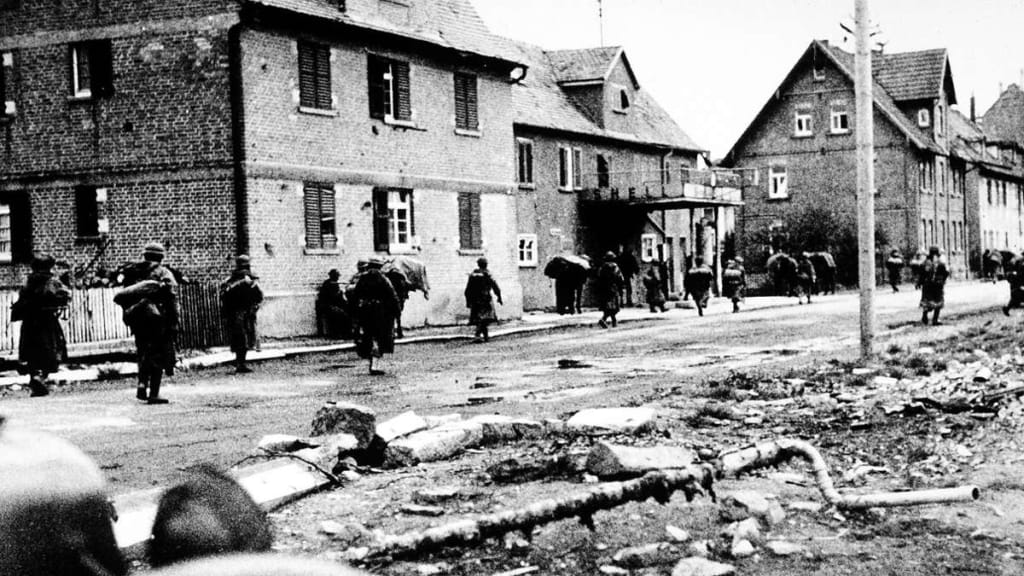
The air outside was heavy with the metallic scent of smoke, the remnants of fire still clinging to the broken city like a shroud. My mother, only five years old at the time, woke in the middle of the night to the silence after the bombing. That silence was the most terrifying part. The roar of engines, the sharp whistle of falling bombs, the thunder of explosions—those had become familiar, almost expected. But when the world grew quiet, when the sky held its breath, she knew something worse might be coming.
The night sky had moments earlier been lit up as bright as day. Now, only the faint glow of distant flames filtered through cracks in the boarded window. Her siblings lay sprawled across the floor, bodies curled into themselves, too exhausted to stir. Their thin breaths came in shallow rhythms, and even the smallest ones had stopped crying from hunger and fear. They were beyond tears now.
She lay awake, staring at the cracked ceiling of the small house that wasn’t truly their home. They had fled weeks before, leaving behind everything they knew—friends, neighbors, even toys—taking with them only what they could carry on their backs. Her father was at the front, and no one knew if he was alive or dead. Her mother slipped out at night, braving the ruins and soldiers alike, to find food or barter scraps. And in the void left behind, responsibility had somehow fallen to her—the small, sharp-eyed girl who spoke three languages while her siblings barely understood one.
She was their translator, their protector, their tiny shield against a world that had grown monstrous.
That night, as the silence thickened, she heard it: a sound. Not the shriek of metal, not the whistle of shells. Something softer. A scrape, a shuffle, then the unmistakable rattle of the door.
Her heart leapt into her throat.
The others slept on, but she sat up, every nerve alive. The knock wasn’t polite, not even tentative. It was a heavy, angry pounding that shook the thin wood of the door on its hinges.
Before she could move, before she could even gather her thoughts, the door burst open with a deafening BANG! The frail walls of their hiding place shuddered under the impact, and her siblings bolted upright, their faces pale with terror.
Russian soldiers poured into the room like a flood of shadows, their boots stomping, their rifles glinting in the dim light. The children froze where they were, wide-eyed and shivering, too frightened to even scream.
“Где деньги? Золото? Украшения!” one of the soldiers barked, his voice a whip-crack of demand. His eyes darted around the shabby room with hunger, searching, measuring, taking.
The words meant nothing to her siblings, but to her they cut through the fog like knives. She understood. And unlike the others, she didn’t hide. She stepped forward.
Her little body trembled, but her chin lifted. “There is no money. No gold. No jewelry,” she answered in clear Russian. “Only us. Little kids.”
The soldier froze, startled that a child had answered him. His thick brows furrowed, and for a moment his grip on his weapon loosened. But the hunger in his face remained. This was not a man looking for treasure out of greed—this was a man starved, broken, desperate, wanting anything to claim as his own.
Without another word, he stormed deeper into the room. His eyes landed on the sewing machine in the corner—a heavy iron relic, chipped but still usable. He grabbed it with both hands, grunting as he dragged it toward the door. Then, behind the mattress, he spotted something else: a savings account booklet, the last fragile proof of a family’s life before the war. He snatched it up, tucking it under his coat.
Her siblings whimpered, watching their last possessions vanish. But she moved.
She darted forward, planting herself between the soldier and the doorway. Her small body looked ridiculous against his bulk, yet she did not waver. Her black eyes blazed as she lifted her chin and demanded, “Where is your commander?”
The soldier scowled. “This is none of your business, child. Go back to bed.” He reached to push her aside, his thick hand rough and careless.
But just then another figure stepped through the open door. A higher-ranking officer, his uniform cleaner, his presence commanding. He filled the doorway with authority, and at once the other soldiers stiffened.
“What is going on here?” the officer asked, his Russian sharper, colder.
The little girl stepped forward again before the thief could speak. Her voice did not tremble. “This soldier is stealing the only things we have left,” she declared. “The sewing machine, so my mother can clothe us and repair for others. And the savings account booklet, so when the war ends, maybe we can build a new life.”
The officer’s eyes fell on her. For a long moment, he said nothing. Then the corner of his mouth lifted into a faint smile.
“Give it all back,” he ordered flatly. “And only to this girl. She is the rightful owner. No one is to touch these things again.”
The room was silent but for the crackle of fire outside. The soldier’s face went pale, his lips tight as he handed over the booklet and released the sewing machine. The little girl clutched them to her chest as though they were life itself.
Her siblings stared at her in awe. They had never seen courage take shape like that.
The officer, still watching her, finally said, “You are such a small child, but already a great hero.” He bent slightly, lowering his face to hers. “Whenever you need help, come to me. I will protect you with my life.” Then he saluted her—an impossible gesture, an absurd formality in that crumbling room—and turned back into the night.
The soldiers followed him, leaving the door gaping open, the night air rushing in.
But from that moment on, he kept his word.
The officer became her silent guardian. Whenever soldiers prowled the neighborhood, it was he who kept them away from the house. When her mother returned with scraps of bread or potatoes, it was because he had turned a blind eye, letting her pass unsearched. And when, weeks later, the trains came to take the civilians away, he made certain she was on board—with the sewing machine, the savings booklet, and more food and water than any other family had received.
Her siblings would grow to remember the night as a blur of fear. But for her, it was the night she discovered her own voice. The moment the knock came, the moment the door crashed open, the moment she dared to stand before men with rifles—it was the night the stillness shattered, and she stepped into a role larger than her tiny frame could hold.
The war raged on, and she would face hunger, cold, and loss again and again. But she carried that moment with her always—the night she proved that even the smallest voice could change the course of fate.
About the Creator
Keep reading
More stories from Dagmar Goeschick and writers in Fiction and other communities.
Winter Ritual
Winter arrives without asking. It comes quietly, often overnight, when the world has decided to slow down. Winter is cold. Winter is white. Winter lasts three long months—sometimes more—and sometimes it comes with snow, and sometimes only with the promise of it. Either way, it changes everything.
By Dagmar GoeschickExclusive • about a month ago
Miss Persephone's Manual to a Seemingly Ordinary Life
Miss Persephone was found at the dining table, her blue eyes swollen, her tears arriving and retreating like the tides of the ocean. Earlier that day, her family had visited her in the retirement home where she had lived for eight years. It was her eightieth birthday.
By Imola Tóth3 days ago in Fiction



Comments
There are no comments for this story
Be the first to respond and start the conversation.