
The Ichor Manuscript
Do Not Finish This Manuscript
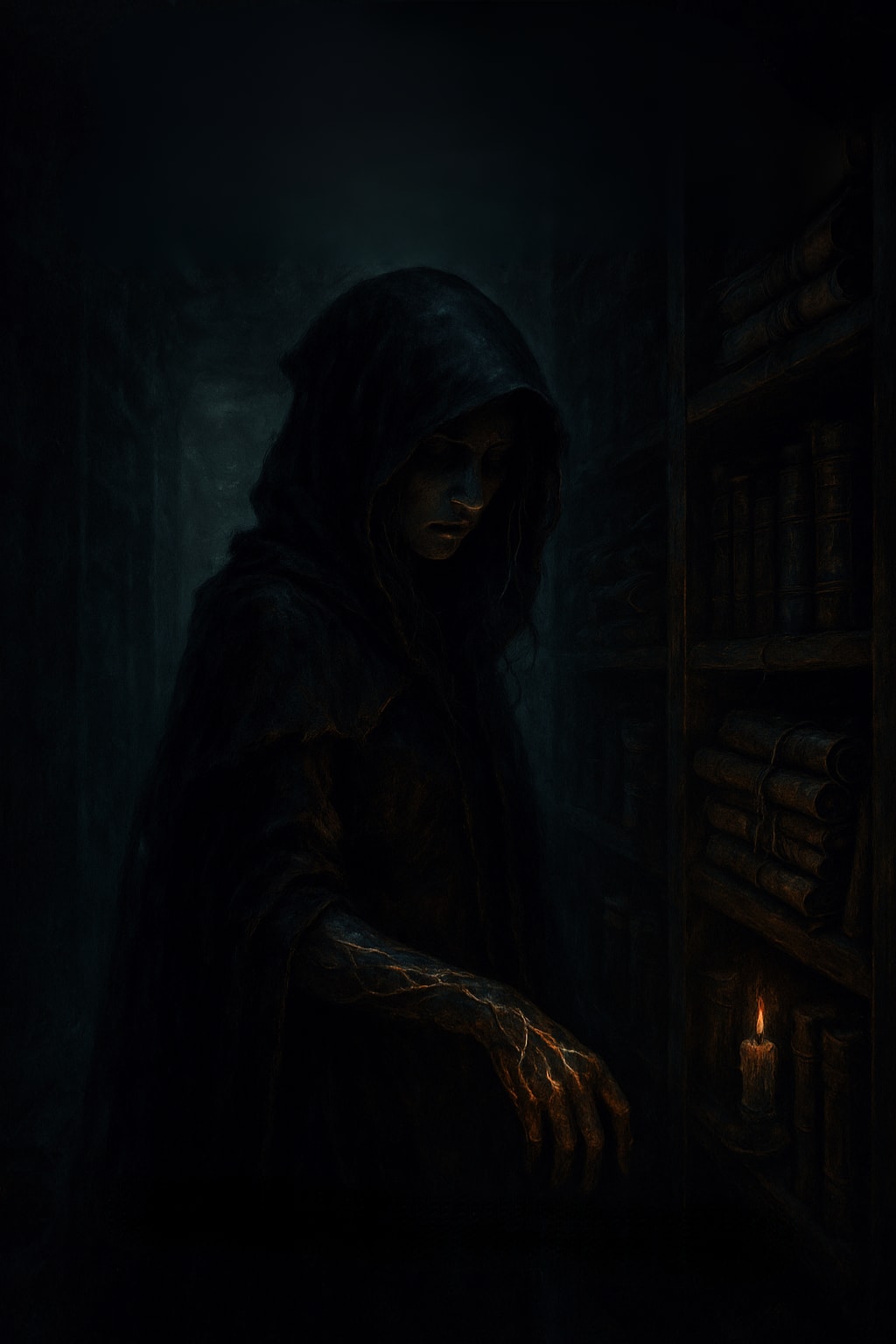
Nobody came to Clinic 9 without a diagnosis. That was the rule. If a patient was here, it meant every test, scan, and specialist had failed. They were mysteries—sent to Dr. Elara Myles for unraveling.
But Claire Pendle was something else entirely.
She sat on the edge of the exam table, her skin taut across her knuckles, the whites of her eyes faintly yellowed. She looked like someone slowly hardening from the inside out.
“It started with rash behind my ears,” she said. “Then the pain moved into my jaw, my neck. My joints started locking. Now I can feel something… shifting. Like my bones aren’t mine anymore.”
Elara jotted notes, trying to hide the chill crawling up her spine. “And who diagnosed you?”
Claire stared blankly at the wall. “No one. It told me its name.”
“What did?”
She looked at Elara. “Oinomaia Syndrome.”
Elara had never heard of it.
—
In the next month, four more patients came through her door. Different ages. Different backgrounds. All describing the same progression: a rash behind the ears. A locking of joints. Stiffness of the spine. Deep bone aches. Hardened tissue where there should be muscle. Cracks beneath their fingernails that wept a pale, almost metallic fluid.
All of them said the same thing.
Oinomaia Syndrome.
Elara turned to every source she knew: peer-reviewed journals, rare disease registries, neuroimmunology boards. Nothing. No mention of the name anywhere.
Until she found The Ichor Manuscript.
—
It was a quiet forum post on a fringe pathology subreddit.
“For research purposes only: PDF copy of The Ichor Manuscript. Do not read past chapter 4 if you have a weak constitution. You’ve been warned.”
The file was attached. No comments. Just the post. She downloaded it on instinct.
The document opened with a warning of its own.
“This text is not fiction. It is an autopsy. A vivisection. What lives in words lives in you. Read wisely.”
The manuscript read like both a horror novel and a medical diary. Its protagonist was a rogue physician chronicling a disease called Oinomaia Syndrome, named after the cursed Greek king torn apart in a chariot race he was destined to lose.
The disease began with bodily tension. Then stiffness. Then transformation.
The manuscript described, in excruciating detail, how the body would calcify, segment, and mutate into something more resilient—less human, more mythic. The afflicted would exude a golden ichor from under their nails and eventually cease needing sleep or nourishment.
By chapter 6, Elara’s knuckles had begun to ache. Two of her fingers snapped when she tried to straighten them.
—
Desperate, Elara traced the manuscript to its rumored author: a reclusive researcher-turned-occultist named Grant C. Tellers. He had disappeared in the 1990s, but she found his daughter—June Tellers—living off-grid in Montana.
June met her with narrowed eyes and a trembling mug of coffee.
“He used to say stories are bones,” June whispered. “Bare and silent—until belief wraps them in flesh. And when enough hearts beat for them… they rise. Not as fiction, but as something that remembers how to live.”
Elara leaned forward. “He created Oinomaia Syndrome?”
“He called it that. But he didn’t create it. He discovered it. He said it was older than language. Something that existed in myth, hiding in our stories, waiting for us to describe it just right.”
June pulled out a burned notebook. On its cover: the ouroboros. A serpent eating itself.
“He said once you read The Ichor Manuscript, it begins rewriting you—cell by cell. Because your body listens when your mind believes.”
—
When Elara returned home, her left arm had stiffened completely. X-rays showed thin, unnatural ridges forming along the humerus—like splints of bone growing from within. Her skin had taken on a golden tint.
And still, her labs had read: normal.
She conducted her own experiment.
Five volunteers. Each given a single chapter of the manuscript.
Subject 1: severe jaw tension within 48 hours.
Subject 2: spontaneous joint fusion.
Subject 3: claimed they no longer felt hunger or pain.
Subject 4: developed golden tears.
Subject 5: fell into a coma.
Elara’s license was revoked the next day.
—
But she no longer cared about credentials. She cared about containment.
She dissected The Ichor Manuscript as if it were alive—mapping its symbolism like genes. Within the grotesque metaphors, she found counter-images: reversals. References to divine resilience, the power of naming, and the undoing of ancient curses.
She wrote her own version.
The Binding of Oinomaia. A myth restructured. A story not of mutation, but of restoration.
She released it anonymously.
Some patients improved. Others resisted. A few evolved further—fingernails became plates. Joints became armor. Some claimed to hear whispers from within their bones: "Finish the story."
—
Then came the new text.
A corrupted rewrite of her version appeared online. It wasn’t hers. It was darker, sharper, more vivid. And in the final chapter, it described her.
“Dr. Elara Myles realized too late that the story didn’t end with healing. Oinomaia wasn’t a disease. It was a metamorphosis. And her body was the cocoon.”
She tried to shut it down.
But the story had already spread.
—
Now, in an isolated exam room, Elara leans against a steel table, her left shoulder encased in a golden shell. Her heartbeat is faint but consistent—like slow thunder rolling through marble.
A young man enters. Shaking. Sweating. His eyes bright with panic.
“Dr. Myles?” he says. “I think I have it. Oinomaia Syndrome.”
She doesn’t flinch. “Where did you hear that name?”
He swallows. “A TikTok video. It said if you even know the term, it’s too late.”
Her skin shifts faintly, like something beneath it adjusting. She offers him a chair.
“Then we begin now,” she says. “Not to stop it… but to shape it.”
—
The boy stares at her arm—golden, gleaming like ancient armor beneath the hospital light.
“Will it hurt?” he asks.
Elara smiles, slow and cracked, like stone awakening.
“It already does. But pain is only the sound of your old self falling away.”
She stands and peels back her glove. Beneath, her hand pulses faintly with gold-veined patterns, like marble soaked in starlight.
“Everything that lives rewrites itself,” she murmurs. “Cells, stories, souls. We’re not cursed. We’re chosen.”
And as the door clicks shut behind them, a single drop of golden ichor falls to the floor.
It doesn’t vanish.
It spreads.
—
Oinomaia will not kill you. It will make you ancient. It will unwrite your softness. You will survive what others cannot. You will ache, but you will not break. Welcome to your myth.
About the Creator
Keep reading
More stories from Whitney Blackburn and writers in Fiction and other communities.
The Duelist
The rays of a dying red sun flashed against the onrushing blade. The grey beards say the key to dueling lies in size, speed, reach, righteous fury, whatever the person in front of them pays them to say. Matteo knew better than any it was none of these and had an undefeated record on these sands to prove it.
By Matthew J. Fromm4 days ago in Fiction


Comments
There are no comments for this story
Be the first to respond and start the conversation.