
The House That Waited for Rain
Some homes remember those who forget them.
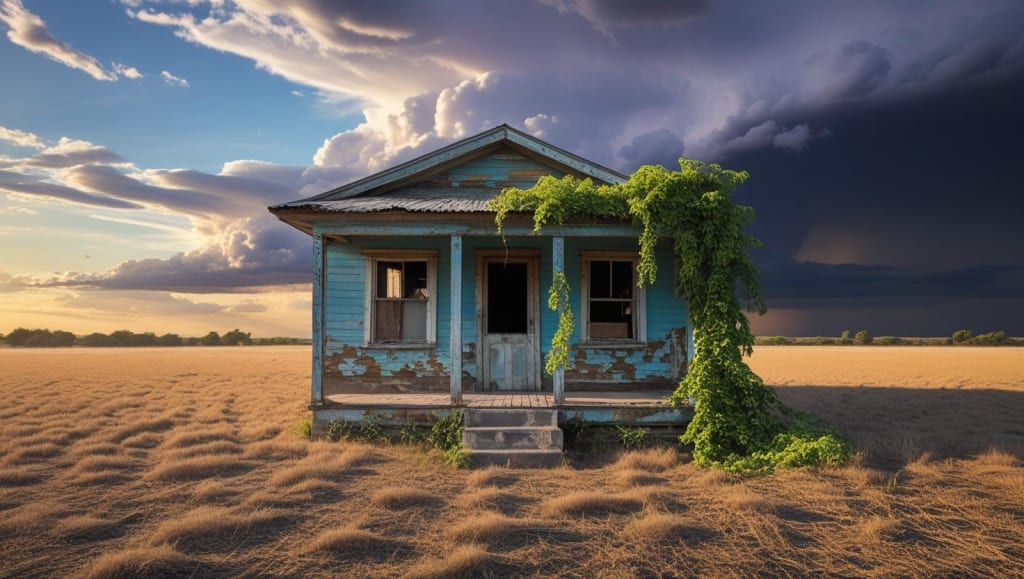
It stood on the edge of the village, where the road thinned and the earth cracked—an old mud-brick house with faded blue windows, a rusted gate, and a courtyard overgrown with silence.
No one had lived there in sixteen years.
Children whispered stories about it. Some said the house was cursed. Others believed it was waiting for someone. But no one really knew—except Amma.
Amma had lived next door her entire life. She was the one who remembered things others chose to forget. And she remembered the day Fareeda left.
Fareeda had once been the brightest flame in the village—quick to laugh, quicker to dream. She’d paint henna with the precision of poetry, and her voice carried like prayer across rooftops. Her feet always danced first at weddings. And yet, her eyes always looked far away, as though listening to something beyond the hills.
The rain stopped the day she left.
It hadn’t been dramatic—just a quiet morning, a small suitcase, and the shadow of a man from the city. He promised her a new life, bright clothes, bigger dreams. She didn’t look back, not even once.
And after that, the clouds simply forgot the village.
Years passed. The children who knew Fareeda by name grew up and left too. Crops dried. Cracks spread through the fields like veins. People stopped building. Stopped singing. The house—Fareeda’s house—remained untouched.
But Amma?
She still lit a diya in her window every monsoon. Every year. Just in case.
Then one August evening, just as the sun bled orange into the sky, a car rolled into the village. Dust curled behind its tires like breath. And from it stepped a woman wrapped in a city’s shadow—gold earrings, weary eyes, and silence in her steps.
Amma knew before the door even opened.
Fareeda.
She didn’t say anything when she arrived. No grand greetings. No tearful reunions. Just stood there, hands trembling, eyes tracing the outline of the house she had left behind like she was trying to remember a forgotten prayer.
Amma opened her door and held out a glass of water.
"You came back," Amma said softly.
Fareeda nodded. "The city didn’t have monsoon. Only noise."
The villagers were cautious at first. They didn’t know whether to welcome her or turn away. But children, curious as always, followed her from a distance. And slowly, as days passed, people remembered her laughter. It returned—hesitant at first, like a tune half-recalled, then fuller, warmer.
She walked through her old house one afternoon. It was cracked, tired, and full of dust—but the walls still remembered her. The swing her father had built still hung in the courtyard. The mirror in her old room was foggy but unbroken.
She sat on the floor and cried.
Amma found her there and said, “Homes forgive long before people do.”
Fareeda began to clean. Not just the house—but herself.
She took off the earrings. She wore old cotton again. She made tea with cardamom. She opened the windows and let the wind in. She picked lemons from the tree she’d planted as a child.
And the house responded—quietly. A door stopped creaking. A bird nested in the corner of the veranda. The scent of wet mud returned, though the rain still hadn’t.
But she was still waiting.
Waiting for something she couldn’t name.
One evening, as Fareeda sat under the neem tree, a little girl came up to her and asked, “Are you the woman who stole the rain?”
Fareeda looked at her, surprised.
The girl continued, “Amma says the sky stopped raining when you left.”
Fareeda smiled, but it didn’t reach her eyes. “Maybe I took the clouds with me.”
“Can you give them back now?”
Fareeda looked up at the blank sky. It was the same question she had asked herself every night.
She didn’t answer the girl. But that night, she stood on the roof, eyes closed, palms open.
“Come back,” she whispered to the sky. “I’m ready now.”
And in the early hours of the next morning, it happened.
The first drop hit the courtyard like a drumbeat.
Then another. And another.
The clouds opened.
The house exhaled.
Fareeda stood in the doorway, soaked, laughing like she used to. Children ran into the streets. Old men clapped. Amma lit a diya not for hope—but for gratitude.
The rain had returned.
And so had Fareeda.
That season, the crops grew green again. Mangoes sweetened. Songs returned to the village wells. And Fareeda stayed. Not because she had nowhere else to go—but because she had finally come home.
She painted the windows blue again. Replanted jasmine near the gate. Started giving henna designs to little girls who begged her to teach them.
The house, once abandoned, became alive.
Some say it had been waiting all along. Not for anyone—but for forgiveness. For remembrance. For rain.
Because some homes aren’t just made of walls.
They are made of the people who return to them
About the Creator
mr azib
Telling stories that whisper truth, stir emotion, and spark thought. I write to connect, reflect, and explore the quiet moments that shape us. If you love meaningful storytelling, you’re in the right place.
Becca
"Everything is so... flat." Denille said stupidly as she looked around her new neighborhood. She looked around at the muted desert where even the smallest sign of life seemed to have given up. The plant life was shrubs that were half cooked by the heat and where there should have been a lawn, a mess of white rocks laid glistening in the sun. Even the sky looked stretched thin, like the sun had ironed it smooth. She’d moved from Riverside, where at least there were hills, but here in Barstow, everything felt baked and brittle.
By Sara Wilson7 days ago in Fiction
The Feather That Fell Back
They say he flew away with wings of cleverness and wax, leaving Crete behind like a cage he finally outsmarted. They say his mind was unmatched—that Daedalus was born to rise above men, to carve the air itself into a pathway of freedom.
By Oluremi Adeoye 6 days ago in Fiction


Comments
There are no comments for this story
Be the first to respond and start the conversation.