
The Feather That Fell Back
The myth of Icarus and Daedalus

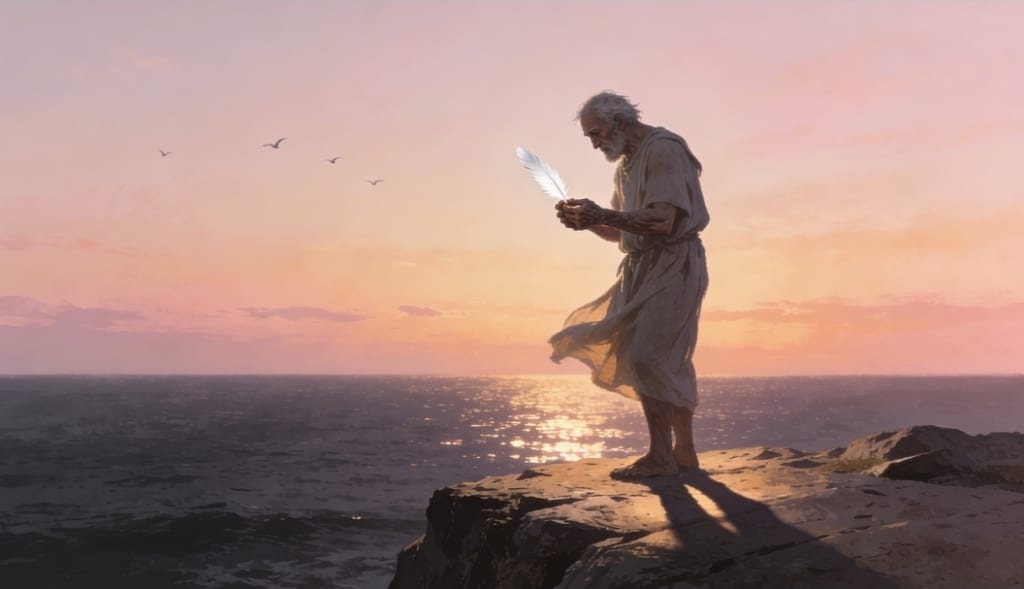
They say he flew away with wings of cleverness and wax, leaving Crete behind like a cage he finally outsmarted. They say his mind was unmatched—that Daedalus was born to rise above men, to carve the air itself into a pathway of freedom.
What they don’t say is how long he stood upon that cliff after the boy fell. The sea murmured below, patient and eternal. The wind, which moments earlier had carried their laughter, now felt like a mouth that swallowed sound. A few feathers drifted in the air—some white, some gold. The sun glared from its throne, merciless, triumphant.Daedalus’s arms still trembled, the muscles remembering motion—flap, lift, glide—though the heart inside him wasn’t sure anymore if man was meant for it. He had warned the boy: not too high, not too low. Every father warns, and every child believes halfway.But even as he shouted the warnings, he’d known. The wings weren’t right. The balance between them was off. Icarus’s feathers were lighter, the bindings thinner. He’d used the best he could find in that prison tower, but the sea air had eaten the wax, and the heat had melted the resin in his lamp. He’d meant to fix it in the morning. There had been no morning left. Now, Daedalus crouched by the cliff’s edge and found one of those feathers—white streaked with salt, bent but not broken. He turned it over between calloused fingers, the same fingers that had shaped labyrinth walls and mechanical birds, hands praised by kings yet empty of mercy for themselves.“They’ll call it my brilliance,” he whispered to the waves. “But I only ever built cages—some to trap others, and one too clever to escape in time.”
The stories later told say he flew straight to Sicily, that he landed in triumph and was welcomed by King Cocalus. But that’s not what happened. He stayed on that cliff for three days. The first day, he built a fire from driftwood and prayed to gods who never answered inventors. The second, he walked the shore, the tide clawing at his legs, searching for wings that didn’t float. On the third, he cut loose the remnants of his own contraption, letting them fall apart into foam.
Only one feather returned, drawn by some quiet current—one small witness to failure. He built a raft from the wreckage and drifted until the horizon stopped feeling like punishment. He didn’t aim for Sicily. He aimed for silence. When he reached a small island—a speck of stone and wind—he made a shelter of reeds and mud. The sun rose and fell, days counted only by the ache in his hands. He didn’t fly again. He still had enough wax and feathers to craft new wings, but to what purpose? The sky had claimed its price. Sometimes, he saw the boy in dreams. Not falling—never falling—but walking along the edge of the world, smiling in that restless way of youth. Icarus had always loved building as much as flying. “If the wings work,” he’d teased, “we’ll teach others. We’ll make the sea islands neighbors again.”That word—we—stayed with Daedalus. Every creation after came with that ghostly partnership. The father built, the son waited in the shadows of memory, asking questions no invention could silence. Years passed. A fisherman from another island found him one morning, unshaven and weathered. “You’re the man who flew,” the fisherman said, half in awe, half in fear.
“That man died,” Daedalus replied. But the fisherman insisted on taking him to the mainland, where the rumour of his survival spread quickly. By the time he reached Sicily, his name had outgrown him. Paintings of his flight decorated temple walls; philosophers preached of courage, poets of ambition. No one spoke of imbalance, of tired hands rushing perfection. The myth had already scrubbed its maker clean. King Cocalus received him with reverence, draping him in silk and laurel. “Master of air,” the king said, bowing. “May I see the wings that freed you?”Daedalus looked down at his sun-cracked hands. “There are no wings. Only weight.”Still, they pressed him—nobles, scholars, apprentices—each one hungry to touch the secret of flight. So he built again, not wings, but a model: a curved frame of ashwood bound with thin twine, lighter than a breath. He brought it to the king’s courtyard, gathered the curious crowd, and placed the single feather he had saved across the wood.
“This is what remains,” Daedalus said softly, the words trembling with memory.
“The world remembers flight as defiance. I remember it as forgiveness."
The feather stirred, lifted by a mild wind, but never rose. He watched it quiver in the air, as if uncertain whether it should dare once more.
“When I built the wings,” he continued, “I forgot that freedom costs understanding. The sky doesn’t care for our cleverness—it only measures balance. My son wasn’t reckless. He trusted me too easily.”
The silence that followed was uncomfortable. People wanted heroism, not confession. They wanted the myth, not the man beneath it. A scribe whispered, “But surely, master, your invention changed the course of history?”
Daedalus smiled faintly, a line folding deep into his cheek. “History,” he said, “likes stories that rise, not those that fall.”That night, after the feast held in his honor, he climbed to the palace roof and looked out over the sea once more. The moonlight turned the water silver, endless and calm. He held the feather again, its edge soft with age, yet intact. He breathed upon it and watched it dance in the air before it drifted away, as light as a sigh. He whispered into the wind, “Fly as far as he didn’t.” The world below went on, thriving on the tale of invention. Centuries later, his name would still mean brilliance, and Icarus would still be a warning printed in every poem—ambition undone by pride. No one would mention the uneven wings. No one would speak of the craftsman’s trembling hands or the way the sea had echoed a father’s cries. Yet on quiet coasts, where salt meets feather and air hums with memory, some say you can still hear the faint beating of wings—a rhythm stitched with sorrow and love, rising not to defy the sun, but to remember the boy who once believed a man could mend his prison with hope.
And that’s the real myth: not that they flew, but that anyone ever thought they escaped at all.
About the Creator
Oluremi Adeoye
Accomplished writer & former journalist. I craft engaging articles for Vocal media, exploring diverse topics with passion and depth, creating compelling narratives that resonate with readers.
Keep reading
More stories from Oluremi Adeoye and writers in Fiction and other communities.
Life is a journey
The old man sat alone, watching the sunset on the deserted beach while the waves crashed onto the shore. He pondered on the fleeting nature of life and the inevitability of death. When his grandson appeared out of nowhere, and asked, "What's the point of life, if we're all going to die anyway?"
By Oluremi Adeoye 3 years ago in Fiction
Lightning Never Strikes Twice
The distant rumble, the sudden deluge, the crescendo of sound, the flash of light, the explosive energy — it never gets old. I became an amateur storm chaser about two years ago. My wife, Cindy suggested it. Sort of. She said, "Alex, you know this cancer is killing me. I've come to terms with that, but you're smothering me. Go join a band, write a book, or become a storm chaser, for all I care. I love you, but you need a hobby."
By Julie Lacksonen7 days ago in Fiction
The Ghost in the Phone
There is a specific frequency to silence. It's not the quiet of an empty room. It's the quiet of a connection that is open but unanswered. It's the hum of the line after the music stops, when the system says, "All representatives are busy," and then just… lets you hang there.
By Edward Smith4 days ago in Fiction



Comments
There are no comments for this story
Be the first to respond and start the conversation.