
The House That Remembers
"Where Echoes of the Past Find Peace"
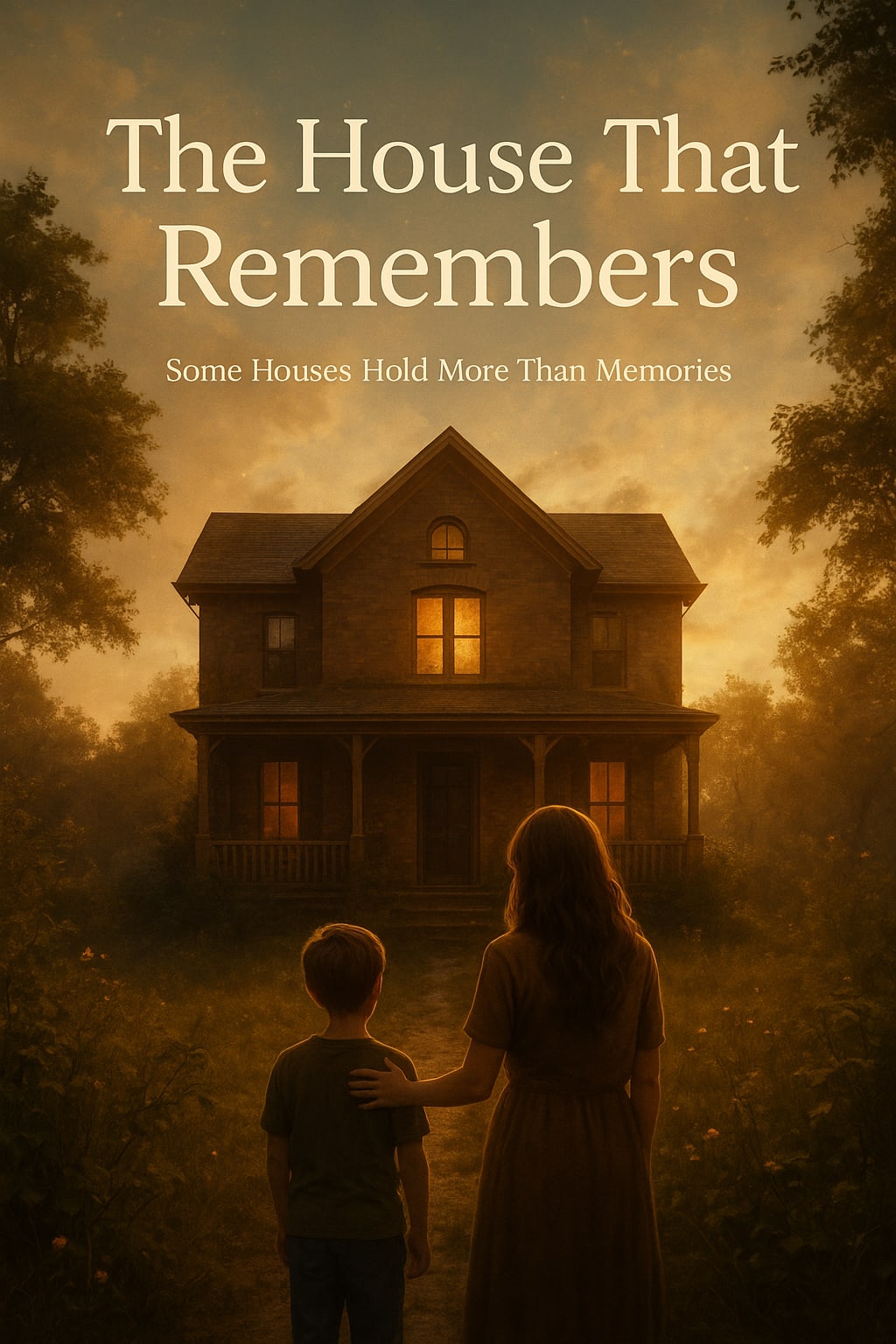
he house had been empty for forty years.
No one dared enter the crooked old place at the edge of Maple Hill. Not since the Roselands vanished in the spring of 1985. The garden had grown wild. The shutters hung crooked. And still, lights flickered in the windows some nights—though the house had no power.
Locals called it haunted.
But Clara Roseland called it home.
Now thirty-six, she stood on the overgrown porch with her eight-year-old son, Henry, clutching her hand. Her father’s old skeleton key trembled in her grasp. The wind whispered through brittle leaves, carrying scents of lilacs, dust, and something forgotten.
“This was where I grew up,” Clara said, more to herself than to her son.
“You never told me about this place,” Henry said, peering through the cracked window.
“I wasn’t ready.”
She pushed the key into the lock. It clicked—a smooth, clean sound, as if the house had been waiting.
Inside, the air was thick with stillness, but not decay. Cobwebs adorned the corners, but the furniture remained untouched, as though the Roselands had stepped out for groceries and never returned.
“Why did we leave?” Henry asked.
Clara ran her fingers along the dusty piano in the corner. Her father used to play lullabies on that piano. Her mother would hum, baking cinnamon bread on Sunday mornings.
“There was… a fire. Not one you can see. The kind that burns inside a family.”
She didn’t say more. Henry was too young to understand how secrets could split bloodlines. How her father’s obsession with the house had turned from love to fear. How her mother whispered about hearing voices in the walls. How one night, without explanation, they left and never spoke of it again.
That night, Clara tucked Henry into the old guest bedroom. The sheets smelled faintly of lavender, as though someone had just washed them.
She couldn’t sleep.
She wandered through the halls, bare feet creaking on polished wood. The house was… breathing. Doors shifted slightly open. The temperature changed with her emotions. When she paused by her parents’ room, she swore she heard the faint echo of her mother’s lullaby.
Was it memory? Or something more?
She stepped into her childhood room, now layered in dust but somehow warm. Her old teddy bear still sat on the shelf. Her name carved in the windowsill: Clara, age 9.
Then she saw it. A slip of paper tucked under her old jewelry box.
She opened it.
“Clara,
If you’re reading this, it means you came back.
The house remembers love. That’s why it still stands.
But it remembers pain too. Heal it—and it will heal you.”
No signature. But she knew the handwriting. Her mother’s.
The next day, strange things began to happen.
Henry woke up smiling, claiming he’d spoken to his “grandma” in a dream. “She said she missed the smell of cinnamon,” he said. “Can we bake?”
Clara, stunned, pulled an old recipe from memory and baked cinnamon bread in the barely-functioning oven. The scent wafted through the halls like incense. The air lightened.
Later, in the attic, Clara found a box of letters—old arguments, apologies never sent, confessions half-written. Her parents had struggled, loved, and tried to shield her from the truth.
One letter stood out.
“To my daughter:
If you ever return, forgive the silence we left behind.
This house holds echoes—but also roots.
Let it remember laughter again.”
Clara cried for the family they could have been. For the years lost to fear.
That night, she played her father’s lullaby on the piano. Badly—but with heart.
The house sighed.
A gentle wind swept through. Pictures that once tilted now hung straight. A floorboard that always creaked fell silent. In the fireplace, a single ember glowed.
The house was listening.
Weeks passed. Henry played in the backyard where wildflowers now bloomed. Clara restored the garden. Laughter returned to the kitchen. And with it, so did the house’s warmth.
Neighbors noticed. “Lights are on,” they said. “Looks like someone came home.”
They had.
One evening, Clara stood by the old tree where her father had hung a swing. She pushed Henry gently, smiling as his laughter rang out.
Then she saw them—just for a moment.
Two figures in the window: her mother and father, watching, smiling. Not ghosts, not shadows. Just… memories made real by healing.
Clara whispered, “I forgive you.”
The wind rustled the leaves in reply.
On the anniversary of their return, Henry placed a single cinnamon roll on the porch, “for Grandma.” Clara smiled. The house smelled of baking, wood polish, and blooming flowers.
People no longer feared the Roseland house.
They called it the home that healed.
But Clara knew better.
It was the house that remembered—and chose to forgive
About the Creator
Keep reading
More stories from abidnaseem and writers in Fiction and other communities.
forever in eyes
The sun melted into the horizon, casting warm hues of gold and blush across the ocean’s edge. Emma stood at the shoreline, the hem of her dress damp with saltwater, her bare toes buried in the cool sand. The breeze curled her hair around her face as if nature itself were urging her to stay—just a little longer.
By abidnaseem8 months ago in Fiction
The Lesions of Devotion
Every day I set myself down on the freshly cut lawn and strip myself bare. I take my guitar and finger the frets and pick at the strings, listening for dissonance. My life is dissonance. I twist the tuning pegs until each string sounds bright. Then I kneel, calves pointing behind me, kneecaps facing forward. All exposed to the breeze. I close my eyes and play the melody.
By Paul Stewart5 days ago in Fiction
The Fire That Refused to Burn
Kael did not wake to light. He woke to silence so complete it rang in his ears. For a long moment, he couldn’t feel his body. No pain, no warmth, no fire. Just emptiness, like the space left behind after something essential had been torn out. Panic rose in his chest, sharp and sudden.
By Imran Pisani2 days ago in Fiction
The Saddest Thing - The Billionaires Who Rule America Aren't Even Enjoying Themselves
This single post says more about our ruling class than a thousand policy papers. The saddest thing about today's system is that the men robbing the rest of us - sabotaging our economic prospects, our pensions, our access to affordable healthcare - are not even happy.
By Scott Christenson🌴5 days ago in The Swamp




Comments
There are no comments for this story
Be the first to respond and start the conversation.