

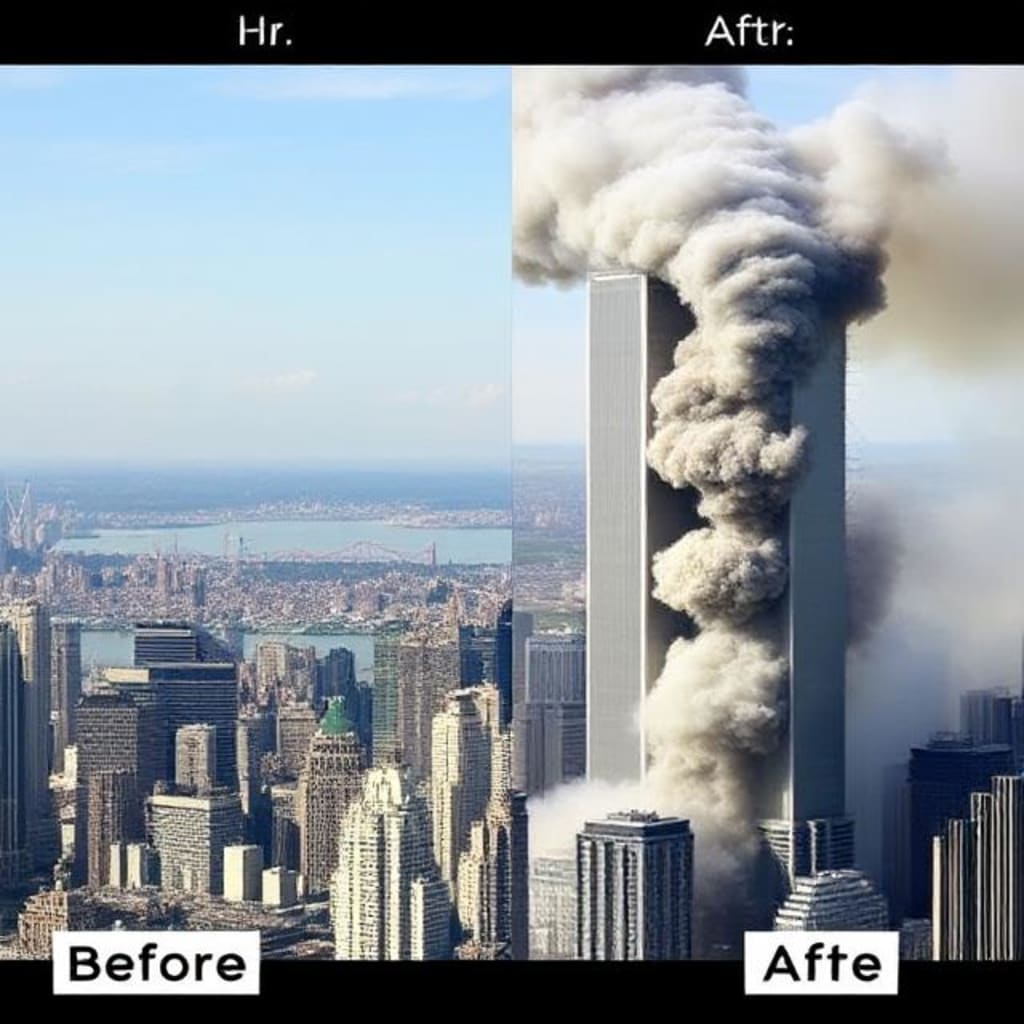
The September 11 attacks, commonly referred to as 9/11, were a series of coordinated terrorist attacks carried out by the Islamic extremist group al-Qaeda against the United States on the morning of Tuesday, September 11, 2001. These attacks were the deadliest terrorist act in world history and had a profound impact on the United States and the world.
The Attacks
On the morning of 9/11, 19 terrorists hijacked four commercial airplanes. Their plan was to use these planes as weapons to attack key targets in the U.S. At 8:46 a.m., American Airlines Flight 11 crashed into the North Tower of the World Trade Center in New York City. Just 17 minutes later, at 9:03 a.m., United Airlines Flight 175 struck the South Tower. The crashes caused massive explosions, fires, and eventually led both towers to collapse within hours, killing thousands.
A third plane, American Airlines Flight 77, was flown into the Pentagon, the headquarters of the U.S. Department of Defense, located in Arlington, Virginia, at 9:37 a.m. The fourth plane, United Airlines Flight 93, was headed for another high-profile target in Washington, D.C.—possibly the White House or the U.S. Capitol—but passengers fought back against the hijackers. The plane crashed into a field in Shanksville, Pennsylvania, at 10:03 a.m.
In total, nearly 3,000 people were killed in the attacks, including 2,977 victims and the 19 hijackers. Victims included people from over 90 countries, and the attacks caused immense physical and emotional trauma across the globe.
Who Was Responsible?
The group responsible for the attacks was al-Qaeda, a radical Islamic terrorist organization founded by Osama bin Laden. Al-Qaeda had declared a holy war (jihad) against the United States, blaming American foreign policy in the Middle East and U.S. military presence in Muslim countries. Bin Laden believed that attacking symbols of American power would weaken the U.S. and spark a global Islamic revolution.
The plan for the 9/11 attacks was years in the making. The hijackers, most of whom were from Saudi Arabia, entered the United States legally and trained at American flight schools. The attacks were carefully coordinated and showed a level of planning that shocked intelligence agencies worldwide.
The Immediate Aftermath
The response to the attacks was immediate and overwhelming. The United States declared a “War on Terror,” and within weeks, launched Operation Enduring Freedom in Afghanistan to remove the Taliban regime, which had been harboring bin Laden and al-Qaeda. The Taliban was quickly overthrown, but the war in Afghanistan would last for two decades, becoming the longest war in American history.
Domestically, the U.S. government took sweeping actions to prevent future attacks. The Department of Homeland Security was created in 2002, and airport security was drastically tightened. The USA PATRIOT Act was signed into law, giving the government expanded surveillance powers—a move that sparked debates over civil liberties.
Long-Term Effects
The 9/11 attacks changed the world in profound ways. In addition to the wars in Afghanistan and Iraq, the U.S. led global efforts to combat terrorism, which included intelligence sharing, military actions, and counterterrorism laws. However, the long-term wars resulted in the deaths of hundreds of thousands, including civilians, and cost trillions of dollars.
For Americans, 9/11 became a defining moment. It reshaped national identity, foreign policy, and attitudes toward security and immigration. Memorials, such as the 9/11 Memorial & Museum in New York City, were established to honor the victims. The phrase “Never Forget” became a national slogan.
In May 2011, nearly ten years after the attacks, Osama bin Laden was located and killed by U.S. Navy SEALs in Pakistan. His death was seen as a form of justice, though al-Qaeda and other extremist groups continued to operate around the world.
Conclusion
The September 11 attacks were a tragic turning point in modern history. They exposed the vulnerabilities of even the most powerful nations and showed how small groups with radical ideologies could inflict enormous harm. The global response reshaped politics, security, and society in lasting ways.
Though more than two decades have passed, the impact of 9/11 continues to be felt. It serves as a solemn reminder of the cost of hatred and the importance of unity in the face of terror. For many, 9/11 is not just a date, but a symbol of loss, resilience, and the ongoing pursuit of peace and security.
About the Creator
Israr khan
I write to bring attention to the voices and faces of the missing, the unheard, and the forgotten. , — raising awareness, sparking hope, and keeping the search alive. Every person has a story. Every story deserves to be told.
Keep reading
More stories from Israr khan and writers in Fiction and other communities.
The Regret of a Creator: The Man Behind the World's Deadliest Weapon
In 1947, deep within the Soviet military-industrial complex, a young Russian military engineer named Mikhail Kalashnikov gave birth to a weapon that would eventually shape modern warfare—and haunt his soul for the rest of his life.
By Israr khan7 months ago in Fiction
Becca
"Everything is so... flat." Denille said stupidly as she looked around her new neighborhood. She looked around at the muted desert where even the smallest sign of life seemed to have given up. The plant life was shrubs that were half cooked by the heat and where there should have been a lawn, a mess of white rocks laid glistening in the sun. Even the sky looked stretched thin, like the sun had ironed it smooth. She’d moved from Riverside, where at least there were hills, but here in Barstow, everything felt baked and brittle.
By Sara Wilson7 days ago in Fiction
The Cracks in the Stone: What the Myth Refused to Record
The myth-makers like to say that when Amaterasu Omikami entered the cave, the world simply went dark. They use the word "dark" as if it were a clean, binary switch—the absence of a lamp, a blanket thrown over a birdcage. They tell you that the gods gathered by the river to laugh her back out, as if a divine party could cure a cosmic trauma.
By Takashi Nagaya3 days ago in Fiction



Comments
There are no comments for this story
Be the first to respond and start the conversation.