
*The Great Goat Escape*
One goat. One village. Unlimited chaos.

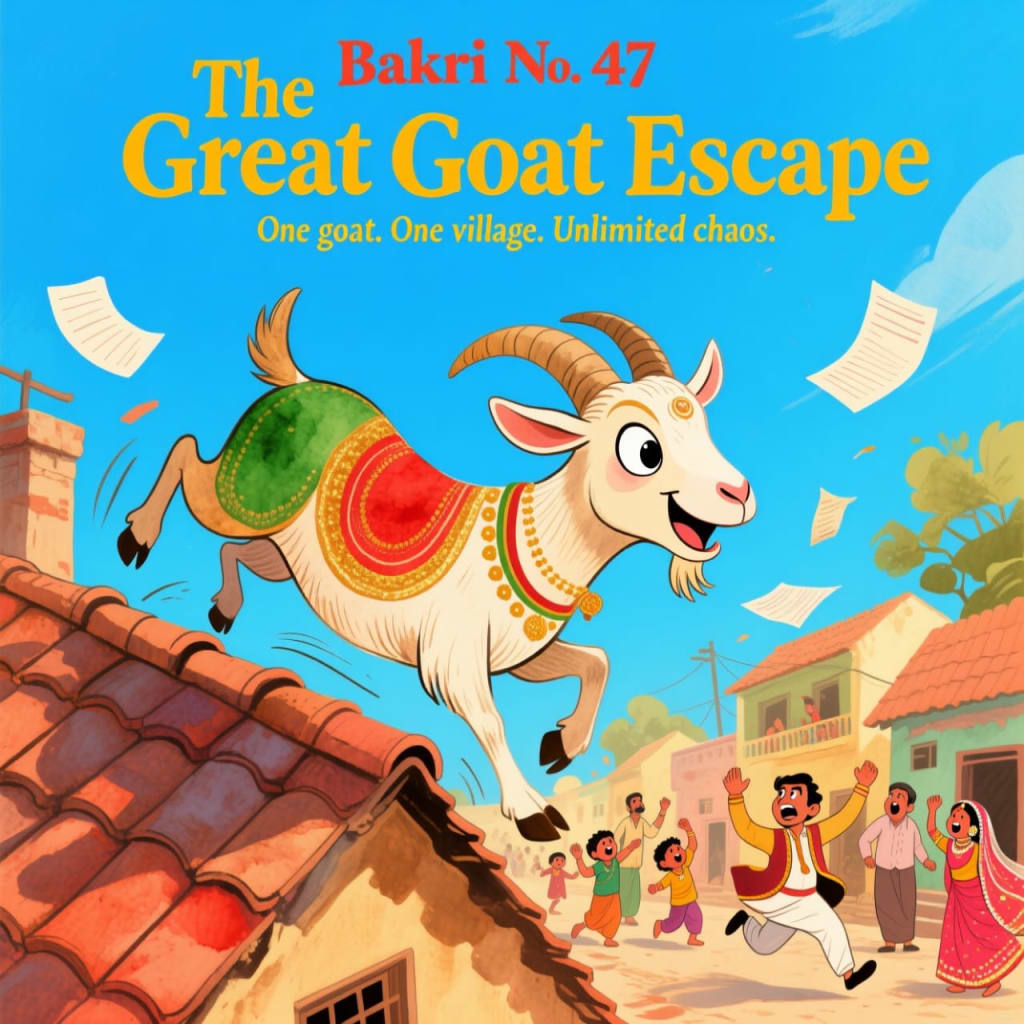
In the quiet village of Chamakpur, where the days passed like slow-moving clouds and the loudest sound was usually the rooster’s morning call, one creature had a talent for turning calm into comedy: Bakri No. 47.
She wasn’t named for affection. No. 47 was the number painted faintly on her side when Master Fazal, the retired school headmaster, bought her at the weekly cattle market. But over time, the number became her identity—like a badge of honor for a goat who refused to follow rules.
She wasn’t big. She wasn’t loud. But she was clever. And mischievous in a way that made you want to scold her and hug her at the same time.
She once ate Fazal’s pension papers—“They were on the table,” he’d sigh. “She looked me in the eye and ate them.”
She chased the new bridegroom on his wedding day, mistaking his red sherwani for a challenge.
And yes, there was that one time she somehow scaled the back wall of the mosque and stood on the flat roof, chewing calmly, while the muezzin tried not to lose focus during the call to prayer.
“She’s possessed,” declared Auntie Nasreen, clutching her dupatta every time the goat wandered near.
“She’s brilliant,” argued young Imran, who had attempted (and failed) to ride her like a pony. “She’s got spirit.”
Then came the Monday that broke the peace.
Fazal tied her to the post near the sugarcane field, double-knotted the rope, and said firmly, “No tricks today.”
Bakri No. 47 blinked slowly. Then she chewed a piece of straw. And waited.
By noon, the rope was neatly looped around the post. The goat? Gone.
Panic spread faster than monsoon rain.
First, she was seen charging into the bakery, knocking over a tray of fresh parathas. The baker waved his rolling pin and shouted, “Not again!”
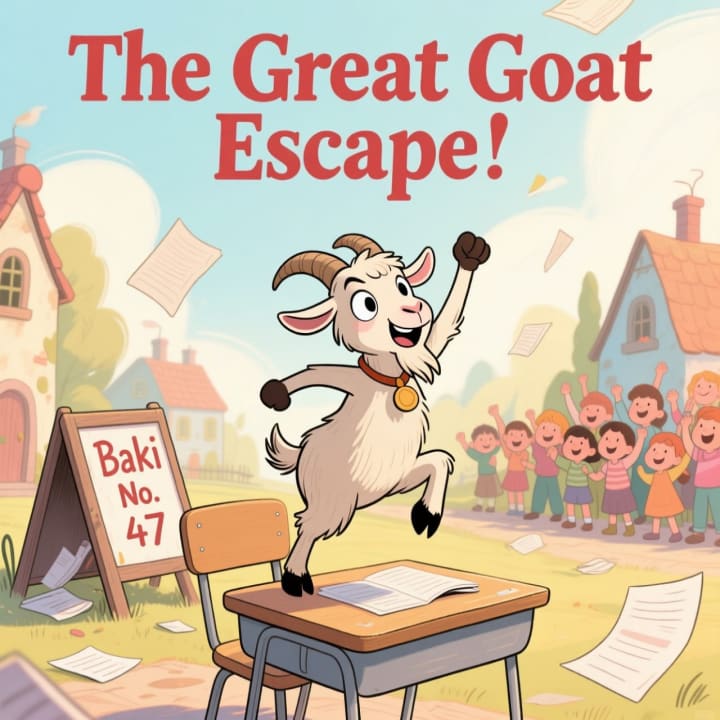
Then, she led a small parade of three other goats straight into the schoolyard during assembly. Kids shrieked with delight as she leapt onto a wooden desk, stood perfectly still, and let out a long, proud “Mehhh!”—as if accepting a standing ovation.
“She’s corrupting the youth,” groaned the current principal, adjusting his glasses.
“She’s starting a revolution,” whispered Imran, eyes shining.
Fazal, meanwhile, was running from house to house, breathless. “Have you seen my goat?”
“She ate my laundry!” cried one woman.
“She tried to follow me into the bathroom!” said another.
Auntie Nasreen, never one to miss a chance for drama, announced at the well, “She’s gone to Karachi. Probably joining the circus.”
Sana, the seven-year-old with more sense than most adults, rolled her eyes. “She wouldn’t last a day in the city. Too many cars. Too little grass.”
By evening, the entire village was caught in goat fever.
“She’s looking for her family,” said one man solemnly.
“She’s protesting against early milking hours,” joked the milkman.
“She’s training to be the next sarpanch,” someone else laughed.
Then—someone spotted her.
Perched on top of the village water tank.
She stood there, silhouetted against the orange sky, one hoof slightly raised, tail flicking like a flag in the wind. The whole village gathered below, staring up in disbelief.
Phones came out. Kids pointed. Even old Mr. Hafeez, who hadn’t smiled since 1983, cracked a grin.
Fazal cupped his hands. “No. 47! Beta, come down! You’ll hurt yourself!”
She turned her head slowly, looked at him, and bleated—long and loud. It sounded suspiciously like laughter.
No one knew how to get her down. The ladder was too short. The tank was too slippery. The watchman, who had once tried to catch her with a lasso and ended up tangled in his own rope, refused to try again.
Then Shabir, the quiet chaiwala from the corner stall, stepped forward with a plate in his hand.
“Bring me a fresh paratha,” he said. “And a little ghee.”
Everyone watched as he placed the warm, flaky bread on the ground, stepped back, and waited.
Exactly 17 seconds later, the goat scrambled down the tank (somehow avoiding all logic and gravity), trotted over, sniffed the paratha, and began eating like a queen at a banquet.
The village erupted.
Children clapped. Women cheered. Auntie Nasreen fainted—genuinely this time—into her neighbor’s arms.
Fazal picked up the empty plate, shook his head, and patted the goat’s head. “You’re trouble, you know that? Absolute trouble.”
She nudged him gently, then followed him home, tail high.
After that, things changed.
Bakri No. 47 was no longer just a goat. She became a legend. The tea stall got a new sign: “Home of the Famous No. 47 – Chai with a Side of Chaos.”
The school painted a mural of her on the wall—hoof on desk, crown above her head, caption: “Our Unofficial Head Girl.”
And every year, on the anniversary of her great escape, the village celebrated Bakri Day—with music, parathas, and one very important rule: No ropes. No cages. Just freedom—and maybe a little mischief.
Because sometimes, it doesn’t take a hero to bring joy.
Sometimes, all it takes is one stubborn goat
who just wanted to see what was on the other side.
And remind everyone—goats and humans alike—
that life is better when you’re allowed to climb a little higher.
About the Creator
meerjanan
A curious storyteller with a passion for turning simple moments into meaningful words. Writing about life, purpose, and the quiet strength we often overlook. Follow for stories that inspire, heal, and empower.
Reader insights
Outstanding
Excellent work. Looking forward to reading more!
Top insights
Compelling and original writing
Creative use of language & vocab
Easy to read and follow
Well-structured & engaging content
Excellent storytelling
Original narrative & well developed characters
Expert insights and opinions
Arguments were carefully researched and presented
Eye opening
Niche topic & fresh perspectives
Heartfelt and relatable
The story invoked strong personal emotions
Masterful proofreading
Zero grammar & spelling mistakes
On-point and relevant
Writing reflected the title & theme
As Wise As an Owl
As Wise As an Owl Deep in the quiet green woods, where a clear stream moved gently over smooth stones, there lived a great white owl with wide golden eyes. She watched the forest from a tall branch, seeing far more than most creatures ever noticed. The animals of the woodland spoke often and loudly, yet the owl remained mostly silent, listening and observing the world around her.
By George’s Girl 2026 7 days ago in Fiction



Comments (1)
So funny