
The Girls the River Remembers
Two women. One train. A journey that carved grief into their bones.

The Girls the River Remembers:-
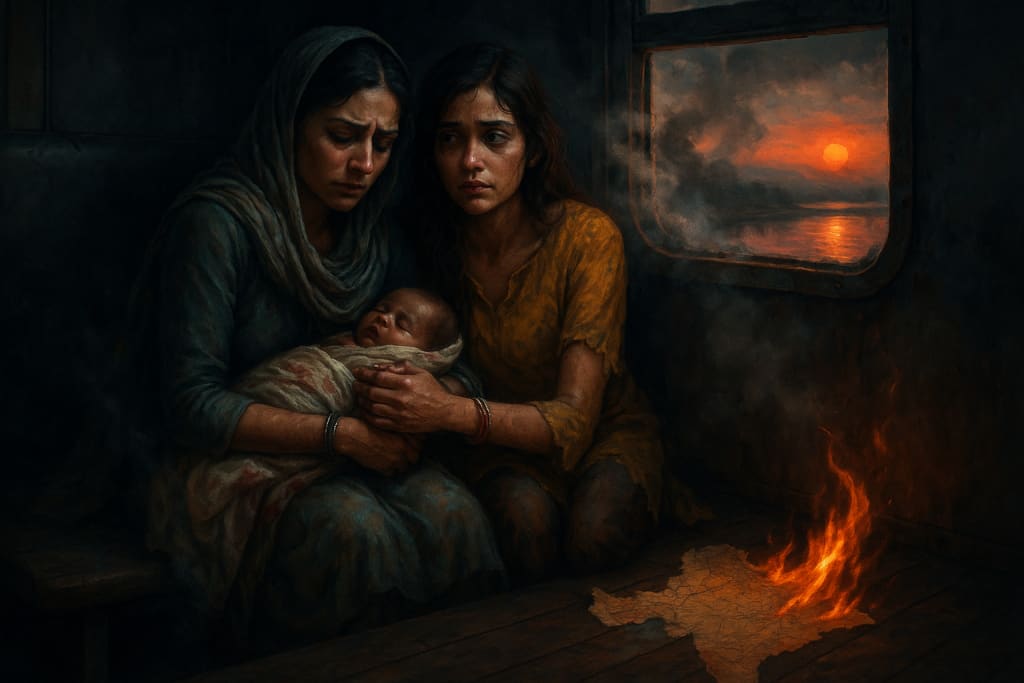
The train screeched to a halt just before the Sutlej bridge. Smoke billowed from the engine, curling into a sky already heavy with ash. Inside the cramped carriage, silence clung to everything. Not peace—just the kind of silence that follows screams.
Ayesha clutched the infant tighter. The baby wasn’t hers. Someone had thrust it into her arms as the crowd pushed toward the train, the station behind them burning. She hadn’t seen where the woman—its mother—went. Maybe she never made it on board.
Seventeen. That was all Ayesha was. Just seventeen. And yet, her hands were already stained with blood that wasn’t hers, her childhood buried beneath the ashes of her home outside Lahore.
Across the carriage, women sat wrapped in what was left of their dignity—stained dupattas, torn saris, trembling arms. No men. Not anymore. The men had been left behind, either to fight or to fall.
This was 1947.
India had been split in two. And the people? Torn apart like pages in a burning book.
Outside, someone shouted. Then another scream.
The door of the train swung open.
Ayesha’s breath caught.
But it wasn’t raiders.
It was a girl.
Blood trickled down her temple. Her salwar kameez, once yellow, was smeared with dirt and something darker. Her eyes darted around the carriage.
“Please,” she whispered, barely audible. “Hide me.”
Ayesha hesitated for just a second. Then she lifted the wooden bench and pointed. The girl crawled under. Ayesha threw a torn quilt over the opening and sat down, heart pounding.
Then the real danger arrived.
Three men—armed, loud, drunk on hate.
“Any Hindu girls in here?” one demanded.
No one answered.
The man’s eyes locked on Ayesha. He stepped closer, suspicious. She held the baby tighter, her gaze steady. Her mother had once told her, never blink when facing a wolf.
He bent, reaching for the quilt.
Ayesha didn’t flinch.
Another voice from outside called, “Nothing here! Move on!”
The man paused. He stared at her another heartbeat—then turned and left.
The door slammed shut. The train lurched forward.
Only when the wheels clattered over the bridge did Ayesha pull the quilt away. The girl crawled out, shaking, tears streaking her face.
“I’m Meena,” she said in a broken voice. “From Gurdaspur. They… they killed my family.”
Ayesha didn’t ask who they were. She already knew. It didn’t matter.
“I’m Ayesha,” she replied softly. “Lahore. They killed mine too.”
The two girls sat in silence, side by side. One Muslim. One Hindu. Survivors of a line drawn by foreign hands. A line that didn’t care about names or dreams or the smell of home-cooked food.
By dawn, the train crossed into Amritsar.
Two strangers who had nothing in common—except everything—stepped off together.
They never saw each other again.
Ayesha ended up in a camp near Rawalpindi. She never found the baby’s mother. She raised the child as her own.
Meena married in Delhi, but some nights, she would wake up crying, hand over her mouth, remembering the sound of her sister’s last scream.
They both lived. But part of them didn’t.
Years later, people would say the Partition was a political event. A historical shift.
But the river knows better.
The Sutlej, the Ravi, the Jhelum—they remember the girls who bled, the women who jumped to escape shame, the mothers who covered daughters with their bodies.
And they remember Ayesha.
And Meena.
Because some borders aren’t drawn on maps. They are carved into skin, whispered into the bones of those who live to tell no one.
And sometimes, if you walk near the river at dusk, you might feel it—a sudden chill, a faint cry.
That’s them.
The girls who survived.
But never came home.
About the Creator
Zakir Ullah
I am so glad that you are here.
Keep reading
More stories from Zakir Ullah and writers in Fiction and other communities.
The Last Letter
The envelope was worn, its edges curled like forgotten memories. Clara found it under a loose floorboard in her grandmother’s attic, tucked beneath dusty photo albums and an old patchwork quilt that smelled faintly of lavender and time. The handwriting on it was delicate and trembling with age—her grandmother’s, but younger.
By Zakir Ullah10 months ago in Fiction
THE EXTRA CHAIR
The first time the chair appeared, it was already set for dinner. Marianne noticed it when she brought the pot roast to the table. There were five place settings instead of four. Five forks aligned like silver ribs. Five water glasses catching the yellow light.
By Ajan Lori Abei6 days ago in Fiction



Comments (2)
Excellent story 🏆✍️📕
This story is intense. It really makes you feel the chaos of that time. I can't imagine being in Ayesha's shoes, having to make such quick decisions to protect others. It makes me wonder how many other acts of bravery like this went unnoticed during the partition. And what must it have been like for those women, losing everything and everyone they knew? Crazy stuff.