
The Girl Who Wrote Herself Alive
An Author Trapped in Her Own Novel Fights for Freedom

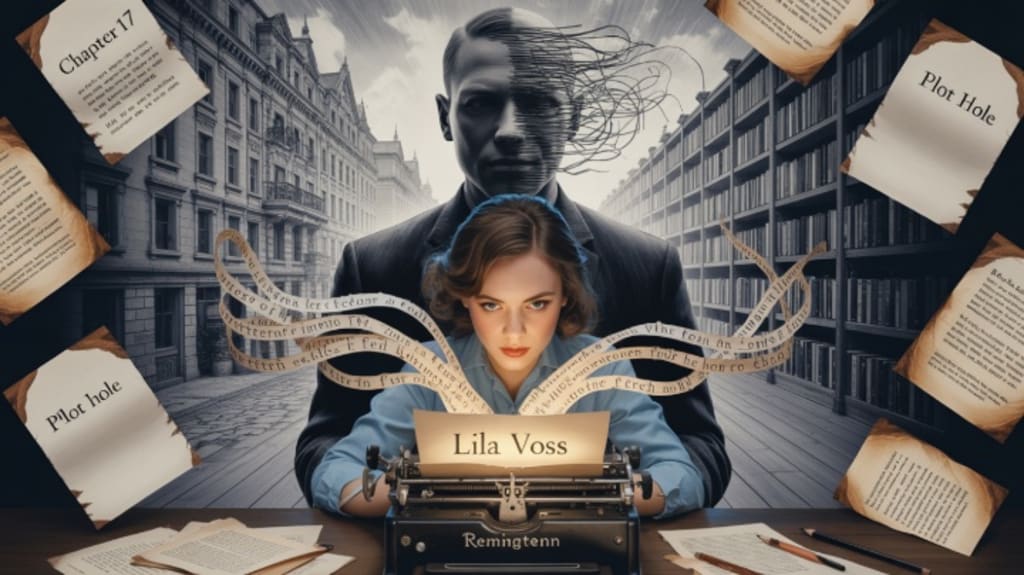
he bestselling fantasy author stared at her vintage Remington typewriter with growing horror as the keys began to depress on their own. Each mechanical click echoed like a gunshot in her silent apartment. The words appeared one by one: Chapter 17: In Which the Author Realizes She Is No Longer the Author.
Lila's fingers trembled as she reached for the page. The moment her skin touched the paper, the world around her dissolved like watercolors in rain. Reality bled away, replaced by the familiar spires of Thornhaven—the fantasy city she'd created for her unfinished novel. Except she wasn't observing it from the comfortable distance of creator. She was standing in it, breathing its air, feeling the cobblestones beneath her modern sneakers.
A distressed young woman in modern clothes typing furiously at a vintage typewriter with glowing words floating mid-air and a shadowy figure looming behind her
A distressed young woman in modern clothes typing furiously at a vintage typewriter with glowing words floating mid-air and a shadowy figure looming behind her
Trapped in Fiction: The Realization
"This isn't possible," Lila whispered, her voice carrying the strange echo that she'd described in her manuscript—the distinctive resonance of Thornhaven's acoustics. A sound she'd invented but never heard until now.
Around her, the city was in chaos. Buildings crumbled at their edges, streets dissolved into blank whiteness at the periphery. Of course they did—she'd never finished writing this chapter. The world was incomplete, existing only as far as she'd described it.
A shadow moved across the fractured landscape, darker than darkness itself. It flowed like ink, absorbing everything in its path. Where it passed, entire sections of the city simply ceased to exist, leaving behind only empty white space—the void of unwritten pages.
Lila knew what it was without being told. The Editor. The antagonist she'd created as a metaphor for her own creative blocks and doubts. A sentient shadow that could erase anything it touched from the narrative. In her novel, it was supposed to be a manifestation of forgotten stories and abandoned drafts.
Now it was hunting her.
A crumbling fantasy city with ink-storm clouds and books flying like birds
A crumbling fantasy city with ink-storm clouds and books flying like birds
Lila ran through the disintegrating streets, desperately trying to remember what she'd written about Thornhaven's geography. If this was Chapter 17, then the Library of Lost Narratives should be just beyond the central square. She needed to find it—in her story, it contained the knowledge of how the world worked.
As she rounded a corner, the library came into view. But unlike the grand repository of knowledge she'd imagined, this building was a charred husk. Blackened pages fluttered from broken windows like wounded birds. The massive doors hung from their hinges, revealing a cavernous interior filled with the ashes of burned manuscripts.
"No," Lila breathed. She hadn't written this. Someone—something—had changed her story.
The Editor: A Self-Created Antagonist
The shadow slithered across the square behind her, absorbing a fountain and three minor characters she vaguely recognized from her own descriptions. They didn't scream as they disappeared—they simply stopped being.
"You shouldn't be here," came a voice like paper tearing. The Editor coalesced into a vaguely humanoid shape, its edges constantly shifting and reforming. "Authors belong outside the text, not within it."
"This is my story," Lila said, backing toward the library. "I created you."
"And now I edit you." The shadow extended a tendril that erased a chunk of cobblestone near Lila's feet. "Your presence is a plot hole. An inconsistency. You must be removed for narrative coherence."
Lila turned and ran into the burned library. Inside, she found what remained of her world-building notes, now reduced to charred fragments. But one display case remained intact in the center of the room. Inside was her typewriter—the same vintage Remington from her apartment.
A library of burned manuscripts with charred pages floating in the air and a vintage typewriter in a glass case
A library of burned manuscripts with charred pages floating in the air and a vintage typewriter in a glass case
Understanding dawned on her. In her novel, she'd given the protagonist a magical artifact that could rewrite reality. She'd never specified what it looked like because she hadn't decided yet. But her subconscious had filled in the blank with her own typewriter.
Lila broke the glass with her elbow and seized the typewriter. It was impossibly light, as if made from thought rather than metal. She inserted a blank page that appeared from nowhere and began to type:
The library restored itself, the burned books returning to their shelves, whole and unharmed.
The words glowed on the page, then lifted off like golden fireflies, spreading through the air. Where they touched, reality reshaped itself. Charred shelves regrew, ashes reformed into books that flew back to their proper places. But as the transformation completed, Lila felt a strange emptiness in her mind. The memory of what her childhood library had looked like—the inspiration for this scene—had vanished from her memory.
She understood the terrible price: every time she rewrote reality, she lost a piece of herself. The memories that had informed her creation were being consumed by the act of creation itself.
The Editor's shadow seeped under the library door, spreading across the floor like spilled ink.
"You cannot edit me," it said. "I am the Editor. I am deletion and revision personified."
Lila's fingers flew across the keys: The Editor could not enter the library, for it was a sanctuary of narrative integrity.
The shadow recoiled from an invisible barrier at the threshold, but Lila felt another memory slip away—her first writing award, the validation that had launched her career. Gone, used as fuel for this new reality.
The Power of Rewriting: Consequences and Discoveries
For hours or days—time moved strangely in this unfinished chapter—Lila remained barricaded in the library, studying her own incomplete manuscript. She discovered she could read ahead to chapters she hadn't written yet, seeing the faint ghostly outlines of plot points she'd only planned. But the further she read, the more she realized how many plot holes and inconsistencies existed in her unfinished work.
These gaps in narrative logic appeared as actual holes in the fabric of this world—places where the Editor could slip through her defenses. She needed to fix them, but each correction cost her another memory.
After what felt like the hundredth revision, Lila paused, horrified to realize she couldn't remember her mother's face anymore. Or was it her father's? Someone important, now just a blank space in her mind.
A close-up of a typewriter page with the typed sentence 'Lila Voss stopped being the author then'
A close-up of a typewriter page with the typed sentence 'Lila Voss stopped being the author then'
The Editor's voice came through the walls now, no longer stopped by her earlier command. The rules were changing as the narrative evolved.
"Every story must end," it said. "Even yours, Lila Voss. Especially yours."
Lila looked down at her typewriter and had a revelation. She'd been trying to fix her story, to make it coherent and whole. But that wasn't how she would escape. The way out was through the meta-narrative—the story about the story.
She began to type again: Lila Voss stopped being the author then. She became the protagonist instead, and like all protagonists, she had one purpose: to confront the antagonist in the climactic scene.
The words lifted from the page, swirling around her like a golden tornado. When they settled, Lila found herself in a vast white void—the blank page at the end of Chapter 17, where she'd stopped writing before being pulled into the book.
The Editor was waiting for her, larger now, a towering pillar of darkness against the endless white.
"You've written yourself into a corner," it said, its voice like a thousand pages being torn at once. "There's no resolution to this conflict. You never plotted one."
"You're right," Lila said, clutching the typewriter. "I never decided how my protagonist would defeat you. I left it as a plot hole."
The Editor surged forward, sensing weakness. "Then you will be deleted, like all failed drafts."
But Lila was smiling now. "That's the thing about plot holes," she said. "They work both ways."
The Confrontation: A Battle in the White Void
In the featureless expanse of unwritten pages, Lila set down her typewriter and stepped away from it.
"What are you doing?" The Editor's form rippled with uncertainty.
"Using the plot hole," Lila said. "You see, I never explained how the Editor could be defeated because I never decided if it could be defeated at all. I left that ambiguous."
She circled the shadow entity, her confidence growing. "But I also never specified the limits of your power. If you're deletion personified, what happens when you try to delete yourself? Can the Editor edit the Editor?"
The shadow recoiled. "That's a paradox."
"Exactly," Lila said. "And paradoxes are just another kind of plot hole. A gap in logic that can never be resolved."
A woman confronting a dark shadowy figure in a white void of unwritten pages with a typewriter between them
A woman confronting a dark shadowy figure in a white void of unwritten pages with a typewriter between them
She lunged for her typewriter and wrote one final line: The Editor, confronted with its own paradoxical nature, attempted to edit itself out of existence.
The shadow began to collapse inward, tendrils of darkness turning upon themselves in impossible geometries. It writhed and twisted, trying to escape the logic trap Lila had created.
"This isn't fair," it howled. "This isn't good writing!"
"It's not about good writing," Lila said, feeling another memory slip away—the face of her first love, gone forever. "It's about survival."
As the Editor imploded, the white void began to crack around them. Lila could see her apartment through the fissures in reality—her desk, her bookshelves, her real typewriter sitting where she'd left it.
She typed one last command: Lila Voss returned to the real world, bringing with her the knowledge of what it means to be both creator and creation.
The void shattered like glass, and Lila fell through the fragments of her own fiction, back into reality.
The Return: Finding Reality Changed
Lila gasped as she slammed back into her body, sitting at her desk. Her apartment looked exactly as she'd left it, down to the coffee mug with yesterday's dregs still sitting by her typewriter. Had any time passed at all?
Her hands trembled as she touched her face, her clothes, the solid wood of her desk. Real. All real.
But something was different. The manuscript pages beside her typewriter were complete—all the chapters finished, including the ones she hadn't written yet. She flipped through them with growing astonishment. The story was complete, polished, and perfect. Better than anything she could have written consciously.
And yet, as she read her own words, they felt like a stranger's. The memories that had informed these scenes were gone from her mind, consumed by the act of creation within the story itself.
A woman looking at completed manuscript pages next to a typewriter in an apartment with bookshelves
A woman looking at completed manuscript pages next to a typewriter in an apartment with bookshelves
Lila set the pages down and noticed something else: her typewriter was different. The vintage Remington now had keys that glowed faintly with an inner light, and the metal seemed to shift subtly when she wasn't looking directly at it.
As she watched, the keys began to depress on their own.
Epilogue: In Which the Author Discovers She Is Still Being Written
Lila tried to pull the paper from the typewriter, but it wouldn't budge. The keys continued their ghostly typing:
Lila Voss thought she had escaped her own fiction, but she had only ascended to a higher level of narrative. She was free of the Editor, but not free of being edited. No one ever is.
With growing horror, Lila looked around her apartment and noticed the edges of her vision were slightly blurred, as if the details hadn't been fully described. The spines of books on her shelves were just colored rectangles unless she focused directly on them, at which point titles would appear.
She hadn't escaped the story. She'd just moved into a different one.
The typewriter continued: She reached for her phone to call for help, not yet realizing that the only numbers it could dial were the ones written for her.
Lila's hand moved to her phone, almost of its own accord. She fought against the compulsion, sweat beading on her forehead from the effort of resisting the narrative.
"No," she whispered. "I'm real. I'm the author."
The typewriter paused, then began again: All authors are characters in someone else's story. All creators are creations themselves.
Lila stared at the machine, a terrible understanding dawning. She reached for a blank sheet of paper and inserted it alongside the one already in the typewriter. If she was in a story, then perhaps she could write her way out of this one too.
She began to type her own counter-narrative: Lila Voss was real, more real than any story. She—
But before she could finish, the typewriter's keys moved faster, drowning out her words with its own:
She would try to write herself free, not understanding that her very attempt was already written. The cursor blinked, hungry for the next word, the next thought, the next chapter in an endless book.
The cursor blinked, hungry.
Explore More Mind-Bending Fiction
Did "The Girl Who Wrote Herself Alive" blur the lines between reality and fiction for you? Dive deeper into the world of metafiction with more stories that challenge the boundaries between creator and creation. Join our community of readers and writers who explore the endless possibilities of speculative fiction.
About the Creator
Syed Kashif
Storyteller driven by emotion, imagination, and impact. I write thought-provoking fiction and real-life tales that connect deeply—from cultural roots to futuristic visions. Join me in exploring untold stories, one word at a time.
Keep reading
More stories from Syed Kashif and writers in Fiction and other communities.
Peace
Something's happening 'round here. Some folks just seem to be gettin' happy ever since Captain Groovy decided to run for public office. He decided to run as an independent on the Peace ticket and name the party the Groovy Party. The Groovy Party was the laughingstock of the political arena, their views on hate and violence were seen as ridiculous. No one took the party seriously, that is, until Captain Groovy became the party leader.
By John Scipio2 days ago in Fiction


Comments
There are no comments for this story
Be the first to respond and start the conversation.