
The Infinite Loop of Us
A Time-Traveler’s Guide to Saving His Marriage

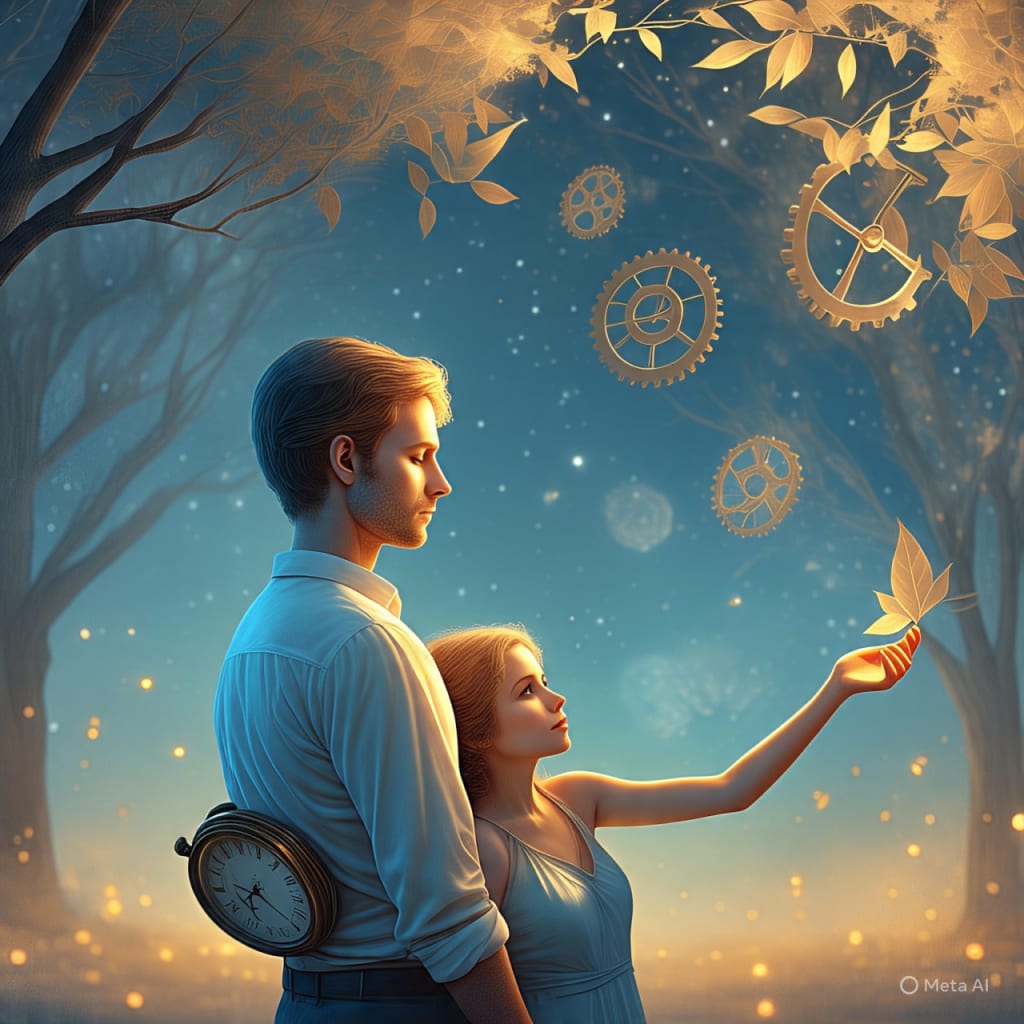
Julian had spent the last five years learning how to manipulate time—not to become rich, not to alter history, but to save his marriage.
The first time he lost Emily, it was subtle. A missed anniversary dinner here, a forgotten conversation there. He always thought there would be time to fix it—until one day, there wasn't. She left him with a quiet, tearful goodbye and a single phrase that haunted him more than any temporal paradox ever could: “I just don’t feel seen anymore.”
That night, alone in his cluttered lab, Julian activated the loop.
Version One lasted a week. He returned to the moment a year before she left. He bought flowers, cooked her favorite meals, complimented her eyes like he used to when they first met. She smiled. But it wasn’t enough. The spark fizzled again, and she slipped away.
Version Two lasted a month. He learned to listen—really listen. He responded with thoughtful questions, sat with her in silence, touched her hand when she needed it most. But she could still sense it—an artificial thread sewn through his intentions. He was trying too hard, not being himself.
Version Thirteen lasted nearly a year. It was his best attempt yet. He’d mapped every argument, every silence, every sigh. He thought he had it mastered. But love, he learned, wasn’t a line of code to be debugged. It was messy, unpredictable, and human.
“Julian,” Emily had said in that version, “I don’t know what’s changed in you, but it’s like... you’re chasing something. And I don’t want to be a goal you’re trying to achieve. I want to be your partner.”
And just like that, she was gone again.
Each loop left a scar on his memory, a residue of failure that accumulated like cosmic dust. He began to forget which version he was in. Time bent around him like glass under heat, warping reality into a blur of missteps and do-overs.
It wasn’t until Version Twenty-One that he did something different. He stopped trying.
He didn’t recite rehearsed lines or cook a perfect dinner. He didn’t avoid the fight about her career or their mismatched schedules. Instead, he let the conversation happen. He let the silence hang. And when she cried about feeling like she had to be the one holding everything together, he didn’t try to fix it.
He just held her.
They sat on the kitchen floor that night, backs against the refrigerator, two humans unraveling the knot they’d become.
“Why now?” she asked. “Why does this feel different?”
Julian took a breath, the weight of twenty failed timelines pressing down on his chest. “Because I stopped trying to control the story. I realized I’ve been trying to edit our love like it was a machine. But it’s not. It’s alive. And sometimes... it breaks.”
She looked at him, really looked at him—for the first time in what felt like lifetimes.
“That’s the most real thing you’ve ever said,” she whispered.
He didn’t loop after that. He let the days roll forward, uncertain and raw.
They had fights. Some ended in slammed doors. Others in laughter.
They built new habits. Morning coffees with eye contact. Evening walks without phones. Honest conversations about therapy, about starting over.
Julian decommissioned the machine.
He buried the time circuit in their backyard with a simple note: Some things are worth living once.
A year passed. Then two. Emily didn’t leave this time.
Instead, one spring morning, she stood beside him in the garden, hands in dirt, planting a lemon tree.
“I want roots,” she said. “Here. With you.”
He nodded, unable to find words. For a man who had all of time in his hands, this moment felt eternal.
About the Creator
Syed Kashif
Storyteller driven by emotion, imagination, and impact. I write thought-provoking fiction and real-life tales that connect deeply—from cultural roots to futuristic visions. Join me in exploring untold stories, one word at a time.
Keep reading
More stories from Syed Kashif and writers in Fiction and other communities.
The Girl Who Sold Time
In the neon-glowing alleys of Zephra, where skyscrapers touched the clouds and time moved like a current no one could escape, lived a girl named Lira. She wore a silver stopwatch around her neck—not old and rusted, but sleek and humming with energy. Its ticks weren’t heard by anyone else, because the seconds inside it weren’t borrowed—they were stolen.
By Syed Kashif 10 months ago in Fiction
Group-think, However Sanctimonious...
Excerpt from Iceman Xavier Rickles Today, I found, at the moonshiners’ old place, something glowing in the muddy ashes where the still once sat. It had been harshly secured as my first sight of That Brochure. I let Gwen know where I was and took the ladder down to the moonshine shrine, a couple of cots, and a workstation. Amongst it was a cash stash of $234,650, 3 crates of shine, a change of clothes per cot, wallet of the deceased. Plus 500 more dollars. Behind the cot, which was the first thing to your left, I found a dart. Maybe the board was once near the large metal cylinder inside a steel tub, shedding rust into the dark dirt. The tip of the dart had been caked in clay, or like I said, that rusted equipment, but also matched that of the D.C.S. Atrium. I searched the wall for the former target spread, spotting a darkness in there that made my flashlight fail like a whimpering torch, feeding off the fresh batteries to an aggravation level almost making my legs wobble. Could have been the unseeable depth and the absence of reference of where the light was truly halting. Stopped five or so feet ahead, but there's more to go...again? The dark makes this hovel feel physically unknowable. I caught a glimpse, however, above the workbench. I moved it for a closer look to find what I thought was bothering me so much, and kept looking even after the motivation in me left. It was trail.
By Willem Indigo5 days ago in Fiction
My First Time Skiing and I Got Lost, Alone, in the French Alps
Looking back, I can trace some of my life’s biggest adventures to a simple action from my sister. She’d introduced me to Tommy (a very long time ago), a colleague of hers, who had overshared his penchant for Italian-looking women, and I ticked that box.
By Chantal Christie Weissabout 23 hours ago in Humans


Comments (1)
This story about Julian trying to save his marriage by manipulating time is really something. It makes you think about how hard it is to fix relationships. I've been in situations where I've tried too hard to make things right, and it just doesn't work. Like Julian, I learned the hard way that love isn't something you can control with a plan. How do you think he should have handled it differently from the start? And do you think there's ever a point where trying to fix things is just a waste of time?