
The Girl Who Sold Her Paintings Too Soon
When creativity blooms, sometimes the world isn’t ready to hold its beauty.
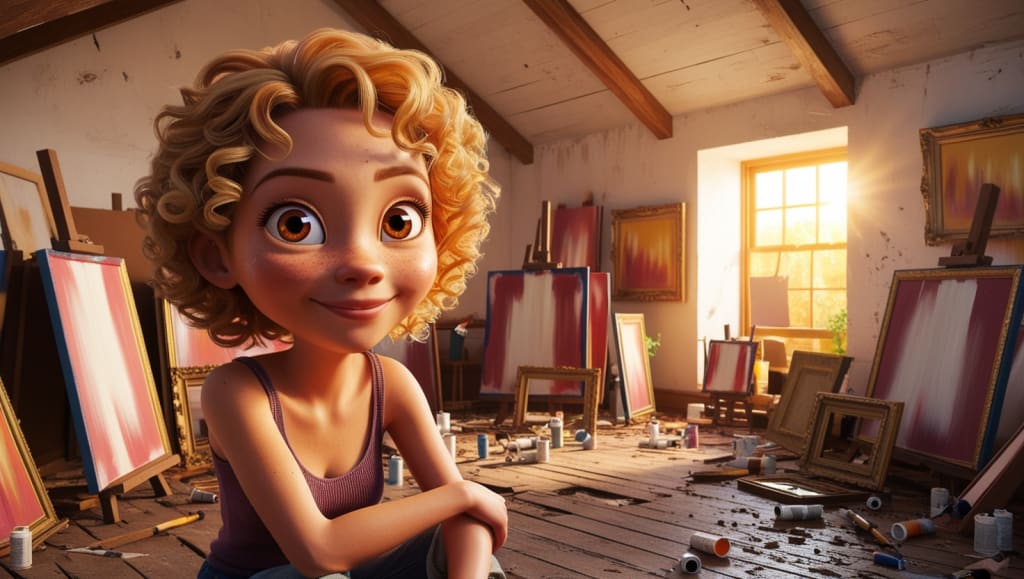
Elena never meant to sell the first one.
It was a small canvas—just a girl under a red umbrella walking through a storm. She had painted it in the early days, when no one but the rain and her mother’s old piano knew how much her heart bled into the bristles of her brush.
She wasn’t painting for anyone then.
It was therapy, it was grief, it was remembering. That first painting held the shadow of her father’s last song, the smell of coffee in quiet winter mornings, the ache of absence no words could explain. She never thought it would end up on someone else’s wall.
But rent was due, and ramen only lasted so long. When the gallery offered her three hundred dollars for it, she said yes with trembling fingers.
She walked home that night feeling hollow.
The first sale sparked others.
A collector saw it. Then another. Then a boutique asked to hang her work in their front window. Within a month, six of her paintings were gone.
The money helped, yes. She finally paid off the heating bill, replaced her torn coat, bought real brushes instead of the ones in discount packs.
But with every sale, she felt a strange thinning. Like bits of her soul were being peeled off and shipped away, wrapped in brown paper and bubble wrap.
She didn’t say it out loud.
Artists weren’t supposed to complain when they got what they dreamed of. Recognition. Exposure. Sales.
But every time she looked at the blank spaces on her studio wall—where once color, memory, and meaning had bloomed—she felt like a museum losing its ghosts.
It was her grandmother who noticed.
“You stopped painting like yourself,” she said, gently stirring tea.
Elena looked away. “I’m just trying to make things people want.”
“People want truth,” her grandmother said, tapping the rim of her teacup. “Not copies of what they already own.”
That night, Elena opened her sketchbook and stared at the pages. They were clean. Too clean. The lines felt practiced. The chaos had been edited out.
She turned to the older pages, the ones from the first winter she moved out on her own. Pages that smelled like charcoal and tea. Pages that showed pain, but also wonder.
She remembered painting those moments barefoot, in silence, sometimes crying, sometimes laughing. She remembered painting for no one at all.
That was when the best work came.
But the world didn’t want truth, not anymore.
The gallery asked her to do more like the red umbrella girl. A series, they suggested. Variations. Commercial appeal.
She painted three copies, each a little more lifeless than the last.
They sold in a week.
Elena bought a better chair and a new set of oils. But she no longer dreamed in color. Her sleep felt like grayscale.
One afternoon, a message popped up in her inbox. A woman from Colorado. She said the first painting—the girl with the umbrella—saved her life. Said she kept it across from her bed and stared at it during chemo. It gave her hope.
Elena cried harder than she had in months.
She didn’t paint for a while after that.
Not out of sadness—but because she was trying to feel again.
She visited museums. She sat in parks and watched the wind move through trees. She listened to songs that once broke her heart.
Then, one evening, she started a new painting.
It had no plan.
It didn’t match any of her previous styles.
It was layered, messy, raw.
A boy floating in a lake under a blood-red moon. Fireflies in his hands. A bird stitched into his shoulder like a badge.
She didn’t show it to anyone.
She didn’t sell it.
She named it “What I Meant to Say.”
A few months later, her inbox filled again.
People wanted commissions. Wanted the “early Elena,” the emotion, the fire.
She said no to all of them.
She painted only when something burned inside her. Not for a market. Not for likes.
And slowly, the walls of her studio filled again.
Not with price tags.
But with pieces of herself.
Elena still sells her paintings—sometimes.
But only when she feels the piece is ready to be released.
Only when she knows it’s no longer hers.
Most, she keeps.
Not because she’s selfish.
But because they are stories she’s still living.
And some stories are too sacred to sell.
About the Creator
Keep reading
More stories from Abuzar khan and writers in Fiction and other communities.
The House with No Exit Plan
It was the kind of house no one remembered moving into. A corner lot wrapped in hedges that grew faster than they should, windows that caught the morning light just right, and floors that never creaked in protest. It looked ordinary from the outside—safe, even. But everyone who entered learned the same lesson:
By Abuzar khan6 months ago in Fiction



Comments
There are no comments for this story
Be the first to respond and start the conversation.