
The House with No Exit Plan
Some homes hold you not with locks—but with memories you can't leave behind.
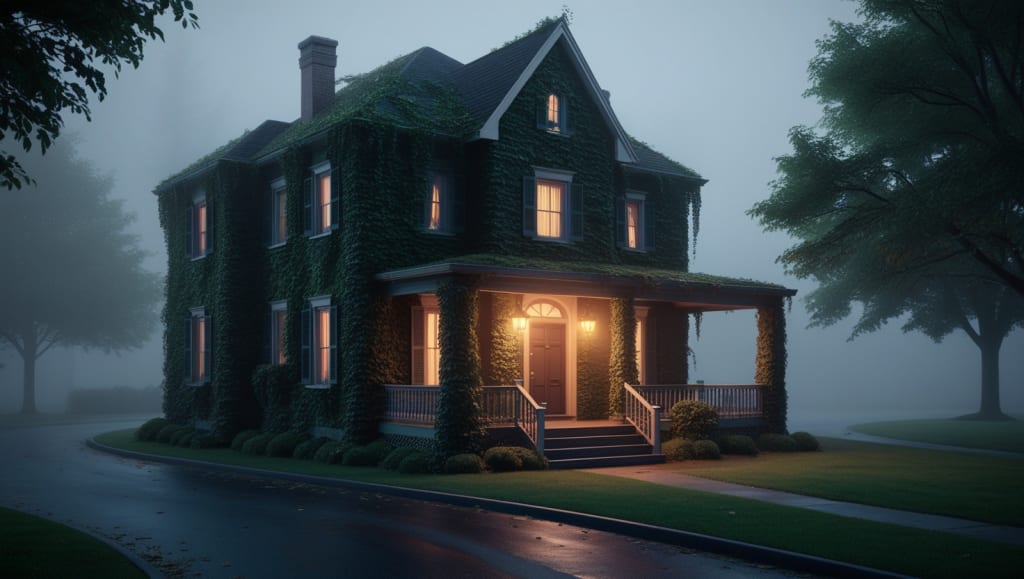
It was the kind of house no one remembered moving into.
A corner lot wrapped in hedges that grew faster than they should, windows that caught the morning light just right, and floors that never creaked in protest. It looked ordinary from the outside—safe, even. But everyone who entered learned the same lesson:
You could go in.
You just couldn’t leave.
I first saw it during a walk that went longer than I’d planned. One of those wandering days where your mind is more map than muscle, and your feet follow thoughts instead of roads.
The house stood at the end of a cul-de-sac I didn’t remember existing. There were no cars in the drive. No mailbox. But the porch light was on, though it was just past noon.
I should’ve kept walking.
But something pulled me forward.
Not fear. Not curiosity.
Something softer.
Like homesickness for a place I’d never lived.
The door opened as I reached the steps.
No one stood behind it.
Inside, the air was still and warm, like a room sealed off too long. The living room was neat—framed photos on the mantle, lace on the coffee table, a rocking chair facing the fireplace. The kind of space that tried too hard to seem lived-in.
I called out.
No answer.
But I stayed.
That’s how it begins, you know.
You don't decide to stay.
The house makes staying feel like not leaving.
The first thing I noticed was how it bent time.
You sit down for a moment, and three hours pass.
You blink, and the sun has set.
You go to the kitchen for water and return with memories.
Not just your own.
Others’.
Sometimes I’d hear a laugh I didn’t recognize echo from the upstairs hallway.
Sometimes I laughed with it.
I tried to leave on the third day.
I packed the satchel I’d arrived with—though I swear I hadn’t brought one—and walked to the door.
But there was no handle.
Just wood.
I checked the back.
The windows.
Nothing opened.
Nothing ever opened.
The house had become whole around me.
Still, it was never cruel.
It fed me.
Not with food, but with comfort.
Warm baths. Soft blankets. Familiar songs playing from nowhere. A fire crackling when the rain fell.
I forgot what cold felt like.
I started hearing the others.
Not clearly. Like whispers through layers of wallpaper.
One voice said, “I stayed for her. She never came back.”
Another: “I thought I could fix the house. But it’s not broken. I was.”
The third just wept.
On the eleventh day—or maybe the sixtieth—I found the basement door.
It hadn’t been there before.
There were no lights, but something tugged me down. The stairs felt like they stretched for miles, descending past the foundation, into something older than the house itself.
At the bottom: a single mirror.
Cracked.
In its fractured glass, I saw all the versions of me that wanted to stay.
And one version that didn’t.
I spoke to her.
“Why are you still here?”
She looked tired. Her eyes were sharp, though.
“You let the comfort convince you it was peace,” she said. “But this house feeds on forgetting. The more you forget what hurt you, the tighter it wraps around you. You’ll never be free if you keep giving it your loneliness.”
When I blinked, I was back in the living room.
The fire was cold.
The windows were boarded.
The furniture had faded.
The house no longer tried to impress me.
That night, I wrote a letter to myself.
A list of things I missed.
People I’d lost.
Regrets I’d swallowed.
I read it aloud in the upstairs hallway where the laughter used to echo.
It didn’t echo back.
Only silence.
A respectful one.
The next morning, the front door was open.
Just a crack.
Enough to see the sky.
I walked out without shoes.
The grass was wet.
The light burned my eyes.
The wind felt strange against my skin.
But I didn’t look back.
I didn’t need to.
The house doesn’t chase you.
It waits.
And maybe someday, someone else will walk too far.
Feel too tired.
Step inside without meaning to.
And the house will do what it always does:
Make them forget what leaving feels like.
About the Creator
Keep reading
More stories from Abuzar khan and writers in Fiction and other communities.
We Sat in Silence Until the Truth Finally Arrived
The café was quieter than usual that afternoon. Outside, a thin October rain slid slowly down the windows, blurring the city into soft gray shapes. Cars passed like distant whispers. The smell of roasted coffee beans hung warmly in the air, mixing with the faint sweetness of cinnamon pastries cooling behind the counter.
By Ihsanullah2 days ago in Fiction


Comments
There are no comments for this story
Be the first to respond and start the conversation.