
The Girl Who Planted Sunflowers in the Graveyard
"A Story of Grief, Growth, and the Light We Leave Behind"

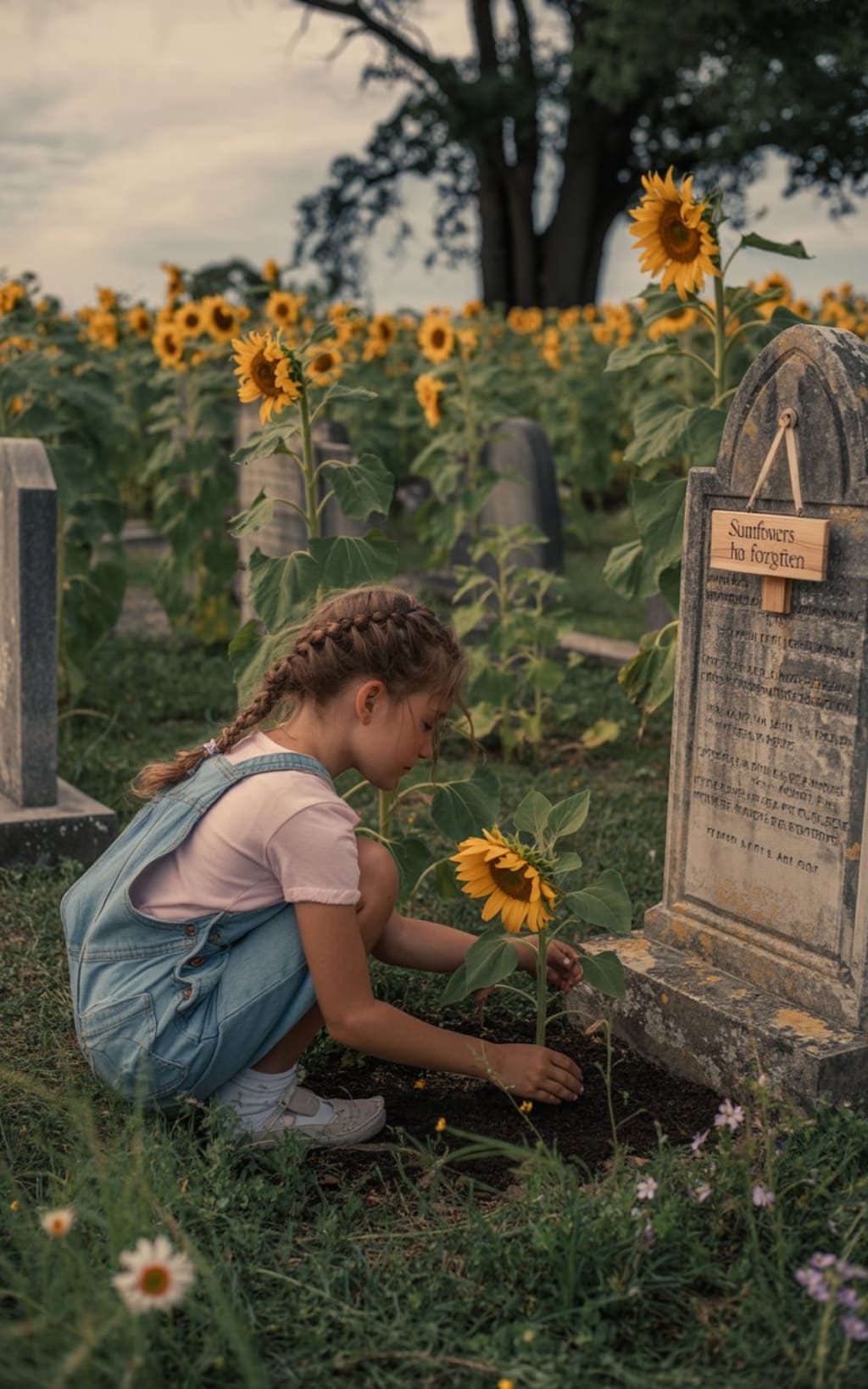
In a garden of graves, she planted hope.
Most people in town tried to ignore the graveyard.
It sat just off the main road, tucked behind the shuttered textile mill, surrounded by a rusted iron fence that hadn’t been painted since anyone could remember. The stones leaned like tired shoulders, many of them nameless, some split in half by frost and time. Nobody had been buried there in decades. Nobody visited—except her.
They called her the Sunflower Girl.
No one knew her real name. She never spoke much. A skinny girl with faded overalls, crooked braids, and a backpack that looked older than she was. Every Sunday, she walked up the hill with a trowel in one hand and a paper bag in the other. Rain or shine, sleet or sun, she came.
And every time, she planted sunflowers.
At first, people thought it was just a phase—like the girl who tried to start a goat yoga studio or the man who wore a sandwich board that said “Repent, The Frogs Are Coming.” Small towns are full of passing oddities. You smile, shake your head, and move on.
But she didn’t move on. And the flowers started to bloom.
By early summer, a patch of bright yellow burst like a spotlight between the gravestones. Then another. Then another. They were tall, impossibly tall—faces tilted to the sky, as if the sun were speaking and they were listening.
People slowed their cars. Some stopped. A local posted a photo on Facebook. It went viral—not Hollywood viral, but small-town viral. "Girl Plants Sunflowers in Abandoned Graveyard. Town Begins to Heal." That was the headline someone wrote.
No one was sure what was being healed, exactly, but it felt true.
I visited one day in late August, driven by curiosity and something else I couldn’t quite name. Grief, maybe. I’d lost my brother two years earlier and hadn’t visited his grave since the funeral.
The girl was there, kneeling by a crooked stone that said only MOTHER. 1913–1945. She wore gardening gloves and worked slowly, gently, as if the earth itself could bruise.
“Why sunflowers?” I asked.
She didn’t look up. Just shrugged. “They follow the light.”
I stood there awkwardly, unsure what I’d expected. Maybe wisdom, or weirdness, or a story about a dead relative. But she didn’t offer any of that. Just pulled a small envelope from her bag and held it out.
“Here,” she said. “You can plant one.”
Inside were sunflower seeds—black and striped, like little drops of night sky. I crouched beside her and pressed one into the soil.
From then on, I started coming back. Not every Sunday, but often enough. I wasn’t the only one. Soon, others joined. A retired teacher. A widower. A pair of middle school girls with rainbow shoelaces. Someone brought a hose. Someone else fixed the fence.
The graveyard changed.
It didn’t become less sad. Just... less empty. There was color now. Movement. Memory. Someone began making small wooden signs with names and dates, placing them near the gravestones that time had worn smooth. Someone else built a bench.
Nobody asked who the girl was anymore. It didn’t seem to matter.
Then, one day, she didn’t come.
The next week, she was still gone. And the week after that.
On the third Sunday, a note appeared, nailed gently to the old oak tree at the edge of the cemetery. It was written in blocky, careful handwriting:
"Thank you for remembering.
Keep planting.
Let there always be light."
That was all.
No signature. No explanation. But the message stuck.
We never saw her again.
But every spring, the sunflowers return. Every fall, someone collects seeds in small brown envelopes and leaves them in a basket near the gate. People still come—not just to visit, but to plant, to tend, to remember.
We call it the Sunflower Graveyard now.
It’s still a place of endings. But also of growth. Of beauty. Of quiet resurrection.
And somewhere among the sunflowers, there’s always a single, empty spot waiting—for someone new to plant a seed.
About the Creator
yasir zeb
best stories and best life
What Walter Never Reads
If you are reading this, it means Walter trusted you enough to let you step inside the broom closet. Or maybe he did not notice at all. Either way, welcome. My name is Holly, and this notebook is not meant for me anymore. It is meant for you.
By Salman Writes6 days ago in Fiction



Comments
There are no comments for this story
Be the first to respond and start the conversation.