
The Girl Who Painted the Sky Blue Twice
When art becomes a secret language with the heavens

Story
In the town of Alder’s Hollow, the sky was always perfect. Not in the way big cities claimed theirs was perfect after a storm, but truly perfect—endless blue, soft clouds, the kind of backdrop you’d expect in a painting rather than in life.
Most people thought it was just the charm of the place, a quirk of geography, or maybe a blessing from some ancient good luck. But there was one person who knew otherwise: Elara Wren, the girl who painted the sky.

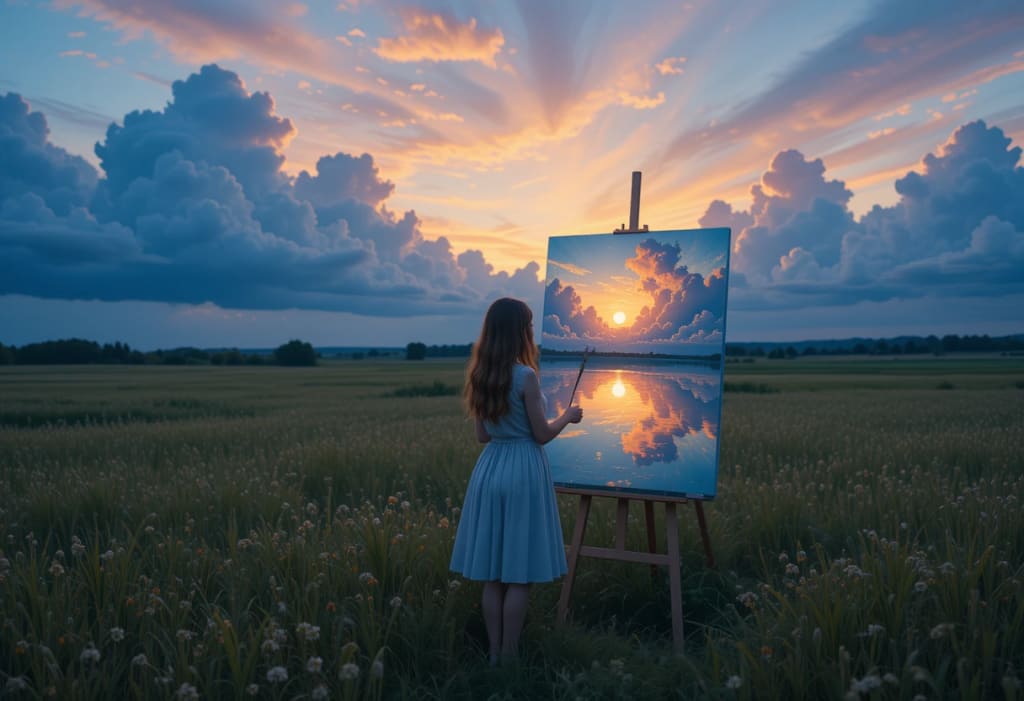
She was not a magician. Not exactly. She was a painter in the literal sense—easel, brushes, oil paints, and a habit of showing up before dawn to set up her canvas in the meadow just outside town. To anyone passing by, she looked like any other artist, lost in her work. But if you stood still long enough and really watched, you’d notice something strange. The clouds she painted were the clouds you saw above—exactly, down to the curve of their edges and the shadows they threw. And by the time the day ended, the sky itself had changed to match her finished work.
It was subtle magic, the kind that didn’t demand applause.
The townsfolk adored her paintings. She sold a few at the Sunday market, but most stayed with her, stored in her small attic studio, each canvas labeled with the date and the phrase: For the record.
Nobody knew why she was so meticulous. Nobody noticed that on certain days—days when the air was heavy and the horizon shimmered—Elara painted the sky twice.
It had started three years ago, the day she first saw it: a hairline crack in the blue, just above the hills, as if the sky were not infinite but painted on a fragile dome. Through the crack she glimpsed something vast and wrong—swirls of colors that didn’t exist in nature, shapes that shifted like living storms. And there were eyes.
Not human eyes, but something older. Watching.
She told no one. What could she say? That she’d seen reality peel back? That something behind it had noticed her?
Instead, she did the only thing that made sense to her—she painted over it. Not on the dome itself, but on her canvas, layering extra blue, adjusting the cloud formations, filling the fracture with light and softness. When she was done, the real sky above shimmered and smoothed, the crack vanishing like a bad dream.
From then on, whenever she saw another fracture, she repeated the process. Some days it was once in the morning. Other days, she would return in the afternoon, quietly painting again while the townsfolk thought she was just obsessed with detail. She became the quiet guardian of Alder’s Hollow, covering flaws in the firmament before anyone else noticed.
But the cracks were appearing more often now.
One autumn morning, she awoke to find not one but five fractures spread across the horizon, like scratches on glass. The shapes beyond were closer, pressing against the thin blue barrier.
Her hands trembled as she worked, mixing cerulean with cobalt, adding careful streaks of white. Each stroke closed one fracture, but the effort drained her. She painted until her arms ached, until her vision blurred.
By evening, the sky was whole again. But when she returned to her studio, she found a single drop of blue paint—not her paint—on her floor. It shimmered unnaturally, as if holding the memory of those impossible colors.
That night, she dreamed she was standing on the other side of the sky. There was no meadow, no town—just the vast shifting expanse, and the eyes. One spoke without words: You cannot keep painting forever.
Elara woke with the taste of cold metal in her mouth and a new crack already forming in the east.
She didn’t stop. She couldn’t.
The town never knew how close their mornings came to being torn open. They only knew that every day, the sky above Alder’s Hollow was the bluest they had ever seen. Sometimes, if you asked her why she painted so often, she’d smile faintly and say, “Some things are worth keeping beautiful.”
And if you looked closely at her paintings, at the faintest outline of the clouds, you might notice that in some of them, the blue was layered just a little thicker—as if hiding something underneath.
About the Creator
Keep reading
More stories from waseem khan and writers in Fiction and other communities.
LHS Class of 01 The Reunion
Megan lingered beneath the flickering string lights of the community hall, the hum of clinking glasses and half‑remembered laughter weaving around her like a familiar tapestry. She had arrived early, hoping the anonymity of the early hour would allow her to observe the shifting dynamics of the once‑tight circle without the pressure of an immediate greeting. The reunion was meant to be a celebration of the decade that had passed since graduation, a chance for old friends to reconnect, but for Megan it also represented an uneasy truce with the past—a past that still held the sharp sting of Valerie's betrayal when she had spread rumors that nearly ruined Megan’s time at Lincoln. As she scanned the room, a sense of quiet anticipation settled over her, a feeling that something, or someone, would soon disturb the fragile equilibrium she had painstakingly built.
By Forest Greenabout 18 hours ago in Fiction
Top tipple tricks
Been thinking a lot about drinking, lately. Not least because of a recent episode of over-indulgence and the inevitable after effects. Some readers may recall the earlier articles I wrote about beating the booze. Here I set out an experiment in techniques for cutting down on my alcohol intake. The experiment was successful, the techniques worked, and I have armed myself with an arsenal of weapons in the war against the demon drink. I have yet to fire the first round however. It's all a question of timing (perhaps procrastination).
By Raymond G. Taylor6 days ago in Psyche



Comments
There are no comments for this story
Be the first to respond and start the conversation.