

Chapter 3: The Researcher
Rockhaven University's faculty archives were a labyrinth of forgotten research and abandoned academic pursuits. Sarah had spent three hours digging through personnel files, her frustration mounting with each dead end. Professor Eleanor Hayes—once a respected researcher in temporal anthropology—had seemingly vanished from academic circles as completely as the passengers of the Ghost Train.
Dr. Nauterlly's words from earlier echoed in her mind. "Hayes was brilliant, but her research became... controversial. Academic suicide, they called it." The forensic chemist had been reluctant to provide more details, warning Sarah that pursuing Hayes's work might lead her down a dangerous path.
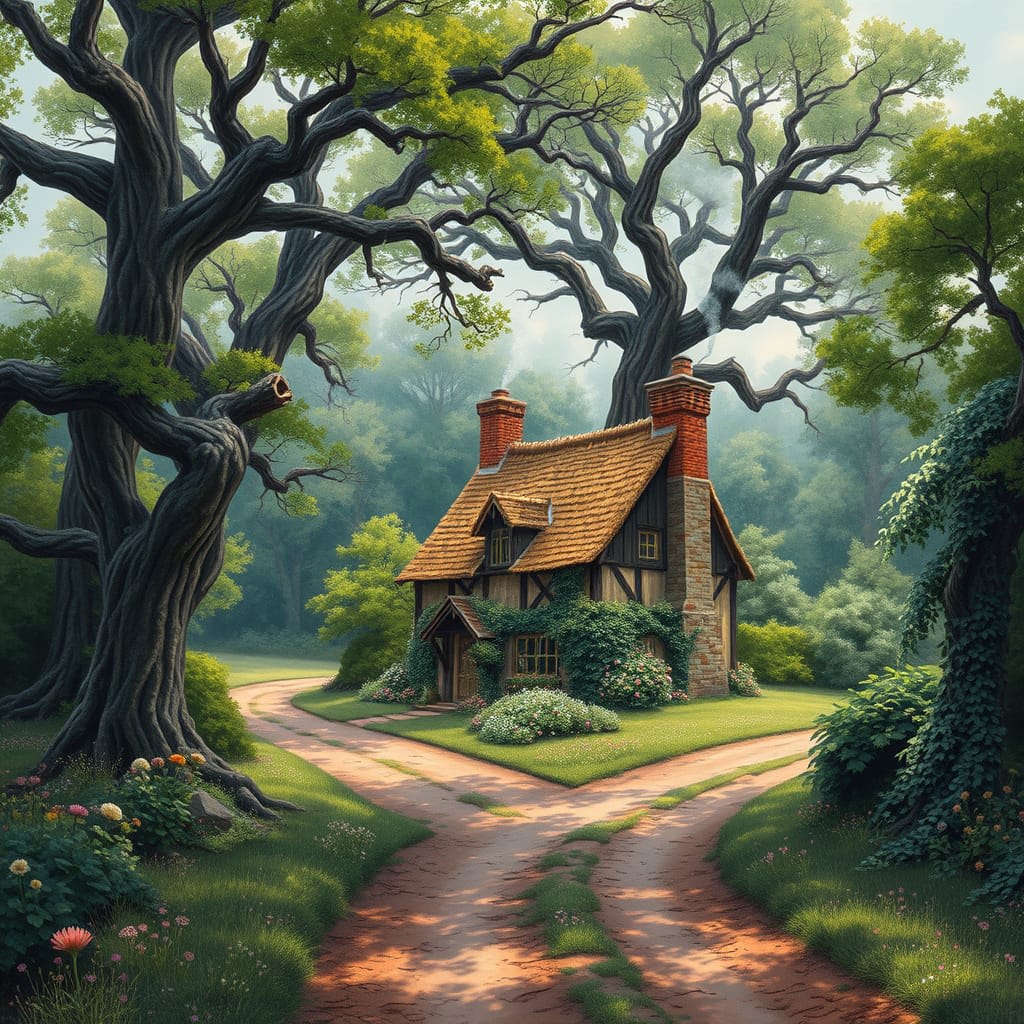
The final file drawer yielded something unexpected. A forwarding address, nearly obscured by a faded stamp, showed a location just outside Rockhaven's city limits. A small cottage in the Silverwood neighborhood—an area known for its dense forests and isolation.
Sarah's GPS led her down a winding road that gradually became less maintained. Dense pine trees pressed close to the narrow street, creating a tunnel of green that seemed to swallow any trace of the city behind her. The cottage appeared suddenly, almost emerging from the forest itself—a weathered structure of gray wood and stone, surrounded by overgrown gardens and rusted wind chimes.
Before she could knock, the door opened.
Professor Eleanor Hayes was not what Sarah expected. Far from the disheveled academic she'd imagined, Hayes was a woman in her late fifties with sharp, intelligent eyes and a posture that suggested military training. She wore a crisp white shirt and khaki pants, looking more like an expedition leader than a discredited researcher.
"Sarah Mathews," Hayes said before Sarah could introduce herself. "Rockhaven PD forensic analyst. You're investigating the Thornwood Station disappearances."
It wasn't a question.
"How did you—" Sarah began.
"I've been expecting someone to come asking questions," Hayes interrupted, stepping back. "Come in. But touch nothing."
The cottage interior was part library, part museum. Every wall was covered in bookshelves, maps, and strange diagrams. Photographs showed impossible landscapes—cities with architecture that defied known design principles, landscapes that seemed to blend geological eras, scenes that looked both ancient and futuristic.
"You're researching the Ghost Train," Hayes stated, moving to a large oak desk covered in meticulously organized documents.
Sarah chose her words carefully. "I'm investigating missing persons cases connected to Thornwood Station."
A dry chuckle escaped Hayes. "Diplomatic. You're skeptical. Good. Skepticism is the first line of defense against accepting impossible truths."
She pulled out a leather-bound journal, its pages yellowed and edges carefully preserved. "What do you know about liminal transit phenomena?"
"Nothing," Sarah admitted.
"Precisely the problem," Hayes said. "Liminal spaces are transitional areas. Thresholds between what is and what could be. Most people pass through them without noticing. But some spaces—some vehicles—exist specifically to traverse these boundaries."
She opened the journal, revealing handwritten accounts and photographs that made Sarah's forensic training war with her growing curiosity. Detailed descriptions of train journeys that described impossible destinations: a city built entirely underground, with streets carved into massive crystal formations. A coastal landscape where multiple suns hung in a lavender sky. Forests where trees seemed to breathe and move like living creatures.
"These are fabrications," Sarah said, but her voice lacked conviction.
"Eyewitness accounts," Hayes corrected. "From passengers who returned. Not all who board the train remain in... other places."
Sarah recognized one of the photographs. The young woman from Thornwood Station—the one she'd watched board the train just two nights ago—was pictured standing in front of a massive stone structure that looked simultaneously like a cathedral and a geological formation.
"How did you get this?" Sarah demanded.
Hayes tapped a complex chart on her wall. It looked like an intricate combination of lunar calendars, geological survey maps, and what seemed to be electromagnetic field readings. "The train doesn't appear randomly. It follows specific patterns. Gravitational anomalies. Lunar cycles. Moments when the boundaries between realities become permeable."
"You're talking about a train that travels between realities," Sarah said flatly.
"I'm talking about a transit system that exists outside conventional understanding of space and time," Hayes corrected. "The train doesn't just move through space. It moves through possibilities."
From a locked drawer, Hayes pulled out a set of documents—research grants, academic publications, peer review comments. Sarah could see the progression: early respect, growing skepticism, final professional rejection.
"They called me mad," Hayes said quietly. "But I have proof."
She handed Sarah a set of crystalline samples—identical to those Sarah had found at Thornwood Station.
"These are fragments collected from potential transit points," Hayes explained. "Molecular structures that shouldn't exist in our current understanding of physics. Proof that something moves between our reality and others."
Sarah's professional training battled with the evidence before her. The samples were scientifically impossible—yet undeniably real.
"The train will appear again," Hayes said suddenly. "In three days. During the next lunar cycle."
"How can you be certain?"
Hayes pointed to her complex chart. "Because some systems are more predictable than humans want to believe. Even systems that seem impossible."
Sarah studied the chart, her forensic training battling with her growing fascination. "These calculations," she said, tracing her finger along a series of intersecting lines and lunar phase notations, "they're incredibly precise."
Hayes nodded, a hint of pride breaking through her academic detachment. "Thirty years of research. Each line represents a potential transit point—moments when the boundaries between realities become permeable." She tapped a series of dates circled in red. "These are confirmed Ghost Train appearances. Not just at Thornwood, but globally."
"Globally?" Sarah's eyebrow raised.
"Munich, 1938. Buenos Aires, 1967. Tokyo, 2001. Always at midnight. Always on a new moon. Always leaving behind those same crystalline fragments." Hayes pulled out a small wooden box, opening it to reveal dozens of similar samples to those Sarah had found at the station.
"Why?" Sarah asked. "Why these specific moments? These locations?"
Hayes's expression darkened. "That's the question that cost me my academic career. The train doesn't just transport people. It... selects them. Passengers who vanish aren't random. They're chosen."
She pulled out a photograph—a group of people standing beside the silver train, their clothing spanning different decades. "Look closely," Hayes instructed.
Sarah leaned in. Each passenger seemed slightly out of place—a woman in 1940s attire standing next to a man in modern clothing, a child wearing what looked like industrial-era work clothes.
"Temporal refugees," Hayes said softly. "People who don't quite fit in their own time. The train finds them. Offers them a way out."
Before Sarah could respond, Hayes's demeanor shifted. She gripped Sarah's arm, her eyes suddenly intense. "The train is coming again. In three days. And this time, you need to be prepared."
"Prepared for what?" Sarah asked, a chill running down her spine.
Hayes walked to a locked cabinet, retrieving a worn leather satchel. "If you're truly investigating these disappearances, you'll need more than your forensic training. You'll need to understand that some boundaries aren't meant to be crossed—and some are impossible to prevent."
Sarah watched as Hayes carefully packed the satchel—old photographs, a compass that seemed to spin without direction, several of the crystalline samples, and a small leather-bound journal.
"Take this," Hayes said, holding out the journal. "It contains accounts from passengers who've returned. Not all of them, but enough to show you this isn't a simple missing persons case."
Sarah hesitated. Professional protocol screamed at her not to accept unverified evidence. But something in Hayes's eyes—a mixture of warning and hope—made her reach out.
As her fingers touched the journal, the room seemed to shimmer slightly. For just a moment, Sarah could have sworn she saw another version of the cottage—different furniture, different lighting, as if the space itself was uncertain of its own existence.
Then the moment passed.
As Sarah prepared to leave, Hayes added one final note. "Be careful, Ms. Mathews. Some mysteries are better left unexplored. And some journeys, once begun, cannot be easily stopped."
The cottage seemed to fade into the forest behind her as Sarah drove away, her mind racing with impossible possibilities.
The Ghost Train was real. And it would return in three days.
The question was: would she be ready?
About the Creator
Shane D. Spear
I am a small-town travel agent, who blends his love for creating dream vacations with short stories of adventure. Passionate about the unknown, exploring it for travel while staying grounded in the charm of small-town life.
Keep reading
More stories from Shane D. Spear and writers in Fiction and other communities.
The Ghost Train
Chapter 2: The Pattern Emerges The crystalline samples gleamed under the microscope's harsh light, their structure unlike anything Sarah had seen in her eight years as a forensic analyst. She adjusted the magnification, watching as the intricate patterns shifted and refracted light in ways that defied conventional crystallography.
By Shane D. Spear10 months ago in Fiction



Comments (1)
Nice work. I really enjoyed this story. Keep up the good work.