
The Gallery’s Secret Part II
Some paintings aren’t meant to be admired—they’re meant to remember.
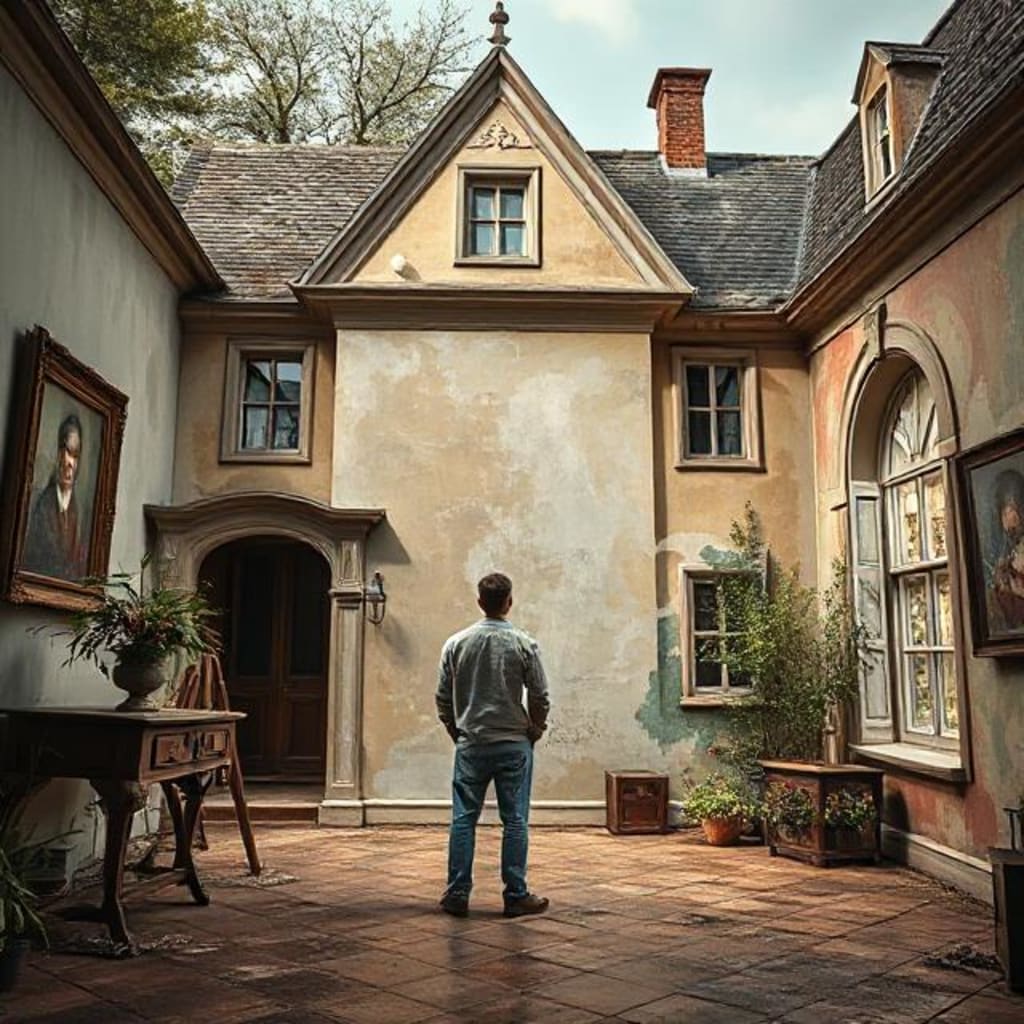
The gallery was quiet after closing hours.
The security lights cast long silver lines across the marble floor, and the faint hum of the air conditioner echoed like breathing.
In the center hall, under a soft pool of yellow light, hung the most famous piece in the collection—
The Painter’s Last Dream.
Tourists came from cities and countries away to see it.
Art critics called it “a psychological masterpiece.”
Mystics called it “a door.”
To Leah Morgan, the new night curator, it was simply… unsettling.
She’d worked at many galleries, but this one had a weight to it—a stillness that pressed against the ribs, as if the air carried secrets.
The first night she was alone, Leah walked her inspection route with her flashlight. The usual routine: lock checks, temperature readings, security logs.
When she passed The Painter’s Last Dream, she stopped.
Elias’s face seemed different tonight.
Not just expressive—alive.
His eyes, once soft and melancholy, now appeared wide open, almost pleading.
Leah frowned. She turned off her flashlight and rubbed her eyes. When she looked again, his expression had returned to normal.
“Okay,” she muttered. “Too much coffee.”
Still, as she walked away, she could feel his painted gaze following her down the corridor.
That night, Leah dreamt she was standing inside the painting.
The mansion loomed around her, the air thick with turpentine and candle smoke.
Somewhere in the distance, a brush scraped across canvas.
When she turned, she saw Elias, painting in silence. His hand trembled.
“Don’t wake me,” he whispered without turning around.
Leah stepped back. “Who are you?”
“The painter,” he murmured. “And the painting.”
Then his brush dripped—thick, red.
When Leah woke, her heart was pounding, and her bedsheet bore a faint streak of crimson.
She tried to rationalize it the next morning.
“Dreams bleed into memory,” she told herself. “You read about him before bed.”
But when she returned to the gallery that night, she noticed something she couldn’t explain.
A new brushstroke had appeared in the painting.
It wasn’t there before—she was certain.
A single red line across the floor near Elias’s feet.
“Restoration effect, maybe?” she murmured. But she knew restorations weren’t scheduled.
She leaned in close, inspecting the paint’s texture. It was fresh—still glossy, still smelling faintly of linseed oil.
Someone had added to it.
But who?
Over the next week, small changes appeared daily.
The shadows in the painting shifted.
The candle’s flame flickered between nights.
And one evening, Leah noticed something that made her freeze:
In the far background—behind Elias’s shoulder—a new figure was forming.
At first, it was just a blur of grey.
But with each passing night, it became clearer.
A woman, standing by the window.
A woman who looked exactly like her.
Leah began researching the painting’s history obsessively.
The artist, Elias Whitmore, had vanished decades ago while working in an abandoned mansion north of the city. Locals believed his spirit haunted the estate. The artwork was discovered years later—its paint still wet.
But there was another story.
One rarely mentioned.
According to a private note found in the gallery archives, every curator assigned to guard the painting had left within a month.
One went missing.
One was committed to an asylum after claiming “the painting breathes.”
And one—an older man—had died of a heart attack standing right in front of it.
Leah stared at the reports in disbelief. “Coincidences,” she whispered. “All of them.”
But when she turned back toward the hall, she saw something that made her blood run cold.
The woman in the painting—the one who looked like her—was now closer.
Almost touching Elias’s shoulder.
The next few days blurred together.
Leah began skipping meals, staying overnight to “observe.”
She would sit for hours in front of the painting, notebook in hand, documenting every tiny change:
“Candle taller by 2cm.”
“Elias’s hand turned slightly right.”
“My figure—eyes visible now.”
Her coworkers noticed her pale face and restless hands. “You should take a break,” one of them said.
Leah smiled weakly. “You can’t take a break from art.”
That night, when everyone left, she whispered to the painting, “What do you want from me?”
The air in the gallery seemed to shiver.
And from the silence came a faint echo—like the sound of a brush stroke, sliding through wet paint.
Leah’s dreams became darker.
The mansion returned—this time older, sadder, whispering through its broken windows.
Elias was there again, standing before the same canvas. But this time, he turned. His eyes were hollow, his smile broken.
“I borrowed time,” he said softly.
“You shouldn’t have come.”
Leah tried to back away, but her feet sank into wet paint. It spread around her ankles like blood.
“Please,” she gasped. “I just want to help you.”
Elias raised his brush. “Then stay.”
When she screamed, he dipped the brush into the darkness and began to paint her face.
The next morning, the gallery director found Leah sitting in front of the painting—silent, pale, her eyes glassy.
“Leah? Are you all right?”
She didn’t respond.
Her fingers were covered in red paint.
And on the canvas—on The Painter’s Last Dream—her figure now stood fully visible beside Elias.
No one could explain it.
No one saw anyone enter or alter the painting.
Security footage showed Leah sitting motionless for hours, the lights flickering occasionally.
But during one flicker, just for a fraction of a second, she was gone.
And then—back again.
Epilogue
Months later, a new curator was hired.
A young man named Arif, quiet and kind-eyed.
During his first night shift, he paused before The Painter’s Last Dream.
Two figures now stood side by side:
Elias—the painter—and Leah, the woman with gentle eyes.
Both smiling faintly, holding brushes.
Both facing the same unfinished canvas within the painting.
Arif tilted his head.
Had there always been a third silhouette behind them?
It was faint, almost invisible.
But it stood in the same posture as him.
He laughed nervously and turned to leave.
As he did, the sound of soft brushstrokes followed him down the hall.
About the Creator
Ghanni malik
I’m a storyteller who loves exploring the mysteries of human emotions — from kindness and courage to fear and the unknown. Through my words, I aim to touch hearts, spark thoughts, and leave readers with a feeling they can’t easily forget.
Keep reading
More stories from Ghanni malik and writers in Fiction and other communities.
The Gallery’s Secret
The mansion stood at the edge of the world—or at least that’s what Elias liked to say. Once a grand estate, now only the wind knew its name. The roof had caved in like a sigh, vines grew through the cracked marble floors, and every step echoed as if the house itself were breathing.
By Ghanni malik3 months ago in Fiction
Day 4 of Quitting
If this is how sobriety feels, maybe it’s better to go through life a little buzzed… this, along with other hits like, I want to kill myself, I wish I was dead, and I’m going to throw myself off a bridge have been the only thoughts on rotation these past few days. I promise myself that if, in a month, I still feel like this (‘this’ meaning despondent, full of rage, and simultaneously numb) I can go back to smoking. Until mid-February though? Nicotine is off the table.
By sleepy drafts5 days ago in Longevity




Comments
There are no comments for this story
Be the first to respond and start the conversation.