
The Gallery’s Secret
Some paintings aren’t meant to be admired—they’re meant to remember.

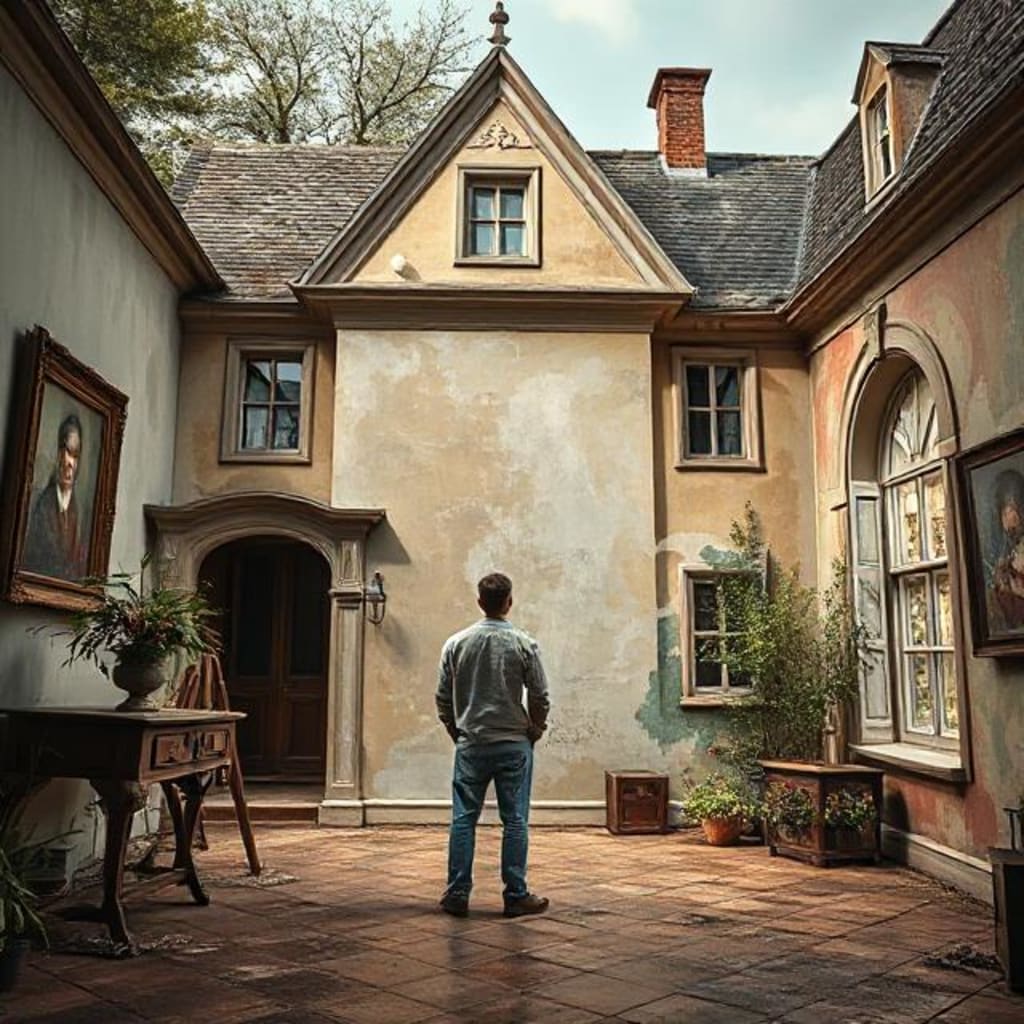
The mansion stood at the edge of the world—or at least that’s what Elias liked to say.
Once a grand estate, now only the wind knew its name. The roof had caved in like a sigh, vines grew through the cracked marble floors, and every step echoed as if the house itself were breathing.
Elias wasn’t afraid of old places. He was a painter, and painters, he believed, lived halfway between the living and the dead anyway.
He came here every evening with his easel, his worn bag of brushes, and a bottle of cheap wine. The mansion was the only place where he could paint without hearing the city’s noise, its laughter, its pity. No one came this far out anymore. Only he did.
The first night, he set his canvas near a tall, broken window where moonlight spilled in like water. He painted what he saw—dust, light, shadows, and the faint outline of a staircase that led nowhere.
When he stepped back, something unsettled him.
The painting looked right—every shadow in place—but in the corner of the canvas, he could swear there was a figure. Faint, almost invisible, standing by the stairs.
He brushed it away, telling himself it was his imagination.
But when he looked again, it was still there.
The next day, Elias returned. The same spot. The same silence.
This time, he painted the room from another angle—the torn curtains, the half-broken chandelier.
Halfway through, he felt something behind him.
He turned quickly. Nothing.
Just the heavy air, the peeling walls, and that strange stillness that made him feel like he was being watched.
When he looked at his painting again, he froze.
There were now two figures.
Both faint, both in shadow.
And neither of them had faces.
He packed up immediately, his hands trembling. That night, he couldn’t sleep. His dreams were filled with whispering colors—reds that spoke, blues that screamed, and greys that seemed to crawl off the edge of his bed.
By the fourth night, Elias was obsessed.
He couldn’t stop thinking about the mansion—about what the paintings were trying to tell him.
He returned again.
But this time, when he entered, he noticed something new.
A long mirror, dusty and cracked, leaned against the far wall. He hadn’t seen it before. He wiped it with his sleeve and stared.
For a moment, he didn’t recognize the man staring back. His reflection looked older, more hollow.
Behind him, in the reflection, the two faceless figures stood perfectly still.
He turned around. The room was empty.
When he looked back into the mirror, they were gone.
Elias began painting feverishly. Days blurred into nights. He stopped eating. The house became his world. Each new canvas revealed more of the story the mansion seemed desperate to tell.
One night, the storm came. The roof shook, lightning illuminated the walls, and for a brief flash, he saw words written across the cracked plaster:
“We remember you.”
The thunder drowned his breath.
He stumbled backward, nearly knocking over his easel.
“We remember you.”
He pressed his palm against the wall where the words had been. When the lightning struck again—they were gone.
In the days that followed, the faces in his paintings began to appear—slowly, faintly.
He painted without realizing whose faces they were, until one night, as candlelight flickered across the fresh canvas, he saw himself among them.
There he was, standing beside the faceless figures, half in shadow, half in color.
Elias dropped his brush.
He backed away from the painting, shaking his head.
“No… no, that’s not me.”
But deep down, he knew.
He remembered the stories—the rumors about the mansion’s painter, decades ago, who vanished while working on his final masterpiece. The same painter whose last name he shared.
He had always thought it was coincidence.
Now he wasn’t so sure.
The next morning, Elias tried to leave. He packed his brushes, his paints, his half-finished canvases. But as he reached the doorway, the light shifted strangely.
The hallway stretched longer than before.
Every door he passed opened slightly—just enough to show a glimpse of old portraits inside. Portraits that looked alive.
He ran.
The mansion seemed to twist around him, folding in on itself. Rooms rearranged. Stairs looped back to the same floor.
By the time he reached what should’ve been the front door, he found only another wall—covered in dozens of his paintings.
All of them different. All of them showing him painting inside the mansion.
And in each, the background figures stood closer.
He screamed, slamming his fists against the wall until the canvases ripped, revealing more paintings behind them—an endless series, like mirrors reflecting forever.
Then he saw the latest one.
Fresh. Wet paint.
In it, he stood exactly where he was now, one hand on the wall, terror in his eyes.
And behind him—something moved.
He turned.
Nothing.
He laughed then—a hollow, broken sound. “So this is it,” he whispered. “You’ve painted me too.”
He picked up his brush again, dipped it into the paint, and with trembling strokes, began adding himself into the final scene.
When the last line was done, he smiled faintly.
The figures in the painting smiled back.
Weeks later, hikers found the mansion.
They said it was silent except for the faint sound of wind brushing across the halls.
Inside, they discovered a single painting propped against the wall—unfinished, but beautiful.
It showed a young man painting by candlelight. His eyes were calm, almost peaceful. Behind him, ghostly silhouettes seemed to watch with quiet reverence.
The hikers didn’t notice that the man’s brush was still wet with paint.
Epilogue
Years passed. The mansion was restored and turned into a small gallery. The painting of Elias became its centerpiece—“The Painter’s Last Dream.”
Visitors often said it felt alive. Some swore the shadows in the background shifted when no one looked. Others said the man’s expression changed from calm to sad when they turned away.
But art critics loved it. They said it was a masterpiece about the line between creation and madness.
They were half right.
Because sometimes, late at night, when the lights of the gallery dimmed—
a faint sound of a brush moving across canvas could still be heard.
And if you stood very still,
you might see a man step out from within the painting,
look at his hands,
and disappear again into the frame.
About the Creator
Ghanni malik
I’m a storyteller who loves exploring the mysteries of human emotions — from kindness and courage to fear and the unknown. Through my words, I aim to touch hearts, spark thoughts, and leave readers with a feeling they can’t easily forget.
Keep reading
More stories from Ghanni malik and writers in Fiction and other communities.
The Hunter in the Mist
The forest road was golden that evening — washed in dying light, leaves whispering like old secrets. Jonas Vale, a solitary hunter, had walked these woods for twenty years. He knew every broken branch, every deer track, every breath of wind.
By Ghanni malik4 months ago in Fiction
Magic
Note from the Author: I want to let you know that this is an unusual story, and it has been written purely from whatever is in my unconscious mind, because before I start writing, I get into a flow state that reaches my unconsciousness. I also write in my subconscious mind, which is like a mid-flow state between the conscious and unconscious mind.
By Denise Larkin7 days ago in Fiction
Insulated From the World
I left for the coast with the deliberate intention of thinking about nothing. For six months, I had been living inside spreadsheets, conference calls, and the ambient anxiety of markets that refused to behave. My mind had become a clenched fist. I needed sun, salt air, and the mental equivalent of white noise. The resort promised exactly that—an insulated enclave on a turquoise edge of a warm sea. The brochures used the word “sanctuary.” Friends preferred “completely safe.” The website assured visitors that the property was buffered from the “regional complexities” affecting other parts of the country.
By Anthony Chan3 days ago in Fiction


Comments
There are no comments for this story
Be the first to respond and start the conversation.