

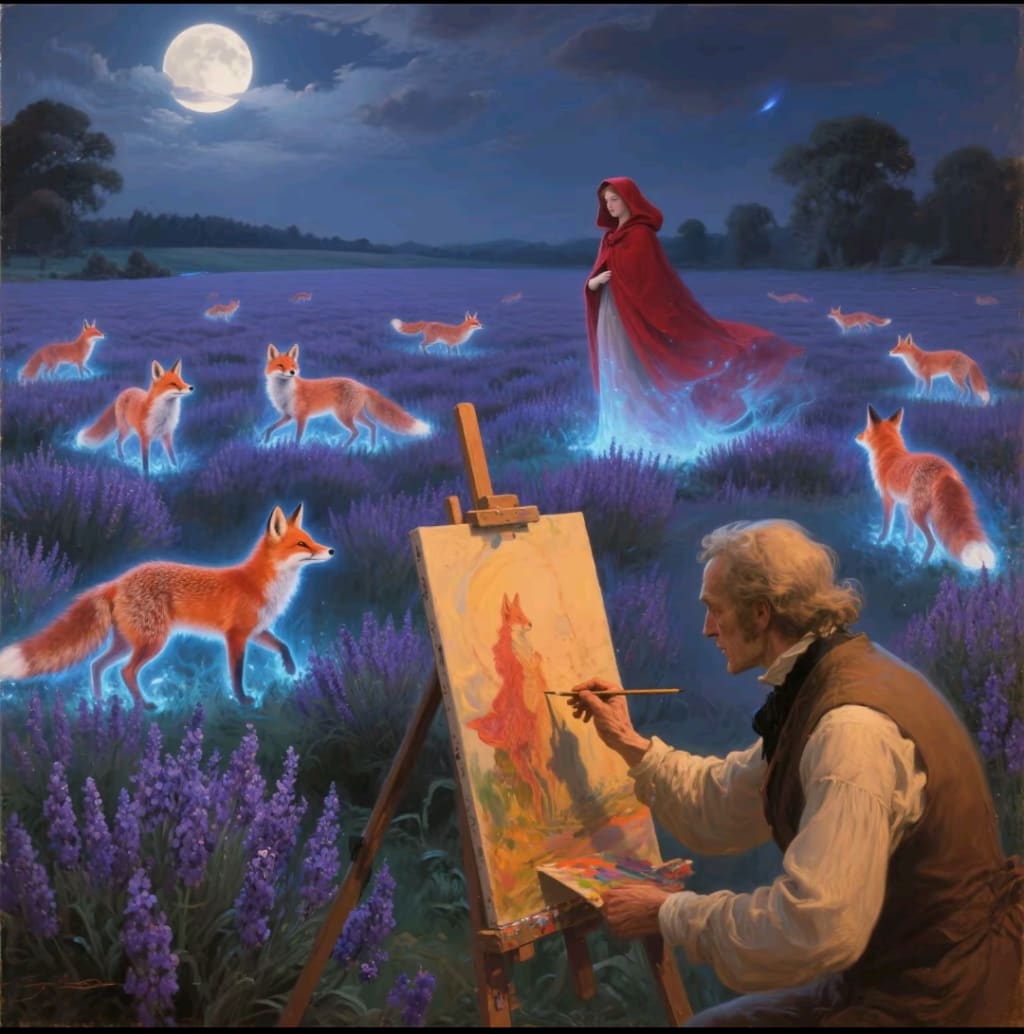
In the small town of Innsbruck, nestled at the foot of the Alps, there lived a peculiar painter named Edmund Gray. He did not paint church spires or shepherd girls, but was completely obsessed with painting foxes. The townsfolk often said that there was a fox living in Gray’s eyes—whenever he gazed at the forest, his grey-green pupils would gleam with a mischievous golden light.
One misty evening, Gray ran into Old John, a hunter, deep in the pine forest. The rough man was dragging a small, fiery-red fox by an iron chain, its hind legs mangled and bloodied from a trap. "Five gold coins, and this beast is yours," the hunter grinned, revealing yellowed teeth. Gray searched his pockets, and in the end, even pawned his pocket watch to buy back the trembling creature's life.
While the fox healed, it would dip its tail in ink, leaving paw prints in the shape of plum blossoms on Gray's sketchbook. One night, as Gray drifted between sleep and wakefulness, he heard a silvery voice: "If you set me free, I'll give you a miracle." The next morning, the studio window was wide open, and all that remained where the red fox had been was a few golden strands of fur.
The true miracle began on the night of the full moon. Suddenly, in Gray’s backyard, a dozen or so foxes appeared, frolicking and chasing one another among the lavender bushes, their fur outlined in silver-blue moonlight. The lead fox, especially lively, would occasionally nudge over a paint can with its nose, or bring dewy wild roses to place by Gray's palette.
But the fox paintings didn’t sell. The pious townspeople were certain they were the work of the devil, until a lady in a scarlet cloak appeared.
"They resemble burning flames," she said softly the first time she bought a painting, the scent of pine needles rising as her velvet gloves brushed against the canvas. From then on, every Thursday afternoon, she would buy two paintings, her silk coin purse embroidered with a family crest, the sound of gold coins clinking like the chime of church bells.
"Who exactly are you?" Gray asked, one time, as he gripped a painting frame. A light laugh came from beneath the scarlet cloak. "What if I told you... I am a mountain spirit?" As she turned, Gray caught a glimpse of the cloak's lining, sewn with purple silk from the church’s confession booths.
She began visiting the studio often, humming ancient folk songs as Gray mixed his paints. Once, he pretended to casually touch the back of her hand—it was as cold as a pebble in a melting snow stream.
Disaster struck suddenly, as abrupt as a landslide. In the town square, on the gallows, Gray watched helplessly as the executioner tore away her scarlet cloak. In the morning light, the townspeople finally saw the true face of the "Countess"—it was Margaret, the star singer of the Rose Tavern, who had disappeared three months prior.
"She always said..." sobbed the tavern owner, clutching a faded performance poster, "that once she saved enough money to buy her freedom, she'd open a proper art gallery..." As the noose tightened, Gray saw the frozen smile on her lips, a smile that resembled the sly curve of the foxes in his paintings.
That night, eerie blue flames consumed the mayor’s mansion. Firefighters found a half-burned paintbrush among the ashes, the handle etched with tiny claw marks. And in Gray’s studio, all the foxes' eyes had turned the same cornflower blue as the singer's, and in the corner of the canvas, unknown to him, a small inscription had appeared:
"Those who believe in miracles will eventually become miracles themselves."
About the Creator
Ellen Lee
One Story a Day
Keep reading
More stories from writers in Fiction and other communities.
Self Help: Grifters' Gospel
On Self-Help, Snake Oil, and the Illusion of Change Psychology professionals and students can be imagined on two opposite sides of a line called self-help books: likely a larger group opposes pop-science and step-by-step manuals filled with talk of success, journaling, and not giving a f**k; others love them, but they aren’t many.
By Avocado Nunzella BSc (Psych) -- M.A.P 6 days ago in BookClub



Comments
There are no comments for this story
Be the first to respond and start the conversation.