
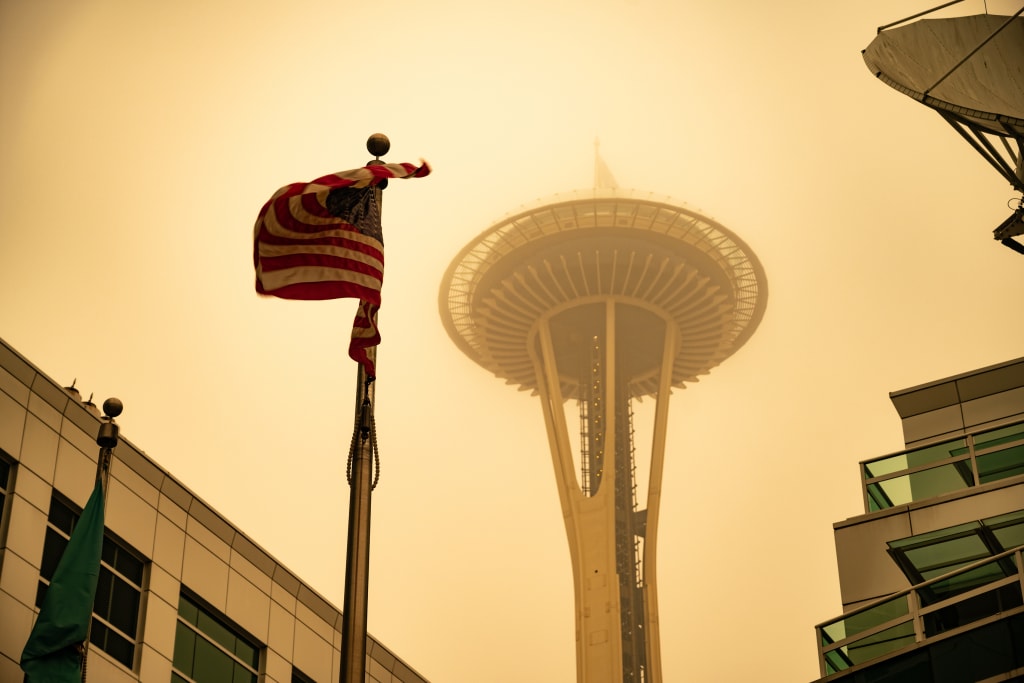
Hani’s lungs burned. She and her mother had been running for eight blocks now in the acrid Seattle air, through the barely perceptible gray haze, now cresting the hill near Harborview hospital. Her mother, Sagal, shambled behind her, her dark blue peacock-themed baati flowing around her as she moved and tugging at the garbasaar around her shoulders as it slipped loose. Only her head scarf, her shash, stayed in place. Sagal always meticulously wrapped and pinned it in place before she left their musty, dated two-bedroom apartment in the Central District.
“[Come on, mother]! You’re a slowpoke! [We have to keep going]!” Hani spat at her mother in a mixture of Somali and English, carefully choosing her mother’s favorite English slang for emphasis. Hani glanced back and saw the early afternoon sky to the east glowing the hauntingly beautiful orange of a dust storm sunset. That made her think of her cousins in Arizona, whom she’d visited a few years before when she was eleven. She wondered if they were still alive. Pillars of gray and black smoke rose and combined in morbid, gaseous, ephemeral architecture, constructing the supports of some godly mansion. But those creations were just as easily torn to drifting shreds by the violent, scorching winds that swept down through the streets and threatened to rip Hani’s loose, hastily-tied shash from her head, as it had many times since they’d fled their apartment.
To Hani’s left, she saw ambulance crews and cops and firefighters loading up their rigs, their shouts arriving formless at her ears as only the chaotic barking of emergency and animal fear. One ambulance crew screeched off, lurching up on the curb and turning around to flee downhill towards the waterfront. They had loaded no one in the back. She looked up and the lights of the high rises in the hospital towers flickered. Her aunt, a certified nursing assistant, had told her that hospitals had backup generators. Maybe something was wrong with Harborview’s.
The shouting grew in pitch and intensity. Near the covered driveway entrance to the emergency room, a big, burly white cop with a filtered dark blue face mask flexed his bulging arms in front of him, clenching his fists, and got up in the face of short Latin firefighter who was built like a gymnast, compactly muscled and lithe. They were in each other’s faces, the Latin firefighter having to crane his neck up to look the cop in the eyes. The cop leaned forward aggressively, his forehead now touching the firefighter’s. Then things changed quickly.
With lightning speed, the firefighter kneed the cop in the thigh. The cop, caught off guard, was hamstrung and his knees buckled, bringing him down a good foot lower to the ground. A split second later, the firefighter’s fist shot into the cop’s neck and the moose of a man was on the ground, coughing and groaning. The firefighter quickly glanced around and made eye contact with Hani. He lifted his finger to his lips. Shhhh. He ran the opposite direction, clambering up into the passenger seat of a waiting fire engine. The rooftop lights fired up and the siren blared its plaintive air raid siren and, as it drove past Hani and her mother, the firefighter waved.
The engine, labeled ENGINE 6 in block white letters on red, turned east towards the CD. It was the only vehicle going in that direction. A clogged knot of cars (maybe every car, she thought), probably backed up all the way from downtown, was heading west towards the waterfront and the only chance of salvation.
They kept jogging. Hani was a distance runner at Garfield High. But the oppressive, caustic smell of the smoke had already made her chest tight and filled her nose with sooty grime. She picked a black, rubbery booger from her nose with her shash just as her mother caught up beside her for a moment.
“[You disgusting animal! What if someone sees you?]” Her mother shouted in Somali, waving her hands at her daughter.
“It’s the end of the fucking world, Mom, I’m not that worried about it,” Hani said sarcastically, a hacking cough rising in her lungs after she finished talking.
Up ahead she could see people abandoning their cars in the long line down to the waterfront. Then they were yelling, pointing back behind them to the east. Hani looked back to see a roil of dark gray smoke barreling down the street, towering several stories up, flame licking from building to building, ash and spark riding this hellish wave of fire towards them like a band of angry demons surfing on the edge of the air. Hani’s dark brown eyes went wide as saucers.
“[Mother, inside!]” She shouted in Somali. The fifteen-year-old, who had just a few weeks before wondered whether she could muster the courage to tell her mother that she liked a Korean boy and they wanted to go to prom together, twisted her mother’s garbasaar in her hand and yanked her towards the storefronts.
Nail salon. Boarded up. She yanked on the doors, but they clanged with the sound of heavy-duty chains locked from the inside.
Yoga studio. Windows broken out, bare floor offering no shelter inside.
Juice bar. Boarded and locked.
A restaurant. In a historic, weathered brick Seattle storefront. Needle and Foam, a Modern Gastropub. She scowled and pulled on the door.
The door jostled, maybe just a quarter of an inch. But something. No chains on the other side. She remembered her friend’s dad, a night security guard at a medical office, telling a story about how a meth-head had broken into their lobby just by yanking hard on the locked doors. She threw all her weight into pulling back and her shoulders roared in pain. “Ahhhh! Ow!” But the doors had moved, just a little more.
“Mom! [Help me]!”
Her mother tottered over and they both grabbed onto the heavy ring door handles and yanked. They barely budged.
“[All your weight, mother]!”
They looked at each other and Hani began to count down from three. On three, they launched themselves backwards and the door sprang open with a clang. The broiling mixture of smoke and fire was rushing toward them like an oblivious, unpiloted, uncaring freight train. They threw themselves inside and pulled the door shut. They both gasped in relief and turned around.
There stood a person, a woman by her shape, her head and face wrapped in a canary yellow scarf and ski goggles covering her eyes. She was standing at what looked to be the door to a walk-in cooler. She pointed a gleaming chef’s knife at them.
Hani shot her hands up. Wind rumbled outside, the sound of fire eating at will, at random, maybe sparing one building, destroying another. The building shook. “There’s a fire storm out there. We just need to hide until it blows past. Please, let us stay here just for a few minutes, I promise we’ll leave as soon as it’s safe.”
The doorway was beginning to feel hot.
“Get. Out. This is my place.” Her voice was reedy and cold behind the face wrap.
“I think we can all fit in the walk-in, right? Please, just a few minutes. We don’t want anything from you.”
“GET OUT!” She yowled.
“[This is taking too long. This woman is crazy,]” Sagal said, pulling open her baati and reaching into a concealed belt. She produced a small, matte-black revolver with a wooden handle and pointed it at the woman.
“It not safe, we stay here,” she said, marching toward the woman purposefully. The woman faltered, backing up, stumbling on a kitchen mat, holding the knife shakily in front of her.
It took a moment for Hani to process what was happening. Her mind resisted piecing it together. Mom? Gun? Where? Why?
“MOM, [why do you have that]?!”
Sagal continued to march toward the woman as she backed into the walk-in. The woman fumbled for the handle and tried to swing the door shut, but Sagal grabbed the edge and wedged her foot in before it could close. Hani half-ran towards them, unsure of what she planned to do but feeling the irresistible urge to be closer.
“MOM!”
The two women struggled over the door. Her mom was overweight, her pear shape hidden by her flowing garbasaar and baati, but she was strong. She planted one foot to the right side of the door frame and shoved off. The door swung open and the woman tumbled out just as Sagal was regaining her feet in front of the doorway and the woman crashed right into her. They tumbled against the bar, punctuating the low roar outside with the shattering of glass. And then they were on the ground and Hani couldn’t see them.
“[LET GO]!” She heard her mother cry out. “[STOP THAT, I DON’T WANT TO HURT--]”
POP. Like the sound of a loud, muffled firecracker. A long plaintive moan. Her mother. Hani ran the rest of the way behind the bar. Even with the power out she could see the two women separating on the grungy floor behind the bar. She could feel the cool air still in the walk-in flowing out, giving heavenly respite as the refreshing briskness hit her skin. It might have been pleasant any other day. But now, her arms felt limp and rubbery, like the blood had been drained from them. Her heart thudded in her chest so loud that she could hear her pulse in her ears. Her chest felt hollow and sick.
The woman stood up. Blood trickled from a cut on her hand. She held her mother’s revolver, a thought that still seemed incongruous and illogical and impossible in Hani’s mind. The woman’s head darted from Sagal to Hani to the door like a frightened deer.
“I’m sorry,” she mumbled hollowly, shock permeating her voice. She placed the revolver on the counter like it were a dinner check. The low roar outside now sounded like little more than a strong wind. She ran for the back of the restaurant and was gone.
Hani stared at the revolver for what felt like minutes, but was probably only seconds. Then, sick fear and pain in her throat, she ran to her mother. Crimson was spreading across her lovely blue peacock-patterned baati, making it cling wetly her chest. Her eyes were fixed on the ceiling and she did not breathe. Hani’s face broke and she wept bitterly.
Then she saw that something glinted in her mother’s hand. She bent down and easily pulled it from her still-warm fingers. A silver heart-shaped locket on a thin chain. Something was engraved on each side. On one, “A Mother Holds Her Child’s Heart With Her Forever.” On the other, “Best Mom Ever!” Her mind blank, her stomach falling through her feet, she opened it.
On each side, a smiling child. On the right, an inscription reading “Finley” below a pale-skinned girl with light brown hair, gap-toothed. Probably ten or eleven. Around the age Hani was when she visited Arizona. On the left, a matching inscription read “Forrester.” A younger boy with curly blond hair. She stared at the photos with hot tears in her eyes, feeling rage and vengeance and shame and horror and heartsick. She stuffed the locket into her sweats. She bent down and kissed her mother on the forehead and tried to close her eyes, but it was not as easy as TV made it seem. She resorted to pulling her mother’s garbasaar over her face. She did not want to disturb her perfectly-wrapped shash.
Then she stood up straight. She wiped the tears from her eyes and put the revolver in her waist pack. Knees up, keep moving, she told herself, channeling her running coach’s voice in her head. She turned west toward the waterfront, taking long, measured strides and sucking down the burning, traitorous air, and made for her only chance for safety.
About the Creator
Keep reading
More stories from writers in Fiction and other communities.




Comments
There are no comments for this story
Be the first to respond and start the conversation.