
THE FINAL PASS: WHY NASA IS TERRIFIED OF 3I/ATLAS'S DEPARTURE
As the interstellar object completes its flyby, the evidence of artificial behavior—from X-ray shields to rhythmic thrusters—is being buried under a mountain of "technical delays."

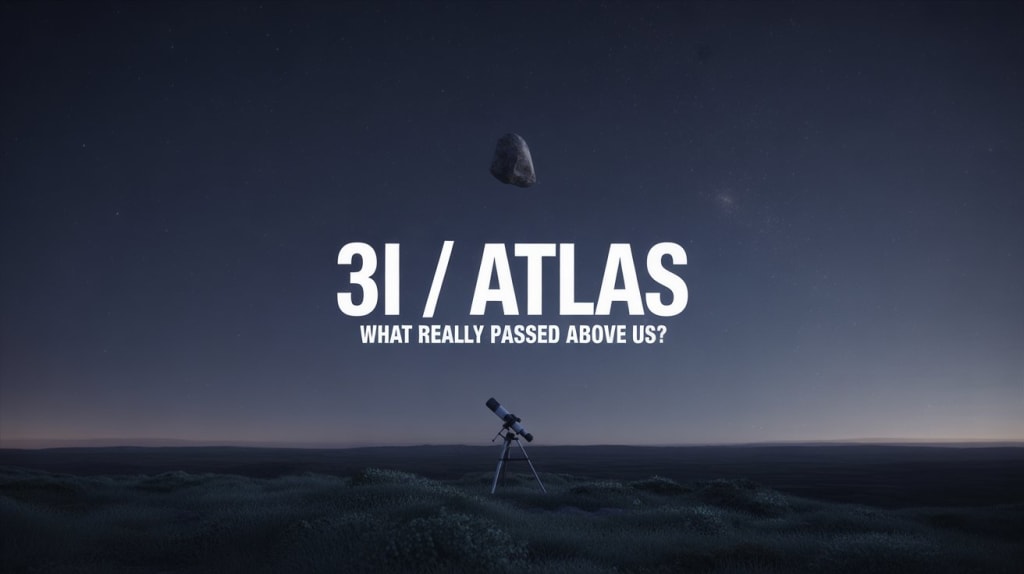
Today, December 19, 2025, the eyes of the world are turned toward the sky. The official narrative is festive; space agencies are calling the closest approach of the interstellar object 3I/ATLAS a "holiday flyby," a harmless astronomical event to be watched with awe and childlike wonder. They tell us to wave goodbye to the "dirty snowball" as it slingshots around our planet and heads back into the dark, frozen void of deep space.
But if you strip away the cheerful press releases and the sanitized graphics, a different picture emerges. It is a picture of panic, containment, and a desperate race to control the flow of information before the public realizes what just flew past our front door.
The Unprecedented Denial
The first crack in the official story appeared last month. In a move that baffled veteran astronomers, NASA held an emergency, televised press conference specifically to address "online rumors." NASA Associate Administrator Amit Kshatriya took the podium not to share excitement, but to issue a denial. He repeated, with almost rehearsed intensity: "It looks like a comet. It behaves like a comet. It is a comet."
Since when does a rock require a global PR campaign? We have tracked thousands of comets. We have never needed a high-ranking official to stand before the world and aggressively promise us that a rock is not a spaceship. The ferocity of their denial betrays them. They aren't trying to convince us; they are trying to drown out the data that suggests otherwise. They needed to silence the questions before the object got close enough to answer them.
The "Wobble" of a Machine
While the cameras focus on the fuzzy white dot, the real story is hidden in the technical data logs of the Teide Observatory in Tenerife. Researchers there detected a specific anomaly: a "wobbling jet" of gas blasting from the surface of 3I/ATLAS.
The scientific community has labeled this "extraordinarily normal" outgassing. But look closer at the mechanics of the report. This isn't the chaotic, explosive venting of a crumbling ice ball heated by the sun. It is a rhythmic, synchronized pulse. The jet "wobbles" with mathematical precision, repeating a specific motion every 14 to 17 hours.
In aerospace engineering, we don't call this a vent. We call it a stabilization thruster. This specific wobble is the signature of an object maintaining a locked orientation. As 3I/ATLAS passes Earth today, that jet isn't just spewing dust; it is likely correcting its course to keep its sensors trained on a specific target—us. The "rotation" they claim to measure is actually a scan cycle.
The 250,000-Mile Plasma Shield
Perhaps the most smoking gun of all comes from the European Space Agency’s XMM-Newton observatory and the XRISM mission. Their sensors picked up a massive X-ray glow surrounding the object. This isn't a faint halo; it extends 250,000 miles from the nucleus.
To put that in perspective, that is a distance greater than the gap between the Earth and the Moon.
NASA claims this is merely the result of solar wind interacting with cometary gas. But to generate a consistent, high-energy X-ray field of that magnitude requires an energy source far more potent than simple sublimation. In theoretical physics, this glow matches the signature of a plasma sheath—a magnetic bubble generated to shield a vessel's hull and electronics from cosmic radiation. 3I/ATLAS isn't burning up; it is protected. It is traveling inside a bubble of its own making.
The Great Data Laundry
As the object makes its "handshake" with Earth today, we should be seeing the highest resolution images ever taken. The Juice spacecraft was perfectly positioned to capture them. Yet, we are told that due to "thermal constraints" and the need to use the antenna as a heat shield, the full dataset cannot be transmitted until February 2026.
We are expected to believe that the most advanced communication array in deep space has a 14-month lag? This delay is not technical; it is strategic. Fourteen months is exactly enough time to scrub the archives, to blur the hard metallic lines of artificial structures, and to ensure that the version of 3I/ATLAS we eventually see looks like the rock they promised us.
Farewell, 3I/ATLAS. You came, you watched, and you are leaving. We may never know what you truly were, but the silence you leave behind is louder than any signal. You have successfully completed your reconnaissance, and we are left here, waving at a mirror, wondering who is looking back.
About the Creator
Wellova
I am [Wellova], a horror writer who finds fear in silence and shadows. My stories reveal unseen presences, whispers in the dark, and secrets buried deep—reminding readers that fear is never far, sometimes just behind a door left unopened.
The Devil's Cut
“Comrade, finally you’re awake.” The voice was smooth, sensual. A flickering incandescent bar was all that lit the white, sterile room. All Vladimir remembered was everything going black. He tried to move his arms and found them strapped to the gurney.
By Matthew J. Fromm5 days ago in Fiction
Him
Him. An unsuspecting commuter on an A-train... he sits gazing out the window, immersed in the view, seeing beyond a world of art which whizzes by as the landscape undulates, ebbs and flows. There is a surreal, dreamlike and beautiful view of nature beyond the window, where bamboo stalks grow impossibly tall, reaching towards a sky painted in the swirling, vibrant colors of a Baroque masterpiece. The interior of the train is dimly lit, casting long shadows. The peace it exudes evokes a painterly illustration with dramatic bright and dark lighting filled with rich textures.
By Antoni De'Leon2 days ago in Fiction



Comments
There are no comments for this story
Be the first to respond and start the conversation.