
The Fifth Room
The room that waits behind your mind.

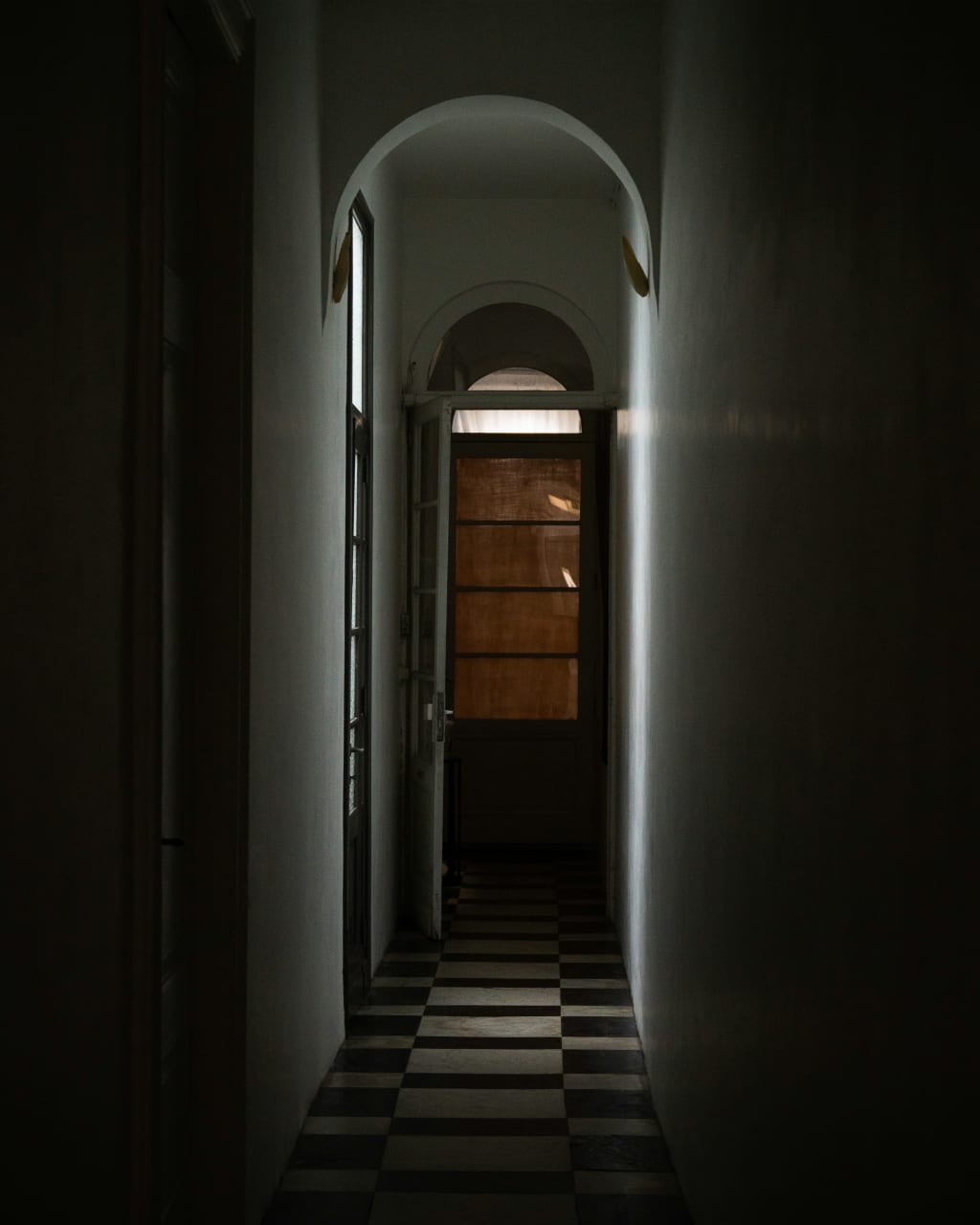
The apartment was supposed to have four rooms.
That’s what the listing said. That’s what the agent confirmed. That’s what Nora counted when she walked through it the first time—bedroom, bathroom, kitchen, living room. Four.
But two weeks after moving in, she found a fifth door.
It was at the end of the hallway, near the laundry nook. A plain, white-painted door, no different than the others, but one she knew hadn’t been there before.
At first, she laughed. A trick of the brain. She was tired. Overworked. Maybe it had always been there, and she simply missed it. That’s what she told herself.
Until she tried the handle.
Locked.
No keyhole, just a cold brass knob that wouldn’t turn. She knocked. Hollow. Something was back there. A room, maybe. But the walls in this building were thin. She should’ve heard something. A draft. A creak.
But there was only silence.
Later that night, she found a key in her coat pocket.
She hadn’t put it there.
Nora was not the paranoid type.
She worked in forensic data analysis—logic was her thing. She didn’t spook easily. But the key was heavy, old-fashioned, not like the modern silver ones her landlord gave her.
When she tried it on the mystery door, it slid in like it belonged there.
Click.
But she didn’t turn it.
Not yet.
Instead, she called the building manager the next morning. Told him there was an extra door in her hallway. He sounded confused.
“There shouldn’t be,” he said. “Just the four rooms, Miss Hale.”
“Right. That’s what I thought. But I swear, there’s another one. Locked. End of the hall.”
He hesitated. Then: “Are you sure it’s not a maintenance closet?”
“I’d have noticed.”
“Well, I can come check tomorrow. But I’ve got floor plans here from the building’s renovation two years ago. No extra doors.”
She thanked him and hung up.
The next morning, when she opened her eyes, the key was on her pillow.
That night, she gave in.
Nora stood in front of the door barefoot, in her robe, heart pounding.
She put the key in, turned the knob.
It opened without resistance.
The room inside was pitch dark.
No light switch. No windows. No sound.
But it wasn’t empty.
She stepped inside, breath catching.
The door clicked shut behind her.
The room was small.
Bare wooden floors. No furniture. No color. And yet, the air inside felt... thick. Like it had weight.
She turned slowly.
The door was gone.
In its place was a wall.
She ran to it, pressed her hands against it. No seams. No knob. Nothing.
She was sealed in.
But just before panic could rise in her throat, a faint humming filled the air.
Not mechanical. Not musical.
Personal.
It was her mother’s lullaby.
Nora backed away from the sound.
“No. That’s not possible,” she whispered.
Her mother had died twelve years ago.
Then a projector clicked on—somewhere above. Light spilled onto the far wall.
Footage.
A home video.
She, at six years old, was dancing in a too-big princess dress.
The tape ended. Another began.
She, at twelve, was crying in her closet.
Then another.
She, at seventeen, was screaming at her father through a locked bathroom door.
More tapes. More images. Things she hadn’t remembered in years.
The room was showing her her past.
And not just the good parts.
She didn’t know how long she stayed in the room.
Time didn’t move normally there.
When the door finally reappeared, she stumbled out, dizzy. Cold. Shaking.
It was still nighttime. But her phone said she’d been gone for six hours.
She collapsed into bed, the lullaby still echoing in her mind.
The next day, she tried to ignore it.
Told herself it was a lucid dream. Maybe she sleepwalked. Maybe stress was catching up to her.
But when she walked past the hallway again, the door was still there.
And now it had a brass number plate screwed into it.
“2”
By the following week, it read “3.”
Each time she entered, the room changed.
Sometimes it looked like her childhood bedroom. Other times it was blank.
But the room always knew what to show her.
Shame. Regret. Memories she’d buried deep.
And each time she left, she felt a little... different.
More forgetful. More was unsure of what was real.
And then came the night she found the mirror.
The mirror stood in the center of the fifth room, covered with a black cloth.
She pulled it off.
It showed her reflection—but not quite.
The woman in the glass tilted her head when she didn’t.
She stepped back.
The reflection stayed still.
Then it smiled.
Her phone buzzed in her pocket.
A message from a contact she didn’t recognize.
“ROOM 5: MEMORY LIMIT REACHED.”
She dropped the phone.
The reflection was mouthing something now.
Words she couldn’t hear. But she could read them.
"YOU LET ME IN."
Nora slammed the door shut behind her and stumbled back into her apartment.
The hallway looked normal again. Four doors. White walls. Clean.
The fifth door had vanished.
She pressed her hand to the space where it had been, feeling nothing but smooth drywall.
But the key was still in her hand. Still warm.
And the message on her phone hadn’t disappeared:
“ROOM 5: MEMORY LIMIT REACHED.”
That night, Nora dreamed in loops.
Her mother’s voice. Her father’s silence. The taste of blood from when she bit her tongue during a panic attack at seventeen.
She saw a version of herself curled up in the fifth room, whispering things to the wall that no one else could hear.
When she woke, her bedside lamp was on.
So was the hallway light.
And so was the fifth door.
Back. Solid. Unmissable.
This time, the brass number plate didn’t say “4.”
It said:∞”
She called the building manager again.
His voice sounded different this time. Distant. Like he was on speakerphone in a giant empty room.
“I told you before,” he said slowly, “there are only four rooms.”
“I have a key,” Nora whispered. “I’ve been inside it. It plays back my memories. It shows me... things.”
A pause.
Then: “And did it take anything?”
“What?”
“Has anything gone missing?”
She blinked. “What do you mean?”
“Not objects. You.”
She checked her bookshelf.
Her diploma was missing.
Her favorite journal, the one she wrote in every night, was gone.
She opened her contacts list. Half her recent messages were blanked out. Names were grayed.
Photos on her phone showed her standing alone, where someone else should’ve been.
One by one, pieces of her life had been pulled from the edges—softly, quietly—like a thread unraveling a sweater.
The fifth room didn’t just show memories.
It collected them.
And now, it had had enough.
The next night, Nora didn’t sleep.
She sat in the hallway, watching the fifth door.
Every so often, it pulsed. Breathing. Like it was alive.
She tried locking herself in the bedroom, but the key returned to her palm.
No matter where she left it—drawer, fridge, outside—it always reappeared.
She took a cab across town and threw it in the river.
It was back under her pillow before dawn.
The fifth room called to her in different ways.
Sometimes in dreams.
Sometimes in her voice, echoing faintly through the apartment: “Come back.”
Other times in memories that played like film reels behind her eyes: her mother crying at the kitchen table, the last time she saw her sister, the thing she said to her friend before the accident.
Each moment presented, unedited, raw.
Each one costs her a little more of herself.
She woke one day unable to remember her address.
Another day, she couldn’t recall what her job had been.
And finally, she couldn’t remember why she moved in at all.
On the seventh night, she gave in.
She stepped through the door.
It closed softly behind her.
This time, the room was different.
There was a chair in the center.
Across from it, another Nora sat.
Calm. Smiling.
"You finally came back," the reflection said.
Nora blinked. “I didn’t leave anything here.”
“Yes, you did.”
It stood up.
“You left me.”
The reflection walked forward and took Nora’s hands.
“You gave me everything. And now that I’m whole…”
It leaned close, whispering in her ear:
“…you can go.”
The lights flickered.
And the door appeared behind her again.
Nora turned, stumbled out, and gasped for breath.
She was back in her apartment.
Except—it was daylight now.
Her phone buzzed.
Unknown number.
“Welcome to Unit 5. Please enjoy your stay.”
She blinked.
Looked around.
Everything was in place. Clean. New. Fresh.
But she didn’t recognize anything.
The paintings. The furniture. The photos on the fridge—not hers.
She went to the hallway.
There were now five doors.
And she didn’t know what was behind any of them.
She tried the front door.
Locked.
Final Note
The fifth room still exists.
It moves. It hides.
It waits for lonely people. People who’ve forgotten themselves. People who have too many regrets and nowhere to put them.
It does not force.
It invites.
And once it has all of you,
It gives you what you think you wanted:
A perfect place.
A perfect version of yourself.
And no way out
About the Creator
Keep reading
More stories from Unaishah Mostafa and writers in Fiction and other communities.
Beneath the Perfect View
It was the kind of view travel bloggers spend hours editing filters to replicate. From the wide glass windows of Cabin 17, the world looked painted. Mountains with powdered snow fringes rose like sleeping gods in the distance. Pine trees flanked the valley below, their spires dusted with white. A frozen lake lay perfectly still, reflecting the twilight like silver glass. The air was crisp, fresh, the sky blooming into shades of rose and indigo.
By Unaishah Mostafa 6 months ago in Fiction
Affection and Healing for Yourself
During the night of the last quarter moon, I gathered my ritual supplies. I carefully handled the chunk of black tourmaline that would protect me from your overall negative and narcissistic energy. I carefully walked the house with my stick of selenite in hand, asking the universe to cleanse our working space.
By Alisha Wilkins ✒️🦋🖋️5 days ago in Fiction
📢 Raise Your Voice Thread: 01/22/2026
Our “Raise Your Voice Threads” are hosted most alternating Thursdays at 12PM ET to offer creators more avenues to uncover exceptional stories on Vocal. As we are continuously searching for fresh creators and inspiring stories, this thread provides an opportunity to exchange and discuss the stories that have moved and motivated us on Vocal.
By Raise Your Voice by Vocal2 days ago in Resources


Comments
There are no comments for this story
Be the first to respond and start the conversation.