


The Summer Before Thomas
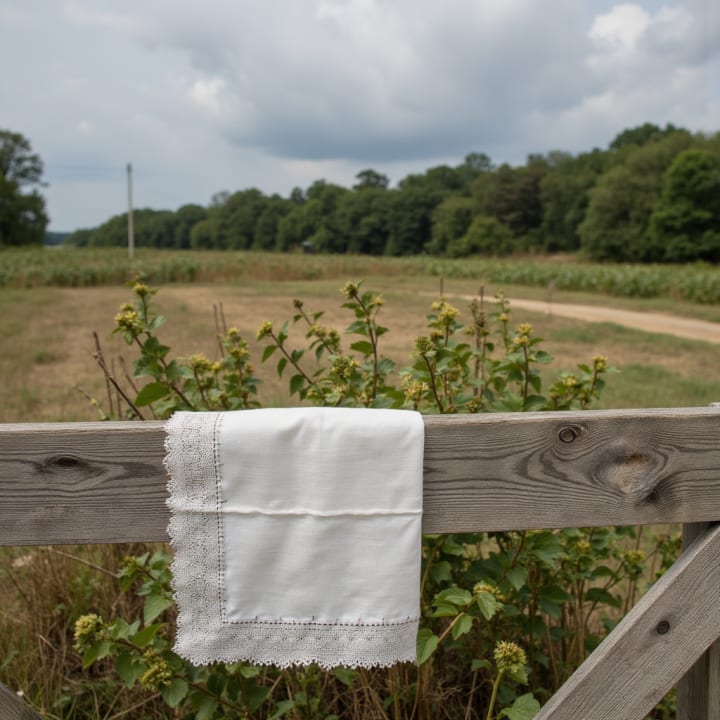
I still have Thomas' hanky.
It may seem silly—his sixty-three years wrapped up in a piece of woven cotton. It no longer smells like him—it smells like my dresser—a mix of cedar and cedar-scented lavender sachets forgotten. But my fingers remember him, even when my nose forgets.
Thomas had hands like the beds of rivers. Smooth in some areas, rough in others. He worked in the tobacco fields of the south, around Meridian, Mississippi. And during that summer in 1961, I was seventeen years old and had knees that wobbled together each time he walked by the feed store my father owned and operated. I was ashamed.
Oh, God, I was scared of him. With pleasure! Was it crazy?
I was afraid, not in the way most people think of fear. I was afraid in the way that makes a person feel like they’re chest-humming a bird in a cage. I had rehearsed saying, “Good afternoon, Thomas,” 400 times in front of the mirror in my bathroom. And whenever he was near me, my tongue turned into wet newspaper. I must have looked ridiculous. A red beet would have been less embarrassed.
My mother once said that you should never feel like love makes you desperate or uncertain. What did she know? She married my dad because their farms were next door. They thought it was convenient, logical, and because they were both “hard people”—starved and worn down by hardship so they appeared emotionally repressed.
There was nothing logical about Thomas.
He began leaving gifts for me. A sprig of honeysuckle would be placed underneath the door of my father’s feed store; a note written on the side of a brown paper bag that said, “Your laughter sounds like Sunday morning.” A beaming smile would greet me every time he saw me, along with a little silly verse or rhyme. I loved it. I thought I was in the seventh heaven of happiness.
I had no idea that he even heard my laughter. Had I laughed? When? Why? All of a sudden I started to go back through all of my life, each of my accidental glances, searching for clues as to which version of “me” he was watching when I didn’t have a clue that I even existed.
Then came the county fair—the warm, sweet cotton candy clouds, the crunch of boiled peanuts, and the creaking Ferris wheel that sounded like a very old man's knees; I was alone there. It was either brave or sad. Still deciding.
I found myself standing in front of the bottle toss (except this was before “real” bottle tops were made). I was throwing a bottle, pretending to care about winning an ugly stuffed elephant that I had at one time fought over. Now I was ready to fight for something much nicer.
“You throw like you're afraid of the bottle, in case it throws back,” came a voice from behind me.
I turned around. The moment was like a blow: unforgettable, as clear as a Polaroid. He stood there with sawdust on his boots, hesitating with eyes that were the color of maple syrup, and all at once I realized he was also afraid. In fact, his riverbed hands were trembling against his sides.
“Yes,” I said. It was the first truthful thing I had ever said to him.
“Me too,” he said, with a crooked smile. “About everything, but especially about you.”
We rode that creaking Ferris wheel over and over until the oppressor, who was, by the way, practically foaming at the mouth, screamed at us to get off. He interrupted, supposedly cough interrupted.
We talked about the most random things of life: the shapes of clouds, whether or not dogs dream, why fireflies become active during the summertime, and the northern lights. There were great songs played along the grounds of the fair. We built something huge and monumental out of absolutely nothing—out of thin air, with “invisible” bricks. It was one of the most beautiful things I will ever be a part of.
At the very top of the third rotation, he kissed me. It tasted of caramel apples and hoping for the future. I no longer felt alive. I felt lost. In that moment, it felt like the whole world shrunk down to the size of the dented rusty seat of a Ferris wheel that was sitting so high above the ground that it felt as though it wouldn't last. My cough, the creaking wheel, and everything else had disappeared.

Fifty-two years of marriage. Three kids. Seven grandchildren. Our lives had been created from that one summer.
Last spring, Thomas died. True to his nature, very quietly. Now I am left with cedar drawers, a faded piece of cotton, and memories that seem far more real than what I just had for breakfast.
People always ask if grief "gets better." What an idiotic question to ask.
When someone dies, their grief doesn’t get smaller; you just grow relative to their sadness. It’s similar to a tree growing around an old fence— the fence doesn’t disappear; it does eventually become part of the “trunk” of the tree, like the rings of a tree when it is cut down. Summer Formed Something Out of Nothing.

About the Creator
RAOM
Turn every second into a moment of happiness.
Reader insights
Outstanding
Excellent work. Looking forward to reading more!
Top insights
Compelling and original writing
Creative use of language & vocab
Easy to read and follow
Well-structured & engaging content
Excellent storytelling
Original narrative & well developed characters
Expert insights and opinions
Arguments were carefully researched and presented
Eye opening
Niche topic & fresh perspectives
Heartfelt and relatable
The story invoked strong personal emotions
Masterful proofreading
Zero grammar & spelling mistakes
On-point and relevant
Writing reflected the title & theme
📢 Raise Your Voice Thread: 01/08/2026
Our “Raise Your Voice Threads” are hosted most alternating Thursdays at 12PM ET to offer creators more avenues to uncover exceptional stories on Vocal. As we are continuously searching for fresh creators and inspiring stories, this thread provides an opportunity to exchange and discuss the stories that have moved and motivated us on Vocal.
By Raise Your Voice by Vocal5 days ago in Resources


Comments (2)
That's how I always feel around my crush. I love how you explained using the tree and the fence. Loved your story!
This is beautiful. I swooned over this line and never recovered: “Thomas had hands like the beds of rivers. Smooth in some areas, rough in others.”