
The Expiration Date Society
What if every human came with a visible countdown timer showing the exact moment they’ll die?

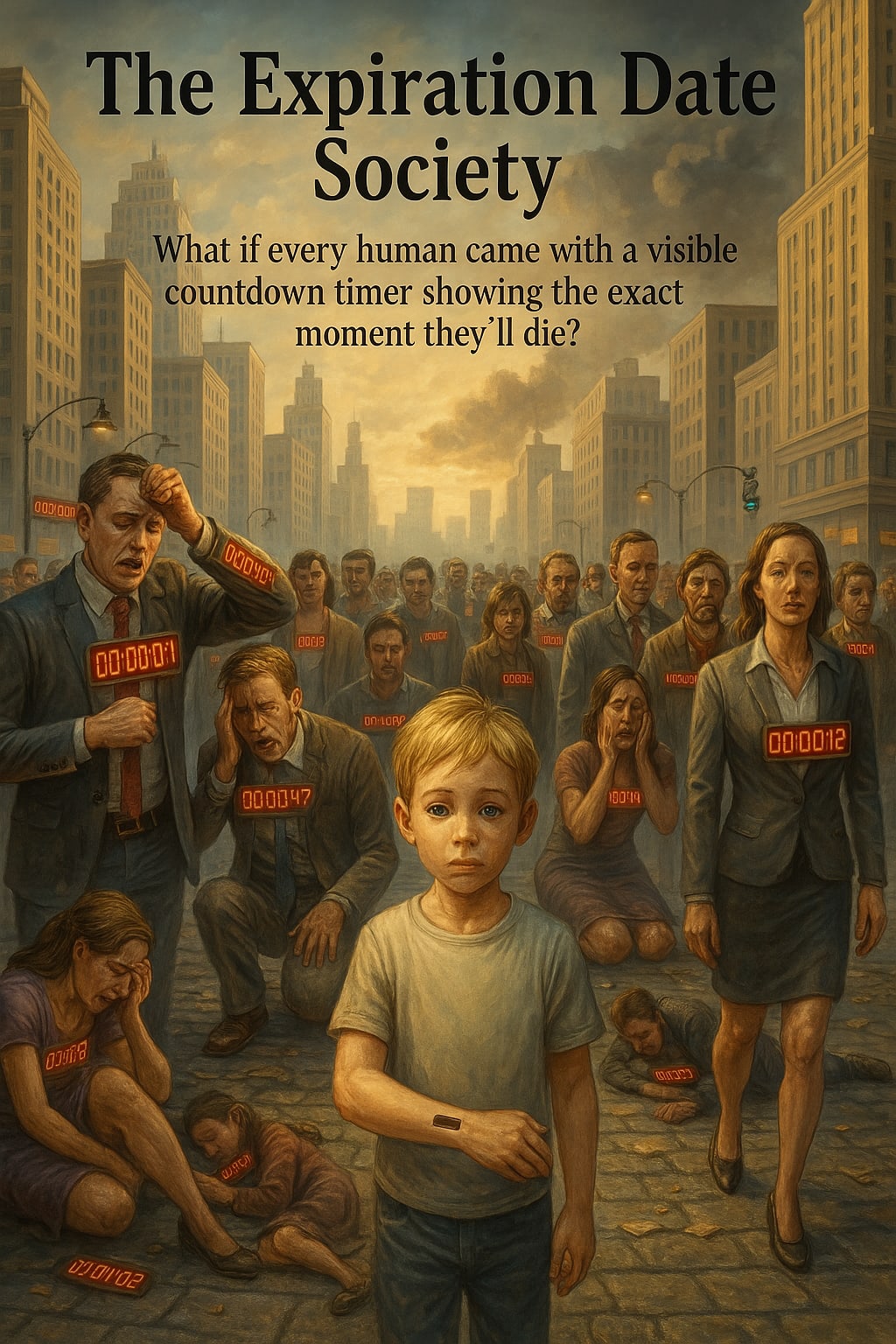
No more accidents. No more mysteries. No more guesswork. In the Expiration Date Society, death was no longer a question. It was a fact — visible, ticking, and unavoidable.
From the moment a baby was born, a glowing timer appeared on their forearm, red digits ticking down from a predetermined span of years, days, hours, minutes, and seconds. No one knew where the timers came from. They simply began appearing one day — globally, simultaneously — without warning or explanation.
And yet, within months, society adapted. As it always does.
⸻
Living by the Numbers
At first, people were terrified. Hospitals overflowed with panic. Religious leaders tried to explain, but their sermons felt thin compared to the cold glow of a death clock. Governments scrambled to track the phenomenon, but it was too widespread, too uniform, too precise.
Soon, the panic gave way to pragmatism. After all, humans are excellent at normalizing the absurd. The timers were real. They were accurate. Denial was a luxury no one could afford anymore.
Insurance companies went bankrupt. Funeral homes partnered with timer-tech companies to offer “departure packages.” Dating apps added filters for “time compatibility.” Schools adjusted curriculums — students with fewer than 10 years left were enrolled in “Soulful Paths” instead of “Future Planning.”
Time, once abstract, became currency. Sacred. Unnegotiable.
⸻
A New Kind of Inequality
The world didn’t become fairer. Just clearer.
The rich no longer flaunted their wealth — they flaunted their time. Billionaires with 90-year clocks were called “Eternals.” They wore short sleeves in winter. Presidents campaigned not on policy, but on years remaining. Some called it vanity. Others called it transparency.
But not everyone was so lucky. “Short-Timers” — those with under ten years — were quietly nudged into low-paying jobs, early-life bucket lists, or “purposeful exits.” Why train a surgeon who would only live to 25?
Children learned early not to ask classmates, “How old are you?” but instead, “How long do you have?”
⸻
Love in the Time of Timers
Romance changed. Some still believed in forever, but forever now had an end-date. Couples engraved their remaining time on rings. Marriage vows shifted: “Until your last second or mine.”
Many refused to fall in love with Short-Timers. Why build a life on borrowed time? But some couldn’t help it — and those love stories were the most intense. Two people, living on a ticking clock, kissing like their mouths were running out of seconds.
There were documentaries about them. Poets immortalized them. And when the timer hit zero, the world paused — not in surprise, but in mourning. These were the people who reminded everyone what time was really for.
⸻
The Birth of Blank Timers
Then came the anomaly.
One winter, in a quiet hospital, a baby was born with no timer. Just smooth skin where the digits should be. Doctors panicked. Was it broken? Missing? Would the child die instantly?
But the baby lived. And so did others like it.
Blank-Timers, as they came to be called, arrived without warning and grew without limit. They had no countdown, no end-date. They were unpredictable — and therefore, unsettling.
Some called them glitches. Others saw them as miracles.
They were immune to the economy of time. They couldn’t be scheduled, managed, or sorted. They didn’t fear — or respect — the ticking. And that made them dangerous.
Governments debated tagging them. Some parents tried to tattoo fake timers on their children, just to avoid social stigma. But as Blank-Timers grew, so did their legend.
They lived more recklessly. Climbed higher buildings. Took more risks. Some even joined Death Witness crews — teams of people who sat beside Short-Timers in their final moments.
The Blank-Timers didn’t fear death. Because for them, it was no longer a countdown. It was a story without a final page.
⸻
The Philosophy of the Tick
As the years passed, society began to splinter — not just by time remaining, but by time philosophy.
Chronoists believed the timers were divine — a cosmic truth finally revealed. They held rituals where people shared their ticking out loud, syncing in groups, breathing together as if composing a song of mortality.
Tick Deniers rejected the clocks entirely. They wore long sleeves, covered their digits, and believed the timers were a mass delusion — an invasive tech experiment, or worse, a psychological weapon.
The Fluidists followed the Blank-Timers. They meditated on unpredictability. Built art installations out of sand and melting ice. Their motto: “To know the hour is to kill the moment.”
Some cities even split by philosophy. You could walk from a neighborhood where everyone wore glowing red digits proudly, into another where time was hidden, buried, or ignored.
The city ticked like a heartbeat. A fractured, beautiful, dying heart.
⸻
A World Without Surprises
With time so tightly managed, life became efficient — and eerily silent.
People no longer panicked about death — but they also stopped dreaming beyond their countdown. Creativity dipped. Risk-taking shriveled. Innovation plateaued.
Why invent a cure for cancer, if you already knew you wouldn’t live long enough to see it work?
Why write a novel, when you only had 6 months and had never written one before?
The timers gave certainty. But they stole wonder.
That’s when the rebellion began.
⸻
The Timer Hackers
A rogue group called The Undated emerged — former engineers, ethicists, and artists. They claimed to have cracked the timer system. They didn’t offer eternal life — but they offered uncertainty.
Their solution was simple: a skin patch that disrupted the signal. Once applied, your timer flickered and died. Gone. Blank. No second chances.
It couldn’t be reversed.
Some saw it as freedom. Others, as madness.
People lined up. Others fled. Families argued. Friendships split. Governments declared the patches illegal.
But the black market thrived. And soon, thousands — maybe millions — lived without timers once again.
Uncertainty spread like a wildfire. And for the first time in decades, people remembered how it felt to not know.
⸻
The Boy with the Blank Wrist
In the middle of all this — the systems, the ideologies, the rebellions — stood a boy.
He was young. Ordinary. Except for one thing: his wrist was blank. Always had been.
He didn’t speak much. But when he did, people listened. Not because he was wise — but because he wasn’t afraid.
Not of time. Not of endings. Not of beginnings.
When asked what it felt like, not knowing when he would die, he said:
“It feels like every day might be the last… and that makes each one the first.”
⸻
The Final Countdown
Perhaps the Expiration Date Society was never about death. Perhaps it was about control.
The timers offered safety — but in return, took the unpredictable magic of living.
Blank-Timers, Timer-Hackers, and the quietly rebellious all whispered the same truth:
We were never meant to live by the numbers.
We were meant to live by the moments.
And sometimes, the most important moments can’t be scheduled.
About the Creator
Ahmet Kıvanç Demirkıran
As a technology and innovation enthusiast, I aim to bring fresh perspectives to my readers, drawing from my experience.
Keep reading
More stories from Ahmet Kıvanç Demirkıran and writers in Fiction and other communities.
The Day We Were All Assigned a Random Stranger’s Dreams
It was subtle at first. On the morning of March 19th, people woke up unusually quiet. Not from nightmares or insomnia, but from confusion—about dreams that made no sense. A truck driver in Montana dreamed she was giving birth in a Parisian opera house. A five-year-old in Cairo had a vivid nightmare of failing a corporate audit. A retired baker in Seoul dreamt, in perfect Swedish, of winning a fencing tournament.
By Ahmet Kıvanç Demirkıran10 months ago in Fiction
The Devil's Cut
“Comrade, finally you’re awake.” The voice was smooth, sensual. A flickering incandescent bar was all that lit the white, sterile room. All Vladimir remembered was everything going black. He tried to move his arms and found them strapped to the gurney.
By Matthew J. Fromm4 days ago in Fiction
Him
Him. An unsuspecting commuter on an A-train... he sits gazing out the window, immersed in the view, seeing beyond a world of art which whizzes by as the landscape undulates, ebbs and flows. There is a surreal, dreamlike and beautiful view of nature beyond the window, where bamboo stalks grow impossibly tall, reaching towards a sky painted in the swirling, vibrant colors of a Baroque masterpiece. The interior of the train is dimly lit, casting long shadows. The peace it exudes evokes a painterly illustration with dramatic bright and dark lighting filled with rich textures.
By Antoni De'Leon2 days ago in Fiction



Comments (3)
This was soo good!! It reminds me of a similar theme in a movie called "In Time", where time was truly a currency that people used to buy, sell, and trade goods with. I really love your creative and philosophical take on it though! You definitely made this idea your own, and it's very well written!! Love your work! A++++
I have read your,s complete story thease words result of our life lesson pesons Many refused to fall in love with short-timers. Why build a life on borrowed time? But some couldn't help it.
I’ll join a “date society!” Goldman quality story! Great work !