
The English of Old Pathan Women
In the mountains where honor reigns, a grandmother's broken English becomes her proudest defiance.

By Ikhtisham Hayat
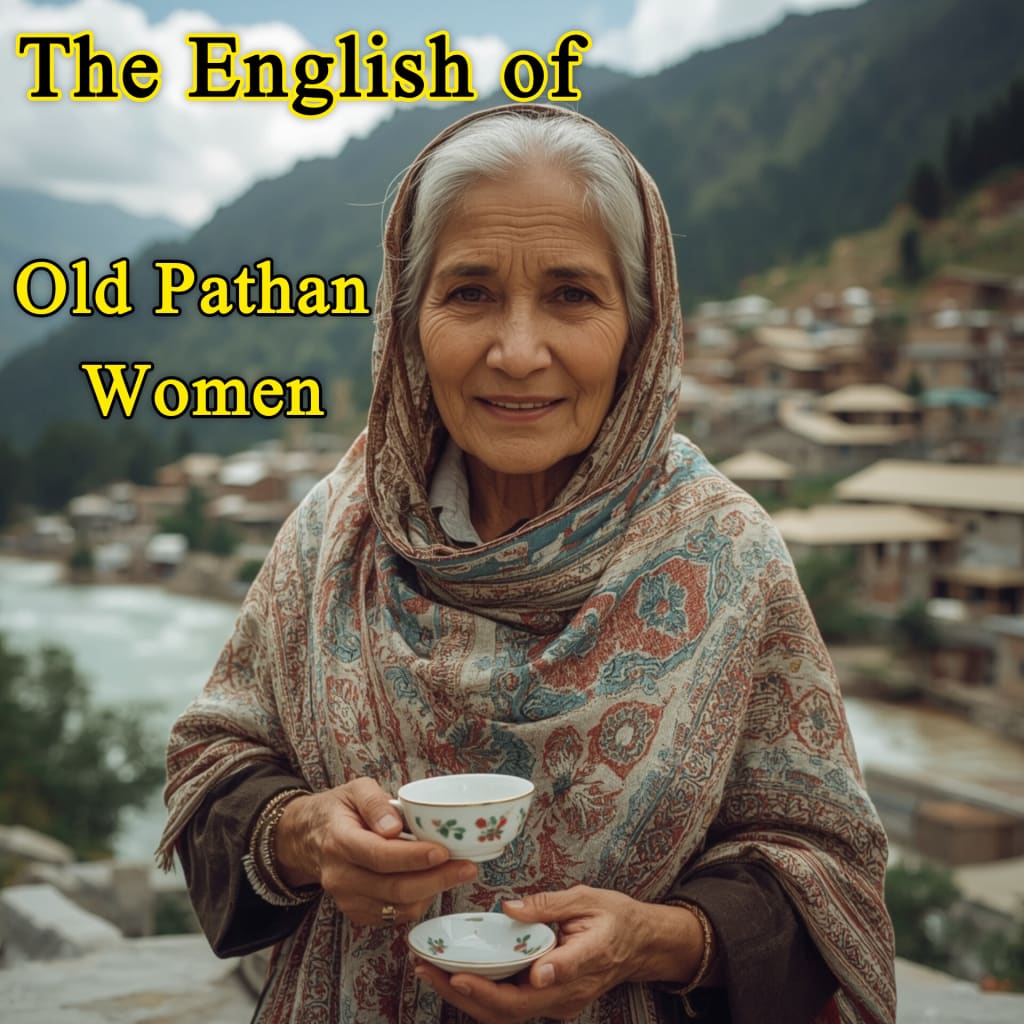
In the remote hills of Swat Valley, where stone houses cling to green slopes and honor is heavier than gold, lived an old Pathan woman named Gul Bibi. Her hair was silver, her eyes sharp like a hawk, and her tongue—though weathered—was unafraid. She had never seen the inside of a school, never held a pen, and yet she carried a fire in her chest that could outshine scholars.
And she spoke English. Not well. Not fluently. But boldly, with all the pride of a queen.
Her English was a mixture of broken grammar, heavy Pashto accent, and wild confidence. Words twisted, meanings missed—but her spirit never did.
Whenever the village children returned from school speaking fluent English, she would straighten her shawl and say proudly, "Me also speaking English, no problem! How are you the fine?" The children would burst into laughter. But Gul Bibi laughed louder. To her, it wasn’t shame. It was victory.
She had learned bits of the language from her son, Hamid, who used to work in Dubai. When he returned home, he brought with him not just money, but a radio that played BBC news and a mind full of foreign words.
Gul Bibi would sit beside him every night, pretending to knit, ears sharp as needles. "Say again that word," she would interrupt. "Government? What is this? Gover-min?" Hamid would explain, and she’d repeat it endlessly, turning it over like a prayer bead.
After he left again, she practiced with whoever would listen—grandchildren, shopkeepers, chickens, even her goat. "Come here goat, you naughty. No discipline!"
One day, a group of NGO workers came to the village. Foreigners. Tall, white-skinned, with cameras and soft shoes. They had interpreters with them, but Gul Bibi refused help. She marched up to them, wrinkles proud like medals, and introduced herself: "My name Gul Bibi. I am the old women. You sit, I bring tea. You are welcome in my heart and in my room."
They smiled, surprised, impressed. They sipped her green tea and took photos of her in her embroidered shawl.
Later, someone asked her grandson sarcastically,
"Your dadi thinks she knows English. Why don’t you tell her it’s wrong?"
He paused.
Then said, quietly,
"She may not speak it right. But she speaks it brave."
Gul Bibi became a kind of local legend.
People would visit just to hear her speak. Young brides, shy and silent, would giggle when she said things like,
"Very tasty your curry is. I am happy in my stomach!"
Or
"No tension. God is big. Everything will be the fine."
In her imperfect English was a kind of defiance—against the belief that only the educated can dream, only the fluent can speak, and only men can be bold.
One winter, her son Hamid died in a road accident abroad. The news came in the middle of a snowstorm. The house was filled with cries, and even the sky seemed to mourn.
Gul Bibi did not cry that day.
She sat by the fire and held his photo close. And then, softly, she said,
"Hamid... you teach me English. Now I am teaching courage. Thank you my son."
Years passed. Gul Bibi grew older, her voice shakier—but her English still danced on her tongue.
When she passed away, the entire village came for her funeral.
One of the NGO women who had once met her sent a message:
"She was the only woman I met in those hills who spoke to me directly—with love, with honor, with courage. I didn’t always understand her words. But I always understood her heart."
Today, in that same village, little girls learn English in schools built by people Gul Bibi once served tea to. And when they struggle to pronounce something right, their teachers smile and say,
“Speak like Gul Bibi. Speak it proud—even if wrong.”
Because sometimes, it's not the language of the mouth,
but the language of courage
that leaves the deepest echo.
About the Creator
Ikhtisham Hayat
Writer of quiet truths and untold stories.
Keep reading
More stories from Ikhtisham Hayat and writers in Fiction and other communities.
The Last Kite of Gaza
The Last Kite of Gaza By Ikhtisham Hayat The sun in Gaza was always cruel, but that afternoon, it softened just enough to let the children play. The sky, once a ceiling of fear, stretched wide and blue — a rare gift. Youssef stood on the broken rooftop of his family’s apartment, a red kite clutched in his tiny hands. It was made of old plastic bags and two sticks his uncle had found in the rubble. But to Youssef, it was a dragon, a bird, a dream.
By Ikhtisham Hayat7 months ago in Fiction
Baba Vanga Predictions for 2026
Baba Vanga Predictions for 2026 Baba Vanga remains one of the most fascinating figures in the world of prophecy. Though blind from childhood, she saw further than most people could imagine. Her name has become a symbol of mystery, a whisper passed between believers and skeptics whenever the world feels uncertain. For decades, her visions have been revisited each time a new disaster unfolds, as if her words continue to echo through time.
By Marie381Uk 4 days ago in Fiction



Comments
There are no comments for this story
Be the first to respond and start the conversation.