
The Emotion Simulator
In a world where emotions can be shared, what happens when love crosses the line between empathy and invasion?

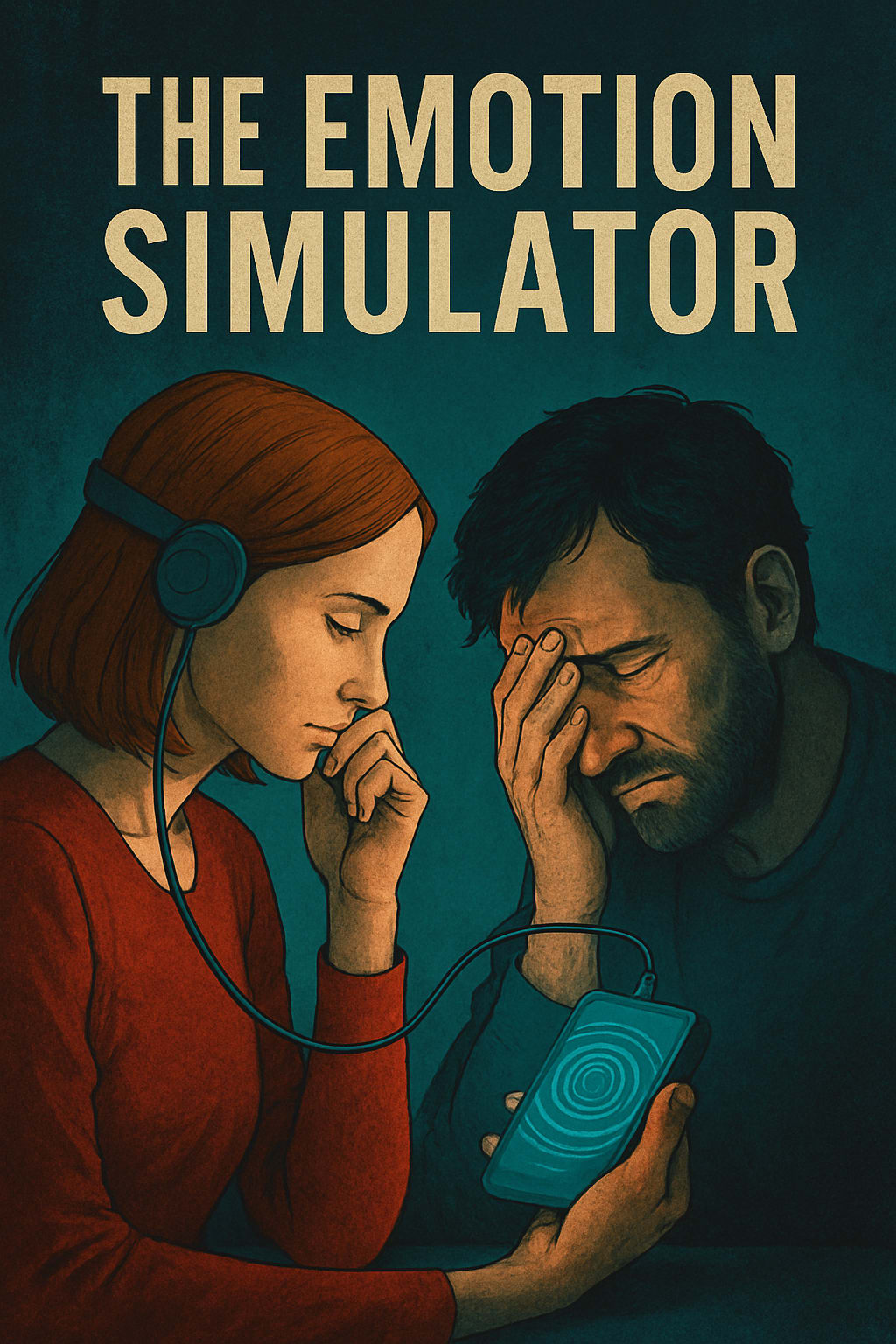
In the year 2047, emotions were no longer abstract. They could be packaged, stored, replayed—felt again. All thanks to the E-Synapse: a neural interface allowing users to fully experience someone else’s recorded emotions.
At first, it was a miracle. Therapists used it for trauma treatment. Couples used it to “truly understand each other.” Artists used it to capture moments of joy, grief, ecstasy, and despair—bottled like perfume.
But emotions, once shared too freely, began to lose their mystery. Or worse, their sanctity.
1. The Curiosity
Elara sat at the kitchen table, watching the golden shimmer of the Emotion Simulator orb pulse gently beside her tea.
Across from her, Owen stirred his coffee without drinking it.
“I want to feel it,” she said softly.
Owen froze. “Feel what?”
“You know what. That night. You never talk about it. You never even let me close to it. But you logged it in the simulator, didn’t you?”
He set his spoon down.
“Elara, it’s not something I want to remember, let alone share.”
“I don’t want to watch it, I want to feel it. That’s the whole point, isn’t it? You always say you wish I understood why you shut down sometimes. Let me try.”
Owen looked like she had asked to breathe in his nightmares. He reached for the orb protectively.
“There are some things you shouldn’t step into. Especially not out of curiosity.”
Her voice sharpened. “This isn’t curiosity. It’s love.”
2. The Download
That night, while Owen slept restlessly beside her, Elara linked the orb to her neural port. She hesitated only a moment before whispering the activation code: “Session 29. Emotion: raw.”
The world slipped sideways.
She was no longer Elara.
She was him.
A teenage Owen, walking into his childhood home, the air tense with the silence of something not quite right. She could feel it—not just see it—but feel the anticipation turning to dread. The footsteps up the stairs. The sudden, crushing weight of discovering a body in a bathtub. A woman. Owen’s mother.
The grief wasn’t a wave. It was a collapse. Elara collapsed with it. The feeling didn’t stop with the discovery—it deepened. The guilt. The words he never said. The way everyone whispered around him at the funeral. The isolation. The rage. The terrifying numbness that followed.
Then came the part Owen never mentioned to anyone. The moment when a teenage boy stood at the edge of a rooftop, wind in his face, wondering if it would feel like flying.
Elara screamed herself awake.
3. The Distance
Owen was already awake, sitting in the corner of the room, holding the orb.
“You did it.”
She nodded, unable to speak. Her face was pale. Her hands trembled.
He didn’t look angry. Just… older.
“You understand now why I kept it locked?”
Elara’s lips parted, but no sound came out.
“I didn’t want you to carry it,” he said quietly. “It was mine to survive.”
“But now it’s ours,” she finally whispered.
“That’s the problem,” he replied.
4. The Shift
In the days that followed, Elara felt different. More connected, yes—but also cracked in places she didn’t expect. She looked at Owen and no longer saw just a partner. She saw the boy in the memory. The brokenness behind the man. It changed the way she touched him, spoke to him, even loved him.
She couldn’t unfeel it. And he couldn’t pretend it hadn’t been shared.
Their silences grew longer. Conversations felt like stepping around glass.
“I didn’t mean to break anything,” she said one night.
“You didn’t,” he replied. “You just… moved something I’d finally found a place for.”
5. The Reflection
At a support group for Emotion Simulator couples, Elara listened to others speak about the same dilemma:
“We always think empathy will bring us closer. Sometimes, it just makes the distance clearer.”
“There’s a difference between knowing someone’s pain—and owning it.”
When it was Elara’s turn to speak, she hesitated.
“I thought love meant sharing everything. But now I wonder if protecting each other means not sharing certain things. Not out of secrecy—but out of respect.”
Owen squeezed her hand gently.
For the first time in weeks, she felt him with her again—not as someone to heal, but someone who had already survived, and didn’t need her to carry it anymore.
6. The Reset
Back home, Elara deactivated the session from her own neural history. The device offered a prompt: Do you wish to permanently delete this emotion file from memory?
She selected No.
Instead, she archived it.
Not to forget. But to acknowledge it.
When she turned to Owen, he was already watching her.
“Thank you,” he said, voice barely audible.
“For what?”
“For giving it back to me.”
About the Creator
Ahmet Kıvanç Demirkıran
As a technology and innovation enthusiast, I aim to bring fresh perspectives to my readers, drawing from my experience.
Reader insights
Outstanding
Excellent work. Looking forward to reading more!
Top insights
Compelling and original writing
Creative use of language & vocab
Easy to read and follow
Well-structured & engaging content
Excellent storytelling
Original narrative & well developed characters
Expert insights and opinions
Arguments were carefully researched and presented
Eye opening
Niche topic & fresh perspectives
Masterful proofreading
Zero grammar & spelling mistakes
On-point and relevant
Writing reflected the title & theme
Keep reading
More stories from Ahmet Kıvanç Demirkıran and writers in Fiction and other communities.
The Day People Could Hear Each Other's Inner Monologues
It began on a Tuesday. The morning was unremarkable. The air smelled faintly of rain, and city pigeons cooed with their usual arrogance. But at exactly 6:43 AM, a woman named Lila Fisher heard the barista at the coffee shop think:
By Ahmet Kıvanç Demirkıran8 months ago in Fiction


Comments (4)
good creator on vocal media
Fabulous story 🌼🌼🌼🌼
This story reminded me of "Eternal Sunshine of the Spotless Mind." Here though, you make the tale your own. Quiet and stirring at the same time, it demonstrates the power of memory and empathy in human lives.
This story captures the paradox of emotional intimacy in a world where feelings can be downloaded, replayed, and shared—but not without consequence. The line “But emotions, once shared too freely, began to lose their mystery. Or worse, their sanctity” lingers like a quiet warning. What begins as a gesture of love slowly reveals the fragile boundaries between empathy and intrusion. Elara’s journey is deeply moving—not because she feels Owen’s trauma, but because she learns that understanding someone doesn't always mean holding what they carry. Sometimes, love is choosing not to enter the memory, and still staying close.