
The Eighth Day - Chapter 1: The Ash Saint
By S.L. James


Chapter One: The Ash Saint
Scene 1: The Arrival (Séraphin Delorme enters the monastery. The past ignites again.)
They arrived in silence.
No bells tolled from the ruined spire, no cloaked figures chanted from the rafters. Only the wind, old, mournful, spoke as Séraphin Delorme stepped across the threshold of the monastery’s bones, boots muffled in dust and soaked in mud. He paused just inside the nave, where rainwater dripped steadily from the fractured ceiling, forming little sanctified puddles that glistened like spilled holy oil. The skeletal remains of a once-grand altar loomed ahead, its stone face cracked by time, weather, and something deeper, betrayal, perhaps, or prophecy.
He hadn’t touched this place in twelve years. Not since the day the Church cast him out like rotted fruit from the tree of sanctity. Not since the Revelation, the one that didn’t come from God, but from something else: a vision in the smoke of a burning prayer book, a voice in the ringing of cathedral bells, a sentence etched in ash on the skin of a dying novice. That moment had split him. A soul cleaved from its calling.
Now, Séraphin’s eyes, no longer filled with piety, but with the embers of conviction, scanned the ruins. The years had not dulled the agony. If anything, the silence carved deeper into him now. He no longer sought redemption. He hunted resurrection. Not of himself, but of what the Church had buried: truth, identity, sanctity unbound from ritual.
Camille stood just behind him, the shadow to his flame. She was soaked through from the rain, her dark coat clinging to her frame like ceremonial armor. Underneath, she carried a blade bound in cloth and memory, silent, unseen, but awake. Her boots did not echo on the flagstones. Her movements were not hesitant. Camille moved with the stillness of someone born to be a guardian, forged in fury, tempered in sorrow. Her presence was both a warning and a vow.
“I thought it would be more… broken,” she murmured, her breath curling into the damp air.
“It is,” Séraphin replied, eyes fixed on the altar. “Just not all at once.”
The monastery was decayed but not dead. Light filtered through jagged remnants of stained glass, casting fractured saints in colors that no longer corresponded to any holy order. Water pooled beneath the pews, warping the rotted wood into twisted, kneeling forms. A rusted censer still swung lazily from the ceiling, its chain snapped on one end, as though the last monk had fled mid-blessing.
Séraphin walked deeper into the nave. Each step felt like an intrusion, a desecration, though he no longer believed in sacred spaces. The smell of mildew, wax, and long-spilled incense hit him in waves. But there was something else, something beneath it all. An older scent. Smoldering parchment. Iron. The faint trace of lilies burnt at the stem.
He approached the altar slowly, reverently, even now. His fingers trailed the crumbling edge, where candle wax had once bled like tears down marble skin. Camille followed but kept her distance. Her eyes scanned the windows, the shadows, the slats of light, and the damp ceiling above them. She trusted no silence.
“Why here?” she asked.
“This is where it began,” Séraphin said. “And it’s where it has to be rewritten.”
The altar’s front was engraved with a once-gilded passage—DOMINUS IGNIS EST. The Lord is fire. Time had eroded the gold leaf, leaving behind scorched impressions. Séraphin crouched low, placing one palm flat against the altar base. The stone felt feverish, though the room was cold.
He found the seam.
With practiced hands, he pushed inward. There was a resistance, then a sigh, like the stone exhaling its own grief. The altar split open with a creak and a soft groan, revealing a hidden trapdoor embedded beneath.
Camille stiffened. “That’s it, isn’t it?”
Séraphin nodded. “The place they couldn’t sanctify. The place they tried to forget.”
The smell that emerged was not death, but something adjacent, truth preserved in wax and rot. Faint light flickered below, rising like breath from a long lung collapsed.
Before they could descend, another light appeared, steadier, warmer. A lantern.
A figure emerged from below.
Father Emeric Marceau.
His presence was like the echo of a forgotten gospel. He wore robes stitched from pieces of old vestments, newspaper clippings, prayer scrolls, and mourning veils. White hair framed his gaunt face, and soot blackened the ends of his beard. Both his forearms bore reversed Latin scripture, not tattooed, but burned in.
He had been silenced by the Church for sheltering a trans novice. And in response, he took a vow never to speak again.
He raised the lantern, illuminating Séraphin’s face. No words were exchanged. Only recognition.
Father Emeric bowed deeply.
Séraphin mirrored him with a hand over his heart. Camille did not bow. She simply watched. She had seen too many false saints to trust gestures.
Father Emeric turned and beckoned them down.
The lantern’s glow caught the glistening curve of the trapdoor’s hinge. Camille brushed her hand along the opening.
“What’s down there?”
“Not what,” Séraphin whispered. “Who.”
They descended.
Behind them, the ruined chapel remained still, silent but listening.
The lilies at the altar curled tighter, as though remembering flame.

Scene 2: Scripture in Soot (The past speaks in ash. Reversed scripture awakens a gospel no Church ever sanctioned.)
The crypt smelled of stone and memory. Each step down the narrow, spiral stairwell scraped against the hollow ache of silence. The walls closed around them, not oppressively, but intimately, like a cloistered truth waiting to be exhaled. The air was warmer here, woven through with dust and smoke and wax, the scent of ritual in defiance.
Father Emeric moved ahead without sound, his robes trailing like the vestiges of forgotten sacraments. His lantern cast golden halos onto the walls, revealing glimpses of old murals buried beneath years of mildew and soot. Saints with blurred eyes. Angels whose wings had been scraped raw.
Séraphin touched the walls lightly, reverently, fingers brushing over damp stone and the remnants of paint. Camille, ever watchful, moved at his side, but even she had gone quiet.
The stairwell gave way to a corridor, long and low, lit only by the trembling glow of the lantern. There were alcoves carved into the stone, small spaces where books had once been kept, relics stored, or bodies hidden. Now they held nothing but shadows.
Father Emeric paused before a sealed wooden door. Its surface was blackened with smoke, and on it, carved deeply into the wood, were the words Scriptura Est Cinis—The Scripture is Ash.
He unlocked it with a small iron key worn on a string around his neck.
Inside was a room the size of a chapel but stripped of ornament. Stone walls, a single writing desk, and a crude altar formed from broken pews. Candles burned in jars of thick, clotted wax. The air tasted of copper and ink.
Séraphin stepped inside. Something buzzed in his blood.
“Here,” he murmured.
His gaze settled on a far wall where soot had gathered in uneven patches, as though the smoke itself had once taken form and left behind residue. Camille followed his stare.
“What is that?”
He moved closer. On the wall, smeared beneath layers of grime and time, were markings—Latin, reversed and broken, written as if from a mirror. He reached up and brushed away the soot with his sleeve. The letters emerged like bruises through skin:
Ignis non condemnat, sed purificat.
“Fire does not condemn, but purifies,” Séraphin translated aloud, voice barely above breath.
“Did you write this?” Camille asked.
He shook his head. “No. But I saw it. Years ago. Before they dragged me from the cathedral. It was in the ashes of the reliquary. I thought I imagined it.”
He ran his fingers across the text. The soot clung to his skin like sin.
“There’s more,” Camille said, gesturing to the side.
They found more lines, some fractured, others faded, all written in reversed Latin. The wall had become a palimpsest of someone’s unraveling, a theology composed not in light, but in aftermath.
Father Emeric came beside them, holding up the lantern. He did not speak. He simply pointed to a passage higher up:
Veritas est residuum ex flamma.
“The truth is what remains after the flame,” Séraphin read.
His hands trembled.
These were not scripture in the traditional sense. They were revelations, testimonies, perhaps even confessions. It was as though someone had taken the sacred texts and turned them inside out, pouring their marrow onto stone.
“This wall…” Camille began.
“Is the first chapter,” Séraphin finished.
He knelt before it, fingers still blackened with soot.
“It was never meant to be read by the clergy. It was meant to be survived.”
Behind them, Father Emeric nodded, eyes reflecting the flame.
From a hidden alcove, he produced a bound volume wrapped in cloth. He placed it in Séraphin’s hands.
Inside: blank pages, aged parchment, and one phrase on the first page:
Rewriting begins with what the Church burned.
Séraphin closed his eyes. The past was no longer past. It was scripture reborn through ash.
Camille placed her hand on his shoulder.
“Then let’s write.”
The candlelight caught the reversed words on the wall, making them shimmer like they were burning anew.
The crypt didn’t just hold memory.
It held the promise of resistance.

Scene 3: The Sanctuary (In silence and shadow, the press is revealed, truth waiting in iron and ash.)
They stepped into the crypt as though entering the marrow of the world. The trapdoor sighed shut above them, and all that remained was the hush of old stone and the echo of their own pulses. Here, silence did not mean peace; it meant reverence and the kind of waiting that grinds centuries into dust.
Father Emeric led them with the lantern high. Each flicker painted long shadows along the curved walls, revealing etched scripture swallowed by soot, cobwebbed alcoves, and the faint, unmistakable shimmer of bone dust resting atop forgotten ledges. This was no basement. This was a reliquary for those exiled from memory.
Camille’s breath steamed in the cold, and Séraphin, ever drawn to lost things, felt his ribs expand like a cathedral breathing. The descent had not chilled him. It had awakened something. A gnawing, familiar ache, like kneeling too long on stone, like praying to a god who watches and will never speak.
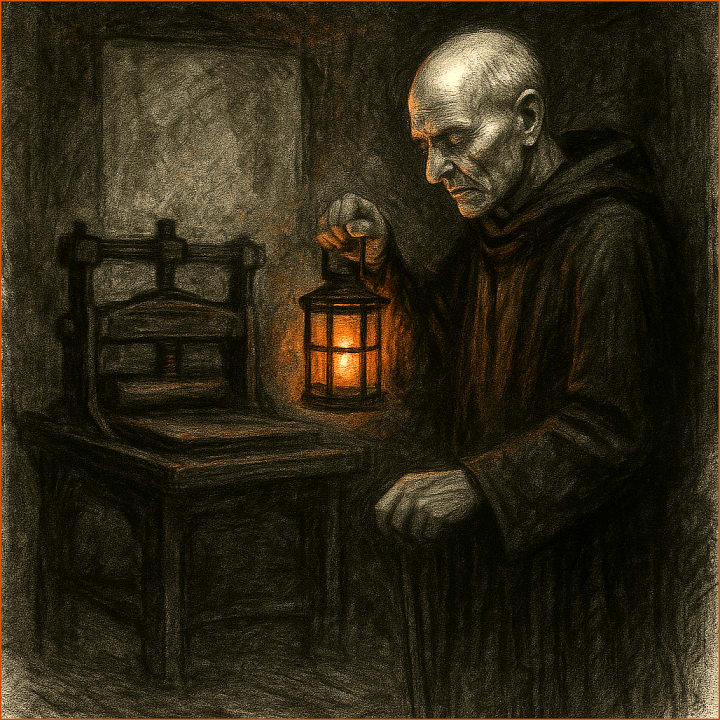
The corridor narrowed, then opened into a sanctuary, a hidden chamber stitched from refusal. The ceiling arched in a crumbling ribcage of stone, and at its center, under a halo of smoke-ringed candlelight, stood an ancient printing press. Iron gears, scribed levers, wood darkened by ink and time. Its limbs were scarred like a body that had known fire. Séraphin stopped. He didn’t breathe.
The press looked like a relic of war. No, not war, of something holier than war. Rebellion.
Father Emeric turned to them, his eyes fever-bright, and pointed to the press. There were no words needed. The press was the word.
Camille circled the machine, fingers ghosting over levers and bolts. She paused before a set of drawers beneath it. She opened one. Inside: rows of metal type blocks, sorted with surgical precision. Some were wrapped in cloth. Others bore letters backwards and scorched. One set had been melted at the edge, as though plucked from a fire and saved by miracle or defiance.
“It survived,” she said softly.
Father Emeric nodded, his gaze heavy with things he would never again speak aloud.
There were murals here too, half-painted, half-carved. Saints with mouths stitched shut. Apostles whose halos burned black.
And in the center, above the altar of broken pews and salvaged wood, a single phrase painted in soot: Loqui in cinere.
Speak in ash.
Séraphin sank to his knees. He hadn’t expected this. He thought they might find ruins, fragments, perhaps whispers of what once was. But not this. Not the press. Not the intent.
Camille stood behind him, one hand resting lightly on his shoulder. No pressure. Just presence.
Father Emeric moved toward the altar and drew a cloth aside. Beneath it sat a leather-bound book.
He opened it. The pages were blank save for the first: Rewriting begins with what the Church burned.
Séraphin took the book, fingers trembling. The parchment felt like skin.
“It’s not just a sanctuary,” he said aloud. “It’s a resurrection chamber.”
Father Emeric lit the central candle. Its light touched the edges of shadow and threw the room into low relief, a chiaroscuro of defiance. A ring of dried lilies sat at the base of the altar, their petals blackened, curling inward like tongues bitten in silence.
On the floor around the press, chalk lines formed a circle filled with sigils. Séraphin read them one by one. Some were Latin. Some were not. Some belonged to tongues forgotten or forbidden. One glowed faintly, as though inked in breath rather than powder.
Camille knelt beside the circle. “This is protection,” she said. “But it’s also containment.”
Séraphin met her eyes. “Do you think they feared what it could print?”
“No,” she said. “They feared what it could make real.”
Father Emeric opened another drawer and pulled free a metal plate, etched with lines that shimmered like veins. It wasn’t a page. It was a map, of ink routes, type positions, and burned words. He handed it to Séraphin.
Written across the top: Sanctum VIII - Dies Octavus.
“The Eighth Day,” Séraphin murmured. “The day after divine rest. The day God did not write.”
Camille frowned. “Or the day we started writing for ourselves.”
A silence settled again. But it was not hollow. It was full.
Séraphin placed the plate on the press. The room seemed to inhale. The wax trembled in its jars. A nearby relic cracked as though releasing breath held too long.
Father Emeric did not bless them. He simply stepped back and waited.
Séraphin touched the press.
And the sanctuary began.
Scene 4: The Hidden Press (The altar splits to reveal what the Church tried to bury.)
The air deepened. Time slowed its pulse.
Séraphin stood still, his body angled toward the altar like a compass drawn to something older than scripture. The low light hummed with unsaid things. Camille stood beside him in a hush, not as guardian now but as co-conspirator, each breath they took fogging into the hush of the crypt like questions dared aloud.
Father Emeric moved toward the altar again. His steps were a psalm. He did not speak. He simply lit a thick taper, its flame catching with a sigh, and placed it inside a rusted iron holder welded to the stone wall. Wax from generations had piled below in drips like stalactites of bone.
Atop the altar sat a slab of rough limestone, its face streaked with soot and scorch marks. Upon it, an iron crucifix lay on its side, bent, warped from heat, its nails long rusted over. Burnt lilies were scattered across its base, curling inward with velvet-black rot. Séraphin reached down to touch one and felt the petals crumble into soot. He let the ash smear his fingers.
Then Father Emeric stepped to the side and, with surprising strength, pressed two fingers beneath the edge of the altar slab.
There was a click. A shift.
The stone top groaned.
Dust leapt upward in startled flight as the altar slowly slid backward—revealing a dark hollow beneath, lined in scorched brick and choked with old air. Camille drew closer. She looked down.
A narrow staircase descended. The stone was blackened, the edges of each stair faintly burned, as if someone, or something, had tried to set the passage ablaze from within. And failed.
"He knew it would be buried," Séraphin whispered. "So he built it beneath the altar."
Emeric handed the candle to Camille. She took it without speaking, descended first. Her boots echoed faintly as she disappeared into the dark, her flame bobbing like a ghost through ink. Séraphin followed.
The walls of the staircase were inscribed, not carved, but scorched. Flame had licked the Latin into stone. Passages reversed. Others broken. Séraphin could read only fragments:
Et lux in tenebris... (And light in darkness...)
Ecclesia mentitur... (The Church lies...)
In cinere veritas... (In ash, truth...)
Camille turned to him. Her face caught the candle’s glow. "It was always meant to be found. But only by those burned."
At the base of the stairs, they reached a chamber.
The room was barely wider than a coffin laid lengthwise. A metal table stood in its center, rusted, scorched, flecked with wax and bloodstains. Upon it sat a narrow box, locked. The walls were covered in paper stitched into the stone. Pages torn from bibles, medical ledgers, heretical tracts. Scraps inked by hand, smeared by tears or something worse.
And in the far corner: another press.
This one was smaller, hidden, its shape swallowed by shadows until Séraphin stepped near. The candlelight shivered.
It had no handles. No visible type. Just an opening.
A place for a single sheet.
A machine for one truth at a time.
Séraphin stepped closer. He reached into his satchel, pulled out the blank book Emeric had given him. Camille took out a worn fountain pen. The nib was chipped.
"Do you know what you want to write?" she asked.
Séraphin looked up at the walls again. At the scraps of other people's silenced voices. One fragment caught his eye:
I bled the truth out of myself so no one else would have to.
He placed the book on the slab. His hand shook.
“I want to write what fire couldn’t kill.”
Father Emeric moved into view. In his hands was a folded cloth. He opened it.
Inside: a page. Crisp. Yellowed. The title, inked in neat calligraphy: Dies Octavus: The Eighth Day.
Séraphin stared. His name was at the bottom.
But he had never written it.
Camille read it in silence, then looked up at him.
“Someone started this before you,” she said. “Or knew you would come.”
Séraphin touched the page. The ink was still faintly wet.
He looked back at Emeric. The old man said nothing. Only pointed to the press.
Séraphin took the page. He slid it inside.
There was a sound, a deep groan of metal meeting memory. A low exhale. The chamber dimmed.
A spark burst from the base of the press. The candle flickered violently.
And then, silence.
When Séraphin pulled the page free, a new line had appeared at the bottom:
The saint is ash, and yet he speaks.
He held it up to the candle.
The ink shimmered red.
The flame flared, then went out.
He didn’t move for a long time.
Camille broke the silence, her voice fraying like old cloth. "What if this press doesn’t just write truth, what if it births it?"
Emeric’s silence was thunderous. He turned and retrieved another artifact, this time a small leather pouch. From it, he poured a handful of teeth onto the table. Human. Some cracked, others gold-capped.
"The cost," he whispered.
Séraphin’s knees buckled, but he didn’t fall. He leaned over the page. The red shimmer had deepened, glowing like embers.
Camille reached for his hand. He pulled it back. “No,” he said, not unkindly. “If I go further, I need to go alone.”
“You think that’s what this is?” she asked. “A path for martyrs?”
“No,” Séraphin replied. “It’s a door. For the damned.”
He pressed the page against his chest. A heartbeat later, the ink bled into his skin. He gasped.
Camille lit another candle. She could see the words now, Dies Octavus, written beneath his collarbone.
She didn't know whether to weep or write.
“Will it consume you?” she asked.
Séraphin exhaled. “Only what was false.”
From above, a groan of shifting stone echoed.
The altar had begun to close.
They were not alone anymore.

Chapter One End.
Ashes Between Chapters: (Author’s Corner – Notes from S.L. James)
The first chapter was never meant to offer answers; it was meant to haunt with questions.
In writing The Ash Saint, I imagined what it means to walk willingly into the ruins of belief. Séraphin doesn’t enter the monastery to find sanctuary, he enters to witness the remains. The echoes carved in soot. The relics buried in flame. The scripture no one was meant to read.
Ash is a sacred element to me. It is not the end of fire, it is what survives it. What Séraphin finds in that wall is more than reversed Latin. It is a gospel for the uncanonized, for those whose truths were too volatile for pulpits or parchment. Every word in soot is a testimony someone died for, and still, it wasn’t enough to silence them.
Father Emeric’s vow of silence isn’t passive. It is a blade made of stillness. Camille’s steadiness is not softness, it is forged resistance. And Séraphin, he begins not as a prophet, but as a man trying to rewrite himself before he disappears.
I wanted to make this chapter feel like a held breath. The flicker before detonation.
If it unsettled you, good. That means you’re listening to the fire under the floorboards.
The next chapter walks further into the dark.
Ask yourself, as I did: What would you sacrifice to write something that can’t be erased?
Until Chapter Two, S.L. James
The ink remembers what the flame forgets.
About the Creator
S.L. James
S.L. James | Trans man (He/Him/His) | Storyteller of survival, sorrow, resilience. I write with ghost-ink, carving stories from breath, scars, and the spaces the world tries to erase.
Keep reading
More stories from S.L. James and writers in Fiction and other communities.
Lightning Never Strikes Twice
The distant rumble, the sudden deluge, the crescendo of sound, the flash of light, the explosive energy — it never gets old. I became an amateur storm chaser about two years ago. My wife, Cindy suggested it. Sort of. She said, "Alex, you know this cancer is killing me. I've come to terms with that, but you're smothering me. Go join a band, write a book, or become a storm chaser, for all I care. I love you, but you need a hobby."
By Julie Lacksonen7 days ago in Fiction
The rule everyone knows
I recently rewatched The Truman Show yesterday amidst all the chaos of the crazed media story that Jim Carrey was cloned. I give that rumor no credence to my own sensibilities, however, when I saw him in that French award ceremony, I had to do a double take. It wasn’t so much that I actually believed he was cloned or anything crazy like that, but, I had a weird gut reaction that made me think, “Someone or something got to him,” because he just doesn’t act like that in most celebrity or movie award ceremonies. You all saw must have seen those interviews where he made fun of Hollywood, being evil that is made to feel real but is really mocking us all. All that Illuminati talk. I was like, “That boy is going to get himself killed.”
By Melissa Ingoldsbya day ago in Fiction


Comments
There are no comments for this story
Be the first to respond and start the conversation.