
The Echo Room
The same creeping ivy clung to the bricks, the porch light still flickered with a stubborn hum, and the oak tree in the front yard stood sentinel, gnarled and wise. Loreen Breen, dressed in an elegant navy coat and polished shoes, looked completely out of place—like a photograph taped onto an old postcard. But here she was, back again, not as a daughter, but as the executor of Lucy Brampton's will.
The house hadn’t changed.
The same creeping ivy clung to the bricks, the porch light still flickered with a stubborn hum, and the oak tree in the front yard stood sentinel, gnarled and wise. Loreen Breen, dressed in an elegant navy coat and polished shoes, looked completely out of place—like a photograph taped onto an old postcard. But here she was, back again, not as a daughter, but as the executor of Lucy Brampton's will.
She had come alone. No assistants, no colleagues, no publicist. The world outside would think the polished businesswoman was simply on a quiet break. They didn’t know she was here to sort through the remains of a life she barely understood.
As Loreen entered the house, the silence hit her like a forgotten lullaby—familiar and uneasy. Everything was intact, preserved like Lucy had only stepped out for groceries. That was Lucy’s way: orderly, composed, and distant.
Then Loreen remembered the room.
The soundproof room.
A place Lucy always called "The Study" but was never used as such. As a child, Loreen had tried the doorknob once, only to be scolded sharply—"We don't go in there." That was the end of it. Decades passed, and she never questioned it again. But now, the house was hers, and so were its ghosts.
The key hung on a brass hook in the hallway. As Loreen unlocked the door, the quiet clicked loudly in her chest.
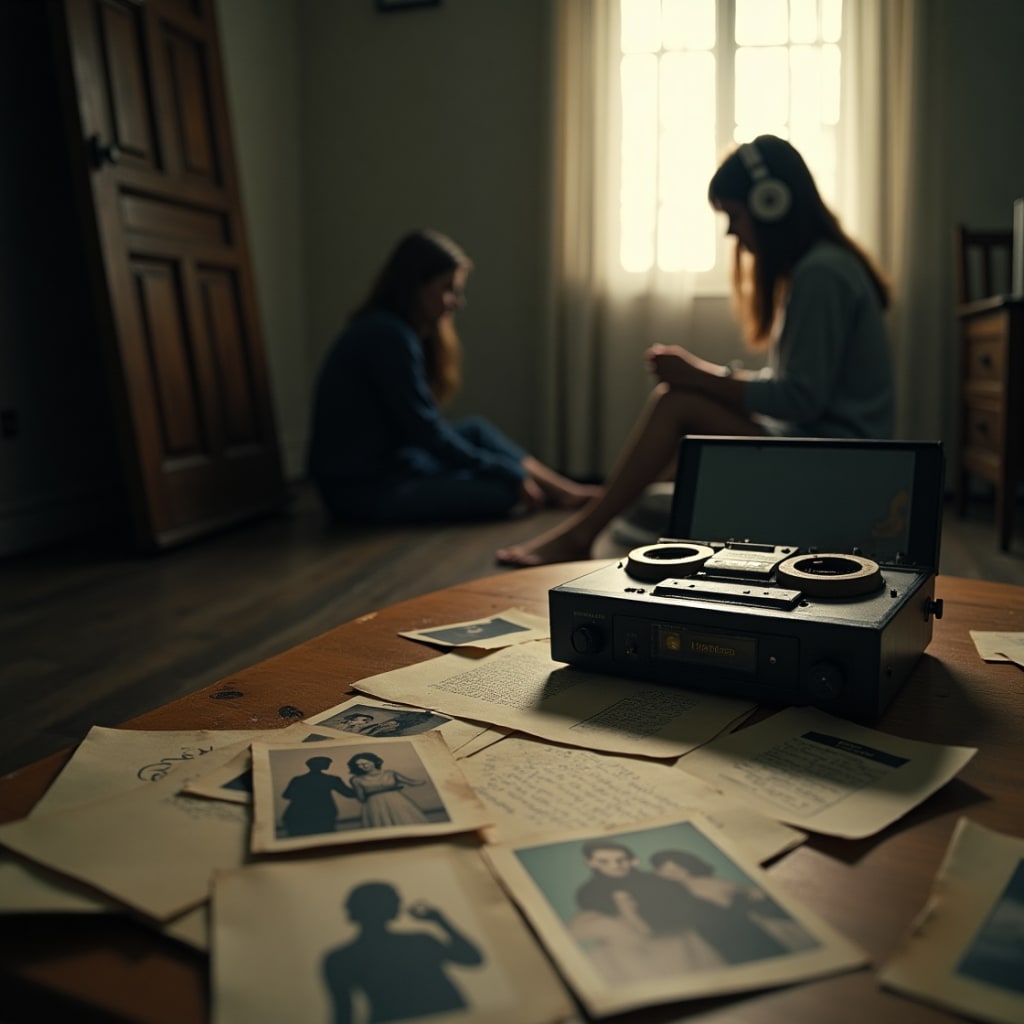
The room was dark, but the air felt thick with memory. Against the far wall was an old wooden table, covered in dust and a small audio recorder surrounded by dozens of labeled cassette tapes. Each tape had a date and one or two words scribbled in Lucy’s neat, slanted handwriting.
"Nov 12, 1987 – Silence"
"April 3, 1992 – Rage"
"June 15, 1999 – Loreen’s Graduation"
"Jan 1, 2001 – Goodbye"
She hesitated, heart thudding. Then she pressed play.
“November 12, 1987. Loreen turned seven today. She looked beautiful in her blue dress. She smiled so hard it made my chest ache. I told her she looked like a doll, but I didn’t say I was proud of her. Why didn’t I say it? Why do the words choke in my throat when I try to love her the way she deserves?”
Loreen’s breath caught.
She rewound the tape and played it again, this time sitting on the cold wooden floor, her coat still on.
Over the next few hours, she played tape after tape.
Lucy’s voice was steady, soft, and hauntingly honest. She spoke to herself like no one else was listening.
There were tapes about her failed marriage to Loreen’s father—“He said I was too cold, too composed. But chaos scared me more than loneliness.”
There were tapes about nights spent standing silently by Loreen’s door, listening to her breathe, too afraid to knock. Tapes about suicidal thoughts, about fear, about a longing to be held and a deeper fear of being known.
But the most painful were the tapes labeled with Loreen’s name. They weren’t criticisms. They were confessions. Lucy had adored her, deeply and desperately, but hadn’t known how to show it.
“She looked at me like I was a stranger at her graduation. I wanted to hug her, to say I loved her, but all I managed was a nod. She left without looking back. And I didn’t chase her.”
“She’s brilliant, my Loreen. Successful. But I wonder—did she become all that in spite of me, or because I taught her to keep feelings locked behind polished smiles?”
Loreen cried for the first time in years.
Not dramatic, cinematic sobs—but quiet, exhausted weeping. For the mother she had never truly known, for the childhood she had misunderstood, and for the pieces of herself she had buried in the pursuit of perfection.
The next morning, she called in a cleaner and took the tapes to the hotel room she was staying in. Over coffee, she began digitizing them, creating folders titled "Lucy", "Childhood", "Regret", and "Love".
She didn’t return to her office in the city. Instead, she stayed in town for weeks, sorting through the tapes, organizing letters Lucy had written but never sent, and even finding a few unfinished stories Lucy had started—a woman with a quiet fire, hidden behind decades of silence.
One afternoon, while listening to a tape from the early 2000s, Loreen heard something that made her freeze.
“If Loreen ever finds these tapes, I hope she knows I was trying. I never wanted her to think she wasn’t loved. I just didn’t know how to hold someone without trembling. But I saw her. Every day, I saw her. And she was magnificent.”
That night, Loreen began to write.
Not business emails. Not public speeches. But a story. A novel, even. About a mother and a daughter who couldn’t speak in the same language, but who both longed to be heard.
Years later, the book would be published under the title “The Echo Room.” It would be praised for its raw honesty and poetic grief. Some readers would say it made them call their mothers. Others would cry over pages they wished they could write to someone no longer alive.
But Loreen wouldn’t think about the readers.
She would think of a soundproof room, dusty cassette tapes, and a voice that had once lived behind walls.
She would think of her mother—not the stranger she resented, but the woman she finally came to know.
And she would whisper, each time she read the last page:
"I heard you, Mom. I heard you."
About the Creator
Ahmad shah
In a world that is changing faster than ever, the interconnected forces of science, nature, technology, education, and computer science are shaping our present and future.
Keep reading
More stories from Ahmad shah and writers in Fiction and other communities.
The U.S. Fighter Jet B-2 Spirit – A Marvel of Stealth Technology
Introduction The B-2 Spirit, commonly known as the B-2 Stealth Bomber, is a highly advanced strategic bomber developed by the United States. Unlike traditional fighter jets, the B-2 is a long-range, stealth heavy bomber, capable of penetrating dense anti-aircraft defenses and delivering both conventional and nuclear weapons. Introduced in the late 20th century, the B-2 represents the cutting edge of aviation technology and military strategy, emphasizing stealth, precision, and deterrence.
By Ahmad shah8 months ago in Fiction
Becca
"Everything is so... flat." Denille said stupidly as she looked around her new neighborhood. She looked around at the muted desert where even the smallest sign of life seemed to have given up. The plant life was shrubs that were half cooked by the heat and where there should have been a lawn, a mess of white rocks laid glistening in the sun. Even the sky looked stretched thin, like the sun had ironed it smooth. She’d moved from Riverside, where at least there were hills, but here in Barstow, everything felt baked and brittle.
By Sara Wilson7 days ago in Fiction


Comments
There are no comments for this story
Be the first to respond and start the conversation.