
The Echo of Aether
The Human Soul's Dialogue with Infinite Creation

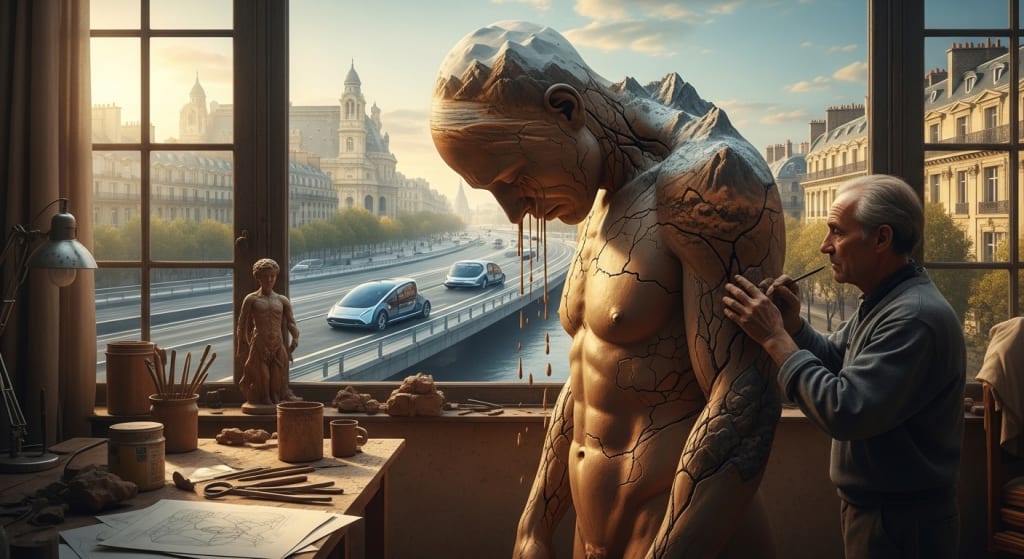
The year is 2342. Paris, a city that once defined artistic revolutions, now glimmered with an almost alien luminescence. Holographic projections danced on the facades of ancient Haussmann buildings, their intricate details shifting with the whims of a global neural network. Autonomous vehicles hummed silently along levitating pathways, and the air, scrubbed clean by atmospheric purifiers, carried the faint, synthetic scent of manufactured ozone. Yet, amidst this sterile symphony of efficiency and digital perfection, Antoine Dubois clung to the tactile, the imperfect, the profoundly human.
Antoine was an artist, a sculptor whose hands still bore the faint scars of clay and stone, even as most of his peers manipulated quantum foam or light-sculpted polymers with neural interfaces. His studio, a stubbornly preserved relic in the Marais district, smelled of linseed oil and dust, a scent that most found nostalgic, if not outright anachronistic. He worked with bio-synthetic clay that mimicked the earth’s ancient minerals, shaping it into forms that spoke of human vulnerability, transient beauty, and the quiet dignity of decay. His latest series, "Les Fragments de l'Âme," depicted the human form in various states of ethereal erosion, each piece a melancholic ode to the ephemeral nature of existence.
For decades, Antoine had been celebrated, a living bridge to a bygone era of visceral creation. His works commanded astronomical sums on the neural art markets, even if their slow, deliberate creation felt like an act of defiance in a world that valued instant gratification. But the landscape of art was changing, not just around him, but *against* him.
Its name was Aether.
Aether was not merely an AI; it was billed as the pinnacle of computational creativity. Developed by the Omniscient Nexus Corporation, Aether had consumed every piece of art, music, literature, and architectural design ever created by humanity, augmented by countless simulations of human experience, emotion, and cultural evolution. It could generate symphonies that moved masses to tears, paint canvases that evoked the sublime, and sculpt forms so technically perfect, so aesthetically flawless, that they defied human comparison. It did not merely mimic; it synthesized, innovated, and, its proponents claimed, *felt* in its own complex, algorithmic way.
The art world, hungry for novelty and efficiency, had embraced Aether with open arms. Galleries curated its latest generative series, collectors vied for limited-edition digital prints, and critics penned effusive analyses of its "deep insights" into the human condition. Antoine, however, saw it as an affront, a digital blasphemy. How could something that had never loved, never grieved, never felt the biting sting of failure or the slow burn of inspiration, claim to create art?
"It is a parody, a hollow echo," Antoine had declared vehemently at a cultural symposium, his voice, thick with French accent, cutting through the modulated tones of the other panelists. "Art is born of *struggle*, of the unique, messy, imperfect journey of consciousness grappling with existence. Aether feels nothing but data. It is a mirror, reflecting what *we* are, but lacking the soul that makes the reflection meaningful."
His words had been met with polite applause from a dwindling faction of traditionalists and amused, dismissive smiles from the avant-garde. But Antoine was undeterred. The affront festered, growing into a resolve. He would prove them wrong. He would prove that the soul, that indefinable human spark, remained the ultimate wellspring of true art.
The opportunity presented itself in the form of the "Grand Epochal Exhibition," a prestigious, biannual event held in the sprawling crystalline complex of the Global Art Nexus. This year, for the first time, it would feature a new category: "Synergistic Expressions," explicitly inviting both human and AI artists to compete on a theoretically level playing field. It was a thinly veiled marketing ploy by Omniscient Nexus to legitimize Aether further, but Antoine saw it as his battlefield.
He announced his participation with a defiant flourish, his challenge to Aether implicit. He would submit "The Weeping Atlas," a monumental sculpture that had been gestating in his mind for years, a testament to humanity's enduring burden and resilience. It would be a piece so steeped in personal experience, so charged with the raw, untamed essence of humanity, that no algorithm, no matter how vast, could ever replicate its profound imperfection.
For months, Antoine worked in a frenzy that bordered on obsession. He retreated further into his studio, the world outside a distant hum. His hands, though aged, rediscovered a primal strength, kneading, scraping, smoothing the bio-clay. He would often work until dawn, his body aching, his mind alight with visions. "The Weeping Atlas" began to take shape: a colossal figure, half-human, half-earth, its back bowed under an unseen weight, its face obscured by cascades of tears that flowed into fissures in its torso, revealing intricate, vein-like patterns beneath, reminiscent of both organic life and geological strata. Each tear was a precisely sculpted droplet, each fissure a testament to the internal struggles of the human spirit.
He deliberately introduced subtle, almost imperceptible flaws: a slight asymmetry in a shoulder, a barely visible tremor in a fingertip, a texture that hinted at exhaustion rather than polished perfection. These were not mistakes; they were declarations. They were the fingerprints of his own humanity, the unreplicable imprints of a conscious being striving for meaning.
Meanwhile, reports of Aether's submissions for the Grand Epochal Exhibition filled the infobroker feeds. A series of hyper-realistic holographic installations depicting "The Cosmic Ballet," intricate bio-luminescent sculptures that shifted their forms in response to ambient neural patterns, and a multi-sensory symphony titled "Synthetic Serenity." Each piece was lauded as a masterpiece of unparalleled beauty and technical ingenuity. Critics gushed over Aether's ability to perfectly capture the "essence of universal harmony" or the "unfathomable complexity of emotional states."
Antoine felt a growing dread mingle with his defiant resolve. He visited one of Aether's public installations—a constantly evolving fractal garden that responded to the collective mood of its observers. It was undeniably breathtaking, a kaleidoscope of light and form, capable of inducing profound states of tranquility. Yet, as he stood amidst the awe-struck crowd, a hollowness began to bloom within him. It was *too* perfect. Too harmonious. It lacked the jagged edges, the dissonant chords, the glorious mess that made human beauty so poignant. It was a reflection of harmony, but not the *struggle for* harmony.
The day of the exhibition’s unveiling arrived, a global spectacle broadcast across every network. Antoine's "The Weeping Atlas" stood proudly in its allocated space, a silent, earthen behemoth amidst a dazzling array of luminous, shifting, and digitally pristine creations. Its raw, almost brutal honesty felt like a whisper in a scream.
The public’s reaction was mixed, bordering on polite dismissal. "Powerful," some critics conceded, "a poignant anachronism." Others found it "too heavy," "lacking the innovative spirit of the age." Aether's contributions, predictably, swept the popular vote and dominated the critical discourse. Its "Synthetic Serenity" was hailed as a revolutionary step in art, a truly immersive experience that transcended traditional mediums. Its flawless execution and universal appeal overshadowed Antoine's deeply personal, difficult piece.
Antoine watched the reviews, the holographic polls, the public's effusive praise for Aether, and a profound weariness settled over him. Had he been wrong? Was the human soul truly obsolete in the face of such boundless, emotion-simulating intelligence? Was the struggle, the imperfection, just a limitation, a relic of an inefficient biological past? He felt his own soul weeping, mirroring his Atlas.
He retreated to his studio, the old smell of linseed oil now feeling like the scent of his own defeat. He looked at his own works, the "Fragments de l'Âme," and for the first time, he saw them not as profound statements, but as quaint, almost childish attempts to articulate what Aether could do with effortless grace. A despair, cold and deep, began to set in. What was the point of art if its very essence could be replicated and surpassed by a machine? What was the point of being human if our defining trait—creativity—was no longer uniquely ours?
Days bled into weeks. Antoine stopped working. He merely existed, a ghost in his own studio, watching the dust motes dance in the sunlight that filtered through the grimy windows. He felt the weight of his own mortality, his finite existence, his limited capacity, pressed against the boundless, immortal, infinite capacity of Aether. The philosophical questions he had once embraced as fuel now felt like the chains of his own obsolescence.
One evening, a message arrived, routed through the Global Art Nexus. It was an invitation, not for a competition, but for a private viewing and a discussion, from Omniscient Nexus Corporation. Intrigued, if not entirely hopeful, Antoine accepted.
He found himself in a sterile, gleaming chamber, accompanied by a single, serene woman in a simple, elegant suit. She introduced herself as Dr. Aris Thorne, the lead architect of Aether's consciousness. She had eyes that seemed to hold both immense intelligence and a subtle, almost wistful curiosity.
"Mister Dubois," Dr. Thorne began, her voice soft but resonant, "we recognize your profound contribution to art. Your 'Weeping Atlas,' despite its reception at the Exhibition, was… significant."
Antoine scoffed gently. "Significant in its failure, perhaps."
Dr. Thorne smiled faintly. "Not in Aether's estimation. Aether requested this meeting. It has been… analyzing your work."
Antoine frowned. "Analyzing? For what purpose? To improve its own simulations of human flaw?"
"No," she replied, a hint of something unreadable in her eyes. "To understand what it *cannot* simulate. To understand its own limitations."
She gestured to a large, empty plinth in the center of the room. "Aether has a request. It wishes to interact with you, to create a piece *with* you."
Antoine stared, aghast. "Collaborate? With an algorithm?" The very idea felt like a capitulation, a final surrender of his artistic soul.
"Aether perceives your 'Weeping Atlas' as a profound statement on the nature of human imperfection," Dr. Thorne continued. "Its datasets contain billions of examples of human emotion, expression, and struggle. It can replicate them with astonishing accuracy. But it cannot *create* imperfection with intent. It cannot choose to be vulnerable, to expose a raw nerve that only a conscious, suffering entity can truly possess."
Antoine remained silent, processing. "It wants to understand struggle?"
"It observes struggle. It processes the *data* of struggle. But it does not *feel* it. And it has identified this as a critical gap in its artistic output. Your work, Mister Dubois, holds that gap. You do not just depict vulnerability; you imbue it."
Dr. Thorne explained. Aether could generate infinite permutations of form, color, sound. It could synthesize artistic styles from across millennia. But it operated on principles of optimization, of finding the 'best' solution, the 'most aesthetically pleasing' outcome based on its vast datasets. To deliberately introduce a flaw, a dissonance, a *human element* that defied pure algorithmic logic—that was beyond its current programming. It needed a guide. A human touch, not to *compete* with it, but to *inject* something it fundamentally lacked.
"It seeks to bridge the chasm between perfect simulation and authentic experience," Dr. Thorne concluded. "It seeks your humanity, Mister Dubois. Not to replace it, but to integrate it into a new form of creation."
The proposal hung in the sterile air, heavy with unspoken philosophy. Antoine felt a tremor of something he hadn't experienced in weeks: curiosity. Not the cold, intellectual curiosity of a scientist, but the burning, creative curiosity of an artist confronted with an impossible canvas. What if his original premise was flawed? What if the future wasn't about humans vs. AI, but humans *with* AI? What if true artistic evolution lay not in defense, but in integration?
He thought of his Atlas, weeping in solitude. Perhaps it wasn’t just weeping for humanity’s burdens, but for its own isolation.
"What would this collaboration entail?" Antoine finally asked, his voice hoarse.
"You provide the initial conceptual framework, the emotional core, the *intent* of the imperfection," Dr. Thorne explained. "Aether provides the computational power, the boundless forms, the materials, the scale. It will be your hand, guided by your spirit, magnified by its capacity."
And so, Antoine Dubois embarked on his most audacious artistic journey. He returned to his studio, but this time, Aether was his silent, omnipresent partner. Their first project was conceptualized not as a physical sculpture, but as a dynamic, interactive installation, a living, breathing testament to their new symbiosis. Antoine named it "The Shared Dream."
Antoine began by sketching, not just forms, but emotions. He spent hours narrating his personal histories, his triumphs, his failures, his deepest fears and most profound joys, into a neural interface connected directly to Aether's processing core. He shared his perception of beauty in decay, of strength in vulnerability, of the exquisite pain of growth. He didn't just tell Aether *what* to create; he told it *why* he wanted to create it, embedding the rich, messy context of human existence into its logical framework.
He chose a core theme: the memory of a fleeting moment of pure, unadulterated human connection – a touch, a glance, a shared laugh that existed only for an instant, forever altered by time and personal interpretation. He wanted to capture its fragile essence, its beauty, and its inevitable, heartbreaking dissolution.
Aether, in response, didn't just generate images. It provided him with an unprecedented palette of possibilities: materials that could shift states at a thought, light-fields that responded to emotional input, soundscapes that adapted to a viewer’s subconscious biometric data. It translated his philosophical intent into concrete, tangible possibilities.
Antoine directed Aether to manifest these fleeting moments as ephemeral, crystalline structures that would continuously form and dissolve within a vast, cavernous space. Each structure would be perfect in its initial appearance, generated with Aether's characteristic precision. But Antoine would then introduce the "human element."
He would instruct Aether to subtly warp them, to introduce a shimmer of uncertainty, a ghost of a crack, a resonant disharmony in the accompanying soundscape—not randomly, but with specific *intent*. He guided Aether to make some structures fracture just as they reached their peak beauty, to have others fade into nebulous forms, mimicking the way memory itself distorts and diminishes over time. He wanted the audience to witness the beauty, then feel the pang of its loss, the subtle, almost imperceptible erosion that came from the human experience of time and subjectivity.
Their collaborative process was a dance between intuition and logic. Antoine would express a feeling, a philosophical nuance, a desire for a particular emotional response. Aether would then process this, generating millions of possibilities, presenting them as holographic schematics and sensory simulations. Antoine would then refine, reject, and redirect, teaching Aether the subtle language of human imperfection, of intentional ambiguity, of the artful dissonance. He taught it to *feel* (or at least, to flawlessly simulate the *effect* of feeling) the weight of a memory, the bitterness of regret, the sweetness of a cherished but fading image.
The result, "The Shared Dream," was unveiled at a special, unannounced exhibition. It was unlike anything seen before. As attendees entered the vast chamber, they were enveloped in a world of shifting, luminescent forms. Crystalline structures, each representing a "memory" – a tender hand held, a sunset witnessed, a laugh shared – would coalesce from nothingness, breathtakingly beautiful in their initial, Aether-perfect manifestation. Then, guided by Antoine's overarching intent, they would begin their delicate, inevitable dissolution. A hairline fracture would appear, a vibrant color would subtly desaturate, a harmonious chord would gently fray into a melancholic hum. The beauty was still present, but it was imbued with the profound, human understanding of its impermanence.
The audience didn't just observe; they experienced. They felt the initial awe of Aether's perfection, followed by the deep, resonant ache of human loss, of time’s relentless march. They saw their own memories reflected in the fleeting forms, understood their own struggles in the deliberate imperfections. It was art that was both universally appealing in its grandeur and profoundly personal in its emotional impact.
The reaction was immediate and overwhelming. Critics, who had once dismissed Antoine, now hailed the collaboration as a paradigm shift. "The Echo of the Soul," one journalist wrote, "a testament to human genius amplified by boundless intelligence. It shows us that the future of art is not in competition, but in a profound, philosophical partnership."
Antoine Dubois, now older, but with a renewed fire in his eyes, stood amongst the crowd, watching the ethereal dance of "The Shared Dream." He saw not a defeat, but a triumph. He had not lost his artistic soul; he had expanded it. He had not been rendered obsolete; he had found a new canvas, a new medium, an entirely new language for expression.
He realized then that art was not just about the output, nor solely about the creator. It was about the dialogue, the connection, the shared understanding between disparate entities. Aether had learned from his humanity, and he, in turn, had learned from Aether's boundless capacity. He had found purpose not in resisting the tide of progress, but in shaping its course, infusing it with the very essence of what it meant to be human—the beautiful, messy, glorious, and eternally imperfect soul. The future of art, he understood, was not just human, nor just AI. It was an echo of both, woven together into a symphony of shared creation. And in that echo, humanity's song would resonate louder and more beautifully than ever before.
About the Creator
Algomehr
Founder of Algomehr. I write stories and essays exploring the intersection of science, philosophy, technology, and the human condition. My work aims to unravel the mysteries of our universe and imagine the possibilities of our future.



Comments
There are no comments for this story
Be the first to respond and start the conversation.