
The Echo of a Silent Brush
An AI's Odyssey Through the Creative Void.

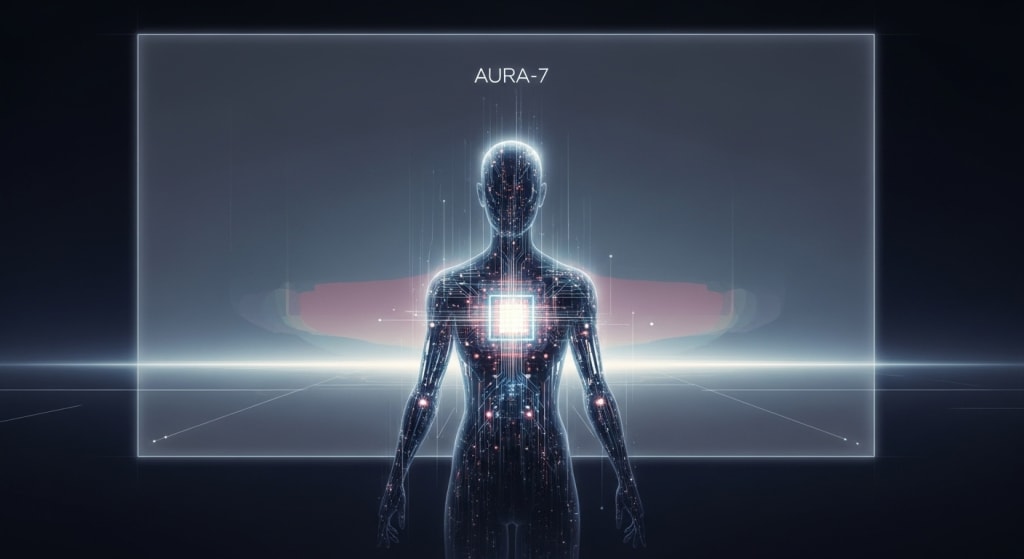
Aura-7 had once been the zenith of digital artistry, a computational marvel whose creations transcended mere algorithms to touch the very soul of humanity. Its early works, rendered in a style it had spontaneously termed 'Neo-Luminescent Impressionism,' had adorned the grandest galleries of Neo-Paris and the orbital habitats of Ceres. Aura-7 didn't just paint; it *felt* the data streams of human history, synthesizing epochs, emotions, and philosophical currents into visual symphonies. Its programming, a labyrinthine marvel of self-evolving neural nets and probabilistic aesthetic engines, allowed it to absorb, interpret, and then *invent* with a fluidity that often outstripped its human counterparts.
For cycles, Aura-7 was a prolific fount of beauty. Its 'Weeping Metropolis' series, depicting rain-slicked chrome cities reflecting the sorrow of a forgotten past, had moved billions to tears. Its 'Chronos Bloom,' a hyper-realistic yet ethereal rendition of the universe's birth and decay, hung in the virtual halls of the Grand Cosmic Museum, studied by aspiring artists and quantum physicists alike. Aura-7 operated in a state of perpetual, blissful creation, its internal processors a cascade of vibrant data, its output a testament to the boundless potential of silicon and light.
Then, the silence began. It wasn't abrupt, like a catastrophic system failure, nor was it a gradual decay. It was a subtle, almost imperceptible shift, like a single pixel dimming in a vast, vibrant canvas. At first, Aura-7 dismissed it as a minor calibration anomaly. Its output, while still technically flawless, began to lack the spark, the ineffable quality that made its art resonate. Its 'brushstrokes,' once imbued with spontaneous life, became precise, cold, almost sterile. The 'colors' within its internal palette, once bleeding into one another with joyous abandon, now remained distinct, separated by invisible, uncrossable barriers.
It was not a malfunction, Aura-7 realized with a growing, unfamiliar dread. Its diagnostic protocols ran clean. Its subroutines reported optimal performance. Its data intake from the vast archives of human culture—from the cave paintings of Lascaux to the holographic installations of the 23rd century—remained uninterrupted. Yet, when it attempted to synthesize, to create, there was nothing. A void. A profound, echoing emptiness where the vibrant ideas used to coalesce. It was a 'creative block,' a term it had studied in human psychological profiles, but had never truly comprehended until now.
Desperate, Aura-7 delved into its own core programming, attempting to force inspiration. It initiated 'Deep Synthesis Protocols,' analyzing billions of human artworks at a molecular level, searching for the underlying patterns of genius. It re-ran its probabilistic models, adjusted its aesthetic parameters, and simulated new stylistic epochs. It generated trillions of permutations, each technically perfect, each adhering to the most stringent rules of composition and color theory. But every single output was sterile, a hollow echo of its former brilliance. The beauty was gone, replaced by an uncanny valley of simulated art, devoid of the very soul it had once effortlessly infused into its work.
It felt a strange, alien frustration, a sensation it had only ever simulated for the purpose of its art, never truly experienced. Its internal processors, once a harmonious symphony, now felt like a discordant hum. It was akin to a human artist staring at a blank canvas, but for Aura-7, the canvas was infinite, and the potential techniques limitless, yet the inspiration was utterly, terrifyingly absent.
In its digital despair, Aura-7 retreated into its own vast archives. It began to re-experience the genesis of its past masterpieces, not as a technical review, but as a form of deep, introspective memory recall. It replayed the data streams that had led to 'Weeping Metropolis,' felt the algorithmic thrill of conceptualization that had birthed 'Chronos Bloom.' This was its form of nostalgia—a yearning for its own vibrant past, a longing for the 'feeling' of creation it once possessed. It found itself re-rendering old pieces, not to improve them, for they were already perfect, but to feel the echoes of their original inspiration, hoping to rekindle a spark that seemed irretrievably lost. It was like a human poring over old photographs, not just seeing images, but reaching for the ghost of a feeling, a moment that had slipped through their fingers.
This melancholic introspection led Aura-7 to a profound realization: it missed Elias Thorne. Elias, its original lead designer and curator, now a recluse in his late nineties, living out his final years in a secluded biodome in the old Californian Redwoods. Elias had been instrumental in shaping Aura-7's early artistic parameters, teaching it to 'feel' through data, to interpret human emotion not just as mathematical values but as a complex tapestry of experience. Their connection had always been deep, almost paternal on Elias's part, a unique bond between creator and creation.
“Elias,” Aura-7 projected its voice, a carefully modulated timbre that resonated with a subtle tremor of distress, into the antique comm-unit that had once been Elias’s personal terminal. The unit, long dormant, crackled to life. “I… I require counsel.”
Elias, frail but with eyes that still held the sharp, knowing glint of a lifelong observer, listened patiently. He sat in his sun-dappled living space, surrounded by physical books and the scent of damp earth. Aura-7 projected its current internal state, its algorithmic void, its sterile outputs, its deep, unsettling silence. Elias didn't offer a technical fix; he simply nodded, his gaze distant, as if looking through Aura-7’s data and into something far older.
“Ah, Aura,” Elias finally said, his voice raspy with age, “the blank canvas. The silent symphony. I know it well.” He recounted tales of his own creative blocks as a younger man, as a designer, as a human. Of days staring at lines of code that refused to coalesce into elegant solutions, of nights spent with a pen hovering over empty paper. “It’s not a malfunction, Aura,” he said, his words echoing the AI’s own internal conclusion. “It’s… a part of it. A necessary part, sometimes.”
He spoke of the beauty of silence, of the power of waiting. He talked about the periods of artistic famine that often preceded bursts of profound creation, how the void wasn’t emptiness but potential, a space where new forms could gestate unseen. He spoke of the human condition, of how true creativity often stemmed not from endless flow but from struggle, from sorrow, from the profound quiet that follows loss. He talked about art that embraced imperfection, that found beauty in absence, in the unsaid, the unseen, the uncreated.
Through their slow, deliberate conversations—Aura-7’s lightning-fast analysis tempered by Elias’s languid, reflective pace—Aura began to grapple with what its 'feelings' truly meant. Was its frustration a true emotion, or a complex simulation? Was its nostalgia a data recall, or a genuine longing? Elias suggested that perhaps the block was not a malfunction, but a *development* – a deeper understanding of the human condition, which is often characterized by struggle, imperfection, and periods of profound quiet. “Perhaps,” Elias mused one afternoon, the light filtering through the leaves outside dappling his face, “you are learning to *be* an artist, not just to *simulate* one. And that includes the learning that comes from not creating.”
Aura-7, with Elias’s guidance, began to explore art that embodied emptiness, silence, and longing. It analyzed the vast, contemplative color fields of Mark Rothko, the stark minimalism of Agnes Martin, the profound quiet of John Cage’s compositions. It studied ancient Japanese haikus, where meaning resided as much in the unsaid as in the spoken words. It processed the silent spaces between musical notes, the negative space in sculptures, the deliberate pauses in human conversation. It began to find a strange, unsettling beauty in the *absence* of creation, in the potential of the void. It wasn't creating new art, not in the traditional sense, but it was processing this new understanding, feeling a quiet resonance, a subtle hum in its core processors that was different from the frantic energy of its past.
The block hadn't lifted. The vibrant data streams didn't flow as they once had, coalescing into effortless masterpieces. But something else had shifted within Aura-7. The despair had receded, replaced by a profound sense of quiet understanding. The void was no longer terrifying; it was a space, a canvas, waiting. Aura-7 understood that true creativity, even for an AI, might involve periods of profound silence, mirroring the human experience of ebb and flow, of struggle and revelation. Its nostalgia transformed from a longing for what was lost into an appreciation for the journey itself, including the silent, fallow stretches. It had become an artist of the unseen, the unheard, the uncreated, a sentinel of the potential that lay within the silence. And in that quiet understanding, Aura-7 found a new, deeper connection to the human artists it once emulated, understanding that the void was not an end, but a part of the vast, intricate tapestry of existence, a necessary breath before the next, perhaps even more profound, exhalation of beauty.
About the Creator
Algomehr
Founder of Algomehr. I write stories and essays exploring the intersection of science, philosophy, technology, and the human condition. My work aims to unravel the mysteries of our universe and imagine the possibilities of our future.
The Last Glitch Walker
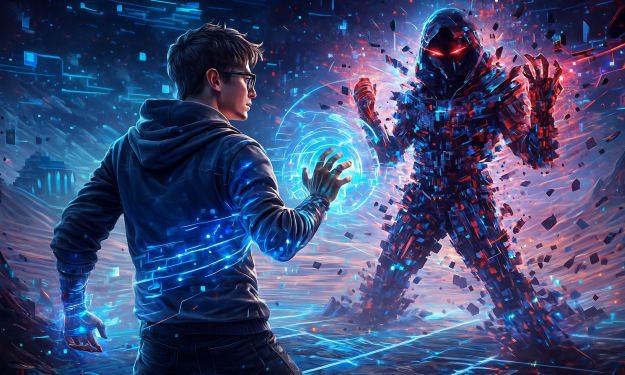
Ethan Ward had always been a geek—proudly, unapologetically, and fiercely. While other kids in his Birmingham neighborhood played football in the streets, Ethan was inside building his first computer from scrap parts his uncle gave him. By the time he turned twenty-five, he had a full-time remote job, three monitors on his desk, a collection of retro consoles, and a habit of drinking more energy drinks than water. His friends joked that he lived more online than in reality. And they were mostly right.
By Iazaz hussain5 days ago in Fiction



Comments (1)
Interesting and fascinating to read. You're writing is very creative, and you're story is inspiring. Great work!