
The Eagle’s Twenty-Year Odyssey: A Journey of Wisdom over Water
Eagle real story

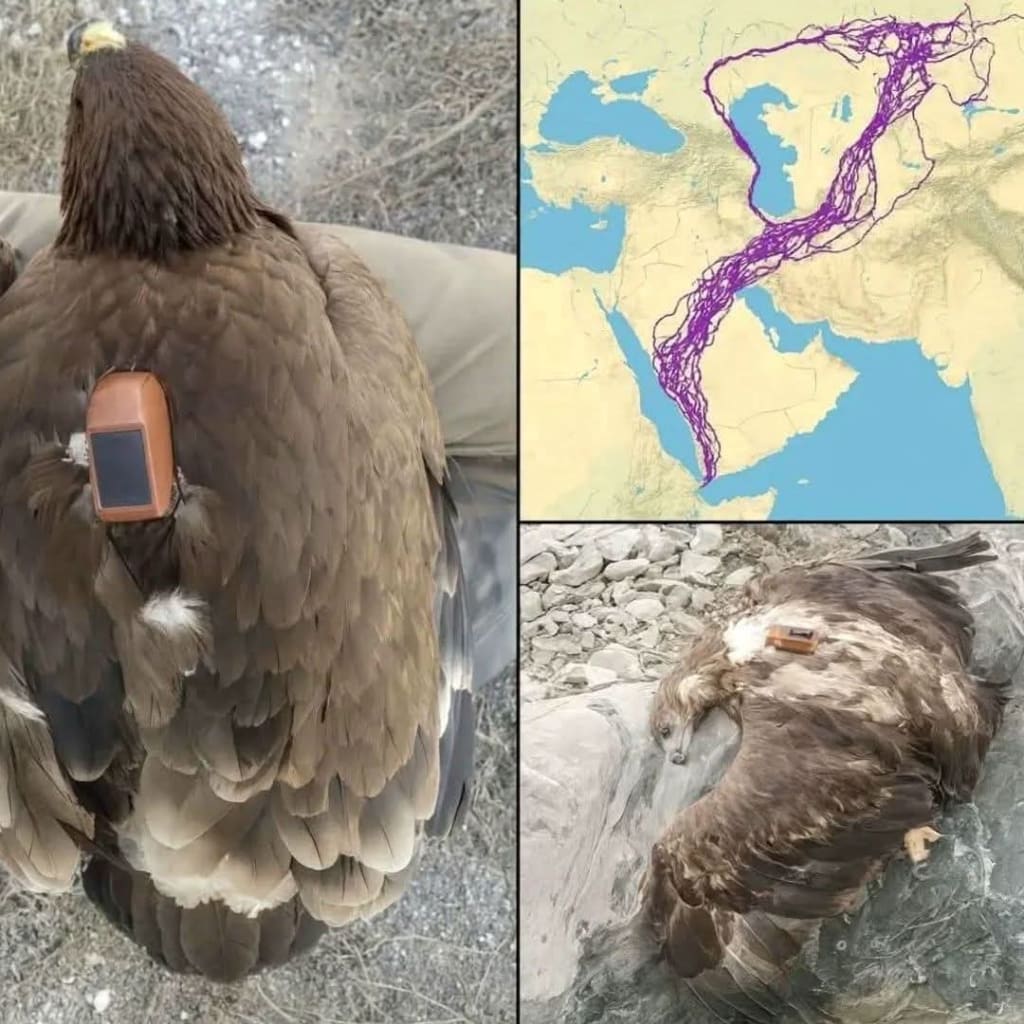
For two decades, a magnificent bird soared above continents, crossing mountains, deserts, and borders — but never once did it dare fly across the sea. This was no ordinary bird. It was a Steppe Eagle (Aquila nipalensis), a creature of vast open lands and high skies, equipped not just with keen eyesight and strong wings but with a deep, evolutionary instinct that helped it survive the test of time — and the trial of travel.
This eagle was one of several fitted with a GPS tracker by ornithologists hoping to study its long migratory patterns. Its journey began in the steppes of Russia and ended in the arid expanse of Wadi Al-Nino, deep in the heart of Saudi Arabia. Over the course of twenty years, the eagle flew thousands of miles across harsh terrain. But what truly captivated scientists wasn’t just the scale of the journey — it was the choices the eagle made along the way.
Time and again, the eagle was presented with seemingly shorter routes — straight paths across open sea. A swift arc over water would have cut hours, perhaps days, off its flight. But the eagle, without fail, always avoided the sea. Instead, it stuck to the long, winding path over land. What seemed inefficient to the human eye turned out to be a masterpiece of evolutionary decision-making.
Unlike seabirds such as the Albatross, which can effortlessly glide for hours over the ocean, the Steppe Eagle is a terrestrial raptor. Its entire flight technique is based on thermals — columns of warm air that rise from the sun-heated ground. These thermals allow the eagle to glide long distances with minimal energy, conserving strength for the journey ahead. Over the ocean, however, these warm air currents are almost non-existent. The eagle would be forced to flap continuously, draining its energy reserves and risking exhaustion or death.
This was not mere instinct — it was survival wisdom, carved by millennia of evolution. The eagle, shaped by nature and tested by geography, had learned through its lineage what paths to follow and which to avoid. Even with no map in its talons, the eagle navigated with a strategy that rivaled that of the most seasoned human travelers.
Scientists from organizations like BirdLife International and the Global Raptor Information Network (GRIN) tracked this eagle and others like it to better understand how environmental factors influence migration. Their findings were as poetic as they were scientific: the bird chose not the fastest route, but the smartest one — a route of endurance, not haste; of instinct, not impulse.
In today’s world, we often equate survival with power — the fastest, the strongest, the boldest. But nature tells a different story. The Steppe Eagle's journey reminds us that survival is as much about strategy as it is about strength. Sometimes, the path to success is not the one that looks most direct on the map, but the one that aligns best with your nature — your strengths, your limitations, and the invisible currents that guide your journey.
This majestic bird’s odyssey isn’t just a tale for scientists or bird enthusiasts. It’s a metaphor — a story of resilience, wisdom, and the silent intelligence embedded in every living being. As climate change reshapes the landscapes these eagles travel, understanding their behavior becomes not only fascinating but essential. Their migration paths tell us about changing wind patterns, disappearing habitats, and the quiet shifts in the natural world that often go unnoticed.
In the end, this story is more than a scientific case study. It’s a reminder that every creature — from the smallest ant to the soaring eagle — is part of a delicate system of survival honed over thousands of years. We often think of nature as chaotic and random, but the Steppe Eagle’s twenty-year journey tells a different tale: one of precision, patience, and profound intelligence.
And perhaps, in watching how an eagle avoids the sea, we too can learn something about the routes we choose — in life, in work, in struggle. Maybe the smarter path isn’t always the shorter one. Maybe survival isn’t just about pressing forward, but about knowing when to take the longer road — the one that lets you glide, not grind.
Sources:
BirdLife International, Steppe Eagle Migration Studies
Global Raptor Information Network (GRIN) – Aquila nipalensis Profile
National Geographic, Tracking Eagle Migration with GPS
About the Creator
Israr khan
I write to bring attention to the voices and faces of the missing, the unheard, and the forgotten. , — raising awareness, sparking hope, and keeping the search alive. Every person has a story. Every story deserves to be told.
Keep reading
More stories from Israr khan and writers in Fiction and other communities.
The Seven Stages of Life: A Reflection on Shakespeare’s Timeless Wisdom
“All the world’s a stage, and all the men and women merely players.” — William Shakespeare The human experience has always fascinated poets, philosophers, and playwrights. Among the most iconic reflections on life’s journey is William Shakespeare’s famous passage from his play As You Like It, where he breaks down the human life into seven distinct stages. This metaphor, where life is seen as a grand performance on the stage of the world, captures the essence of our existence in a simple yet profound way.
By Israr khan4 months ago in Fiction
The Devil's Cut
“Comrade, finally you’re awake.” The voice was smooth, sensual. A flickering incandescent bar was all that lit the white, sterile room. All Vladimir remembered was everything going black. He tried to move his arms and found them strapped to the gurney.
By Matthew J. Fromm4 days ago in Fiction




Comments
There are no comments for this story
Be the first to respond and start the conversation.