
The Dragons Remember
The Sign of the Four

There weren’t always dragons in the valley. When I was still young, the morning sun creeping above the horizon, I would lead our goats through the village gates to lazily wander wherever the choicest grasses led us. On really hot days, I would lounge on the mossy bank beneath the old willow, its thin silvery leaves waving gossamer fingers in the breeze.
In the evening, the old men at the gates would scold as we returned from the fields, ‘Remember the days of old, ask your father and he will tell you, your elders, and they will explain it to you.’ But of all the numberless generations who knew the happiness of our little valley, only I remain to tell of it.
After the dragons came their fires burned in the valley for weeks, turning our beautiful pastures and orchards to wasteland. Our once blue skies were perpetually darkened by smoke and the old willow leaned sadly, its branches blackened and leafless. The stream that fed our land for a hundred generations turned black as pitch with ash.
We tore our clothes and threw ashes on our heads, weeping and petitioning our gods with arms raised to the darkened heavens above us. But they had grown deaf. Most of those who did not starve in the famine that followed the desolation of the valley fled our little village to serve as slaves in the city of the great king. Those who stubbornly remained died of dragon fever. I alone lived, cursed with long life to remember all that I had lost.
The memories of my wife were the most painful of all. The thought of her would hurry my steps as I returned with our little herd every evening. She would milk the does and make cheese for the bread that she baked in a little clay oven. Simple in faith and fervent in prayer, she loved to act out the ancient stories as we lay together in the still of the night.
Caressing my cheek with her fingertips, she would ask me to pretend that I was Apsu, the great sea god hidden in the deepest wells of creation, and that she was Tamtu, the glistening ocean goddess flowing gently above. Pressing her body against mine, she would whisper huskily, “Rise from the depths my Lord and mix your waters with mine.” Then she would giggle as if bedding me was simply another game.
But when she lay upon our bed deathly ill with dragon fever, there was no more acting out of the sacred stories. Instead, she would take my hand as I sat at her side, telling me gravely, “The dragons remember their murdered mother,” as if that might explain what had happened to our valley. Before she fell ill, that was the one story that she never asked me to act out. After Apsu’s murder, Tamtu gave birth to the first dragons, the blood running through their veins poisoned by their mother’s terrible rage.
As my wife grew weaker, she finally stopped speaking, her sad eyes following me as I washed her soiled bedding or when I would return with fresh water from the village well to mop her feverish brow. As ill as she was, she managed to live several more days, but spent much of it sleeping.
On her last morning, she unexpectedly opened her eyes and I took her hand as tears filled my own. She whispered, “The dragons remember,” and looked at me as if seeing me for the first time. “You alone will live.”
“How? How could I ever live without you?”
She shook her head and reached for me with a trembling hand, her fingers softly coming to rest on my lips. “The fever spared you,” she said softly. Closing her eyes, her lips mouthed ‘You will live.’ And then my precious wife left me.
She was the last person to die in the village. Weak in body and spirit as I was, I dug her grave that evening and lowered her body gently into it. I wept so hard as I covered her with our garden soil that I could barely see.
The following day, I lay listless on our bed, a thousand conversations that we had held in happier days running through my thoughts. But it was the story of the first dragons that returned to mind most forcefully.
The gods who murdered Apsu and Tamtu had many children. When their sons looked down at the earth and saw that the daughters of men were fair, they wooed and bedded them. The daughters of men bore children onto the sons of the gods, the same becoming the mighty races of old. The dragons remembering their murdered mother, made war on those same children till the last of the mighty men and women disappeared into legend and myth.
Before my wife’s death, I had never prayed alone. It was something that she always insisted that we do together. But uncharacteristically, after she died, I began to pray that the gods would send the sign of the four, the ones prophesied in an earlier age, the mighty men who would make war on the dragons and end their reign of terror. Even though my body grew gaunt and weak with hunger, I remained faithful and obedient in prayer long after any remaining hope had died within me. Only once I was too weak to lift my arms were my prayers finally answered.
One night as I dozed fitfully on my bed, I opened my eyes and saw the celestial heavens shining above me. I had not seen the stars since the dragon fires had begun weeks before and I wept at their beauty, almost believing that the gods had restored our precious valley back to life. It felt too real for a dream, but when I was caught up into the night and sailed like an eagle upon the western wind I laughed like a little child. I climbed so high that I could see in a glance the mountains surrounding our valley as well as the great tracts of forest and desert stretching out to the far sea. And still I flew on, the waves of the sea so far beneath me that their restless waters seemed glassy and tranquil. When I finally reached the distant shore, I floated as gently to the ground as I was earlier lifted from it.
A young woman wearing a plain white chemise met me there and bade me silently to follow.
Leaving the shore, we entered a hidden cavern with torch lined halls, the ground sloping downward as we walked, its rocky ceiling sparkling as if inlaid with precious stones. The deeper into the cavern that we journeyed, the warmer and mustier the air became, and even though I wore only my flimsy night shirt, my discomfort increased greatly. It had not occurred to me that I had died until we stood before death’s terrible gates.
My guide slipped off her gown and bade me to do the same. My face flushing with shame, I violently shook my head.
“Naked thou came into this world,” she admonished me, “and naked thou shalt take leave of it. Think thou canst hide anything from the judge of thy immortal soul?”
She reached out her hands as I reluctantly pulled off and surrendered my night shirt to her. Only then did the gates begin to open and we passed together through them. The light in the hall of judgement shone with such brightness that I raised my hands from covering the shame of my nakedness to protect my eyes. But once my sight returned, I raised my hands in horror and fell to my knees with a cry of pain. The room was filled with bodies burned to death while still living, their faces contorted with pain beyond all imagining. I tore my hair at the sight of mothers, their blackened arms still holding their charred babies protectively to their breasts and fathers who had tried and failed to shield their children from the flames.
Dizzy with nausea and terror, I collapsed to my hands, my bladder helplessly emptying, urine sliding hotly down my thighs to the floor.
“Thou think this is the work of the gods?” a deep voice growled. Then the voice laughed like logs crackling on the fire. “Gaze upon us, son of man,” it mocked, “and despair.”
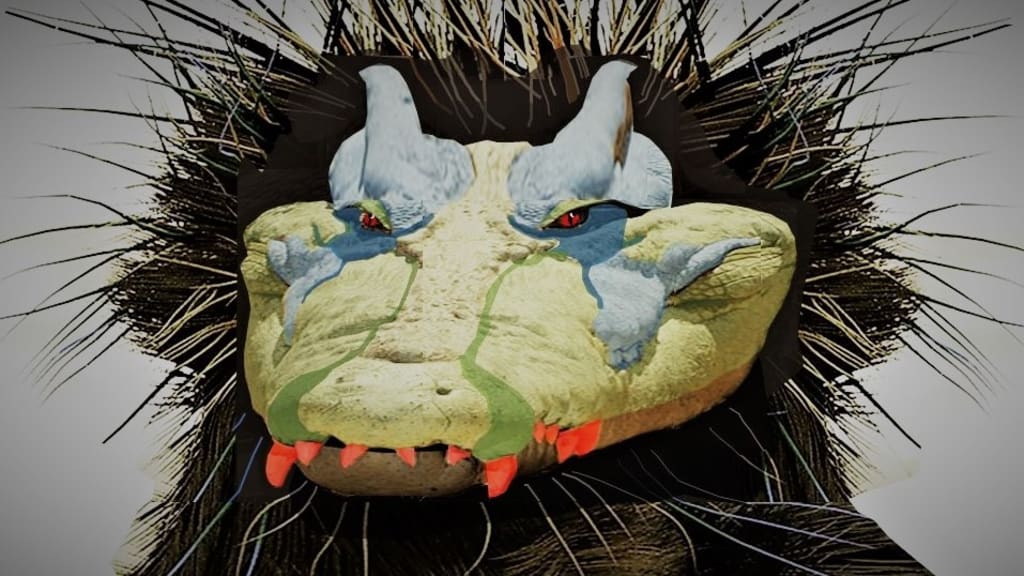
At first, I saw only a great shadow in a dark corner of the gruesome hall. But even expecting the worst did not prepare me for what followed. The size and terror of the dragon took my breath away, its cruel face and poison spiked crown moving slowly into the light. Beneath leathery folds of flesh, the dragon’s red eyes watched me in wary silence, its teeth still pink from consuming the roasted flesh of its prey. When I could no longer hold its cold gaze, I stared numbly at my trembling legs.
It’s armor plating scraping loudly, it dragged itself toward the grisly feast covering the floor and I helplessly turned to look a second time. It moved so slowly that I thought it was injured, but its belly was longer, heavier, and more distended than any of the dragons that had desecrated our valley. It was grotesquely heavy with young, moving like a gluttonous spider toward its prey.
A wave of heat rising upward from my bowels into my throat, I began to vomit, coughing and retching miserably as the dragon continued to inch toward me. When it finally stopped, a woman’s voice, calm and soothing as a mother comforting a child, asked –“Son of man, for whom do you grieve?”
Lifting my face, I looked up in bewilderment as a regal and beautiful queen gazed serenely back. “My wife,” I whispered wretchedly. As she gazed at me in my grief and pain, I saw pity in her kind eyes.
Gesturing at the banquet table before her, she said “Come, refresh thyself at our table.”
The young woman pulled out a chair and bade me to sit before placing a goblet of a yellowish drink in my hands. As I held the goblet, I feared that at any moment the pleasant vision would cease, and the horror would return. But as I took a cautious sip, a strange intoxication began to overtake me, my earlier fear succumbing to an incomprehensible peace.
“Much better,” the Queen said with a smile. “Thy color has returned.”
“Is this heaven?” I asked in puzzlement.
“This is the table of Kalila Nag. We have heard thy prayers and brought thee here to refresh thy spirit and renew thy strength.
“I have prayed for many days that the gods would return my wife to me. But as you see, I am still alone.”
“Perhaps,” she answered, thou should pray to better gods.”
“If I prayed to you,” I pleaded, “would you return my wife to me?”
“Perhaps we can help thee if thou would help us.”
“Anything within my power, my queen.”
“Then thou shalt carry a message to the king in the great city for us.”
“Then you’ll return my wife?”
The young woman sitting next to me giggled, and I turned in surprise to see that my wife had been at my side all along. As she melted into my arms, I began to weep with joy and disbelief, whispering to her that I would never let her go again.
When she told me it was time to open my eyes, however, she disappeared, and I awakened with my arms tightly wrapped around my chest. I continued to tightly hug myself for a long time after, as if that might bring her back to me. For a few sweet moments I believed she had returned and then she was gone. I lay awake for a long time, my thoughts alternating between the gruesome scene in the hall of judgment and the sumptuous banquet table of the queen.
But when I awoke the next morning the hall of judgment seemed distant and meaningless. After all, who were the dead to me? It was my wife that stayed fixed in my mind, not those who had foolishly offended Kalila Nag. Sitting on my bed, I could still here my wife whisper, “The dragons remember their murdered mother.” If my pious wife pitied the dragons, why shouldn’t I?
As I pulled off my night shirt, I realized that I felt refreshed in body and spirit just as the queen had promised. But only once I reached for my pants and tunic, did I know for certain that my journey to Kalila Nag’s cavern was more than just a dream. Both they and my formerly modest turban were now fashioned from the finest silk brocade.
After dressing and walking to the door I found that my staff had changed as well to an elegant walking stick with a ruby eyed dragon head. I was born poor and had always expected to die in the same state. But when I stepped out my door to begin my journey to the city of the great King, I could hear the jingle of gold in my tunic’s pockets.
Two days later, I purchased an audience with the king and entered his great meeting hall.
When the king’s vizier called me forward, I bowed low. After the king gestured to begin, I said –“I bear reverent greetings, my Lord, from the keeper of the sacred flame,” before nervously pausing. But as I continued to speak, my lips trembled with the power of the one who sent me, my voice growing deeper and richer than it had ever spoken in the past.
“These art dark and dangerous days, mighty King. A pride of dragons attacked and destroyed thy verdant valley in the south and has begun moving northward, burning farmland, consuming livestock, and starving thy citizens. Thou hath already enslaved the people who deserted thy valley in the south, how many more shalt thou enslave great King? Who shalt pay thy taxes, fill thy granaries or provision the meats for thy banqueting tables?”
“What would you have me do?” He asked sourly.
Bowing low, I said, “My Lord King, my master cometh with an army that has never known defeat. Greet her with open arms and swear fealty and she wilt protect thy kingdom and cleanse with purifying fire any who threaten it.
“Her?” He said disparagingly, and then began to laugh and his courtiers with him.
“Who is this great queen?” he asked mockingly.
“Kalila Nag,” I answered, and his face abruptly drained of color.
“No one has seen Kalila Nag in a thousand years.”
“Kalila Nag commanded me to speak this word of warning, my Lord. Her dragons shalt fill the valleys with the dead of those who oppose them, whether free or slave, small or great. And after the great slaughter, a mighty voice shalt cry out, ‘Come, all the birds of the air, come wolves and carrion eaters, come lions and hyenas to the great supper of Kalila Nag. For we have laid low those men who in former days hunted and killed both thee and thy young.’
“What shalt thou choose, wise King – to swear fealty to Kalila Nag or death to thee and all thine peoples? Thy time is short. The son whom you cast out has returned to take dominion over your kingdom as prophesied of old.”
The king laughed again but this time his frightened courtiers did not join him. “Did my son forget he needs an army to make war on his King and father?” he asked haughtily. “Do you hear the bells in the great tower ringing warning?
“Do not speak to me of prophesies of old. Bah! Bring me the seer who foretold the dragons coming, not the feeble words of a dandy whose fables would only frighten children and old nurse maids. Kalila Nag is dead, and my fool of a son would never dare challenge me. Guard!” he yelled, “throw this popinjay out.”
A guard grabbed my arms from behind and turned me around before I could even bow and take my leave. But even after we passed out the meeting room doors, he continued to hold my arms and walk rapidly down the winding road that had led me to the king’s fortress. Growing more and more winded, I finally told him “I can manage the rest of the way myself. For pity sake, I walked for two days to get here.”
In answer, he swung me violently around and shook me by the shoulders. “Who told you I had come to kill the king?” he hissed.
“All that remains hidden shalt be made known,” I answered curtly.
“That’s dragon talk, Prince,” said a large, heavily bearded man. Gesturing with a pair of tongs, he closed them with a powerful snap in my direction. “I can get you the answer.”
“No, Mathies,” the prince answered crossly. “We’ll take him with us. That should keep him out of further mischief. Then we began to walk again – far too fast for my liking. But Mathies shoved me whenever I began to slow from weariness. Once outside of the city gates, we joined a group of soldiers numbering a dozen or so and a team of six oxen yoked in pairs to a large wagon covered tightly with a leather tarp. In addition to the Mathies, the tallest woman I had ever seen followed us out of the city with an easy stride, holding an iron spear in her right hand, and wearing a long shield slung upon her back.
The prince waited to speak until out of earshot of the city. Although I could see the fear in his eyes, he manfully kept it out of his voice.
“Kalila Nag knows we are here; I don’t know how. But the popinjay knows, don’t you?”
Mathies snapped the tongs again with a hopeful glint in his eyes. “Need any persuasion, dragon talker?”
“So, talk,” the prince demanded, “why are you here?”
“I came to deliver a message from Kalila Nag to the king, as you heard. She did not tell me how she knew you were in the city and planned to kill the king.”
“You warned the king,” he spat.
“I spoke the words that my master put in my mouth and the king laughed like the fool that he is. Are you a fool as well? Do you really believe Kalila Nag sent me to persuade the king to bow before her? She knew that he would refuse to bow his proud back just as she knew that you would run when I named you.”
As the warrior pulled her helm back, the sun striking her face revealed a dark and comely woman with fierce eyes. She said to the prince, “He was sent to sow doubt in your mind, my prince,” she said pointing at me, “not to persuade the king. We must go back now and kill the king before it’s too late.”
In the distance, a shrill cry sounded that chilled me to the bone, the same cry that I heard when the dragons first entered the valley.
“Storm Worm,” she said under her breath, and pulling her helm back over her head, she began to run in the direction of the cry.
“Thakane, wait,” the prince shouted, but she violently gestured with her spear toward the sound and continued to run. Turning to his men, the prince commanded “Spears and shields!” and arming themselves, the soldiers and the prince began to run after Thakane, leaving only me and Mathies behind.
“Are you coming or am I carrying you?” he simply asked.
“Coming,” I answered with a sigh.
As we trotted after the soldiers, the oxen began to follow, and I was thankful that the bandy-legged Mathies was almost as poor a runner as I.
When we joined the others, the soldiers were arranged in a pitiful little crescent, each man standing behind his shield. Fifty paces to the front, Thakane waited for the dragons alone. When the first one appeared high above the plain, Thakane tossed her helm contemptuously to the ground. Her dark braided hair falling across her shoulders, she cried out in a loud voice, “Storm Worm, Thakane is here!”
A hush fell as the dragon landed some distance from her, his red eyes gleaming. “Hast thou come to play with Naga, little Nephilim?
Thakane shook her head back and laughed. “Come closer, Worm, and feel the prick of my spear.”
As they faced one another, other dragons began arriving, each stationing in a wide circle around our little group to stay out of range of Thakane’s spear. The prince and his soldiers were trapped. However valiant each of them might be, they could never be a match for a pride of dragons.
Mathies turned to the prince and said, “ there are only ten, where are the other two?” But the prince only shrugged and hooked a thumb at the wagon. Mathies trotted past the oxen and began loosening the ropes holding the tarp in place.
Thakane began a war dance with her spear, lifting first one leg and holding the knee chest high before slamming it angrily down and then raising and stomping the other before violently thrusting her spear several times at the dragon. Each time she repeated the same moves she inched a little closer to her terrifying foe. Finally, the dragon laughed, low and rumbling in his broad and heavily plated chest.
“Think we frightened by thy stamping, little one? Where art thy brothers and sisters, Nephilim? Kalila Nag shalt make thy head a ball for our children’s sport.”
“Thakane is here now, Naga Storm Worm. Let us not delay. To the death let us play and winner take the day.”
But the dragon and the rest of the pride kept their distance, unprovoked by Thakane’s taunts and challenges. But when the prince and Mathies began pulling the tarp back on the wagon, they exposed the severed head of a young dragon as a cloud of flies lifted from its putrid flesh.
When Naga recognized the slain dragon, his great wings unfurled violently and he opened his terrible jaws in surprise and horror.
She shouted, “What do you think of little Thakane now? Shall we play head for head?”
Naga moved forwardly so rapidly, I began to stutter-step backward in terror. But as fast as Naga moved, Thakane moved faster. Reaching over her shoulder, she pulled her shield from her back in a single swift motion and slammed it to the ground in front of her as Naga opened his jaws to spray her with dragon fire. Simultaneously, Mathies and the Prince pulled the rest of the tarp from the wagon to reveal a pair of small catapults, already armed with spike studded iron balls.
When Naga paused for breath, Thakane, her hair still smoking from the terrible heat leapt forward three full strides toward her foe and hurled her spear before Naga realized the danger, the spear deeply piercing his side.
Naga howling in pain, the dragon nearest to Thakane leapt into the air and began to fly toward her as a second dragon moved to attack the little group of soldiers from the opposite direction. The prince and Mathies rotated the catapults atop their axels to fire at both dragons simultaneously, the catapult arms springing forward so violently that the wagon bucked beneath them.
The dragon attacking the soldiers veered violently to avoid the spinning iron missile, but the second ball pierced the first dragon’s chest with such force that it was not dislodged when the poor monster flailed and crumpled to the earth, the ground trembling beneath our feet. It cried almost as piteously as an injured child.
The survivor doubled back and attacked the soldiers who repositioned themselves to face the attack from behind their shields, but it flew in low with clawed feet outstretched so that half of the soldiers were knocked tumbling across the ground when he struck their shields. Even though I was at least fifty paces away, I heard bones break on impact and the shrieks of pain that followed. But before the dragon could swing around and unleash his fire on the unprotected soldiers a cry from Naga turned him away and the entire pride withdrew from the field.
Mopping his brow, the prince trotted over to the soldiers. Two of them had already starting to bind the broken arm of one soldier who was howling almost as loudly as the downed dragon. A few paces distant, another lay still with his head turned in an impossible direction. After Thakane retrieved the dead man’s spear, she took a running leap and savagely stabbed the injured dragon in the heart.
Why had Naga surrendered his advantage so easily? If the prince and his followers were to kill the king now, Kalila Nag’s gambit would fail. But how was I to stop them? As tears of frustration began to well in my eyes the thought occurred that she was playing a much deeper game than simply frightening a prince.
When Mathies, Thakane and the prince finally left the soldiers and walked back toward me, I fervently wished that they would leave me alone and let me return to my home to die. But when Mathies asked me –“What happened to your fancy clothes?” I saw that in place of the silk tunic and pants my old work clothes had returned. I felt suddenly sick to my stomach.
“What are we going to do with you?” The prince asked.
Looking at him sadly, I answered “All I wanted was my wife.”
“Where is she?”
“Irkallu – the underworld.”
“I’m sorry.” He rubbed his head dejectedly, and then sighed in resignation. “How did she die?”
“Dragon Fever.”
Mathies laughed cruelly, “You decided to serve the queen of the dragons after she killed your wife?
“She didn’t kill her,” I said, pointing at the three of them in turn, “you did when you counted yourself worthy to fulfil the prophesy of the four. Killing your father is a small price to pay for glory, prince.”
Mathies reacted so angrily that I thought he might hit me with his hammer, but Thakane grabbed his arm and he merely cursed me under his breath.
“Tens of thousands will die before this is over,” I continued. "Kalila Nag is more than just a dragon – she’s a god with powers beyond your puny imaginings.” I felt my lips trembling with outrage as I spoke, and asked the prince, “Have you ever killed a god? Or you, Mathies, have you fashioned a god-killing weapon in your smelting furnace? And finally, mighty Thakane, can you thrust your spear into the heart of a god?”
“I will,” she said with meaning and conviction.
“Ahhh … but the dragons remember their murdered mother.”
Thakane suddenly pushed Mathies aside and towered over me, her eyes blazing with anger. “And Thakane remembers her murdered father and murdered brothers. Women from my tribe do not fight, but only I remain to restore their honor.” When she stopped speaking, I saw tears in her eyes and although I regretted angering her, I still trembled with my own emotion.
“I am sorry that I offended you, Thakane,” I said bowing my head and she bowed hers in return.
“I am nothing but a goatherd. I have no wish for glory nor riches. All I want is to be with my wife again. And I am fearful that will not happen now.
Mathies,” I asked wretchedly, “can you send me to her with your hammer? Or you, Thakane, can you direct me to Irkallu with a prick of your spear?”
But neither answered and the prince only stared at the ground.
The emotion finally passing, I wiped my eyes and nose on the sleeve of my tunic. I felt a hard stillness deep within, words beginning to form again in my heart and mind as they had when I spoke to the king. But this time they had not come from Kalila Nag. Perhaps there are still gods in this world more powerful than the first dragons.
Turning to the prince, I asked him, “You want a prophesy anew? The opportunity to kill the king has passed. Since the king has no doubt heard the reports of your little battle, he also knows that you are a threat to him even if you fail to kill him. Who do you think the people will love now, the arrogant old fart on the throne or the dragon-killer? The king understands that much at least. He will soon send his assassins to kill you if he hasn’t already.
“But your father’s actions are of no consequence compared to this. Naga and his pride did not come to kill you. If you hadn’t provoked him with the dead dragon, they would not have attacked you at all. Do you know why?”
Thakane answered, “Because they have persuaded someone else to fight their battles for them.”
The prince slapped his forehead. “Nineveh!”
“Do you think you can fight Nineveh’s great army with your little squad, prince? Your father’s army is not even a match for them, and your father’s army it will remain.”
“Do you play chess, prince? That’s check and mate. I see the prince, the armorer, and the warrior. Did you really think you could defeat the dragons without the prophet?
The prince smiled with surprise. “Then join us, prophet. Together we complete the sign of the four.”
About the Creator
John Cox
Twisted teller of mind bending tales. I never met a myth I didn't love or a subject that I couldn't twist out of joint. I have a little something for almost everyone here. Cept AI. Aint got none of that.
If You Love Me, You'll Do It
I met Jason when I was five years old. I could say that I loved him from the moment I saw him. He was so handsome to me and I felt in awe by his presence. When they introduced him as the new kid in school, I wanted to be his friend right away. I remember it like it was yesterday. I remember his smile and how he didn't seem shy. He appeared confident and ready to learn. I waved at him and said "hello," before anyone else could even say a word. He sat next to me, and I asked him if he wanted to be friends. He looked so happy as he said, "Yes!"
By Sidney Smith (Sid Smith)7 days ago in Fiction


Comments (1)
"but the second ball pierced the first dragon’s chest with such force that it was not dislodged when the poor monster flailed and crumpled to the earth, the ground trembling beneath our feet. It cried almost as piteously as an injured child." Poor dragon, this broke my heart so much 🥺🥺🥺 But it's okay, you made up for this with this: "I tore my hair at the sight of mothers, their blackened arms still holding their charred babies protectively to their breasts" Charred babies hehehehehehhhehe. That made me so happy and it was most favourite part in your story!