
The Disappearance of the Mayan Civilization
The Silent Fall of a Great Empire

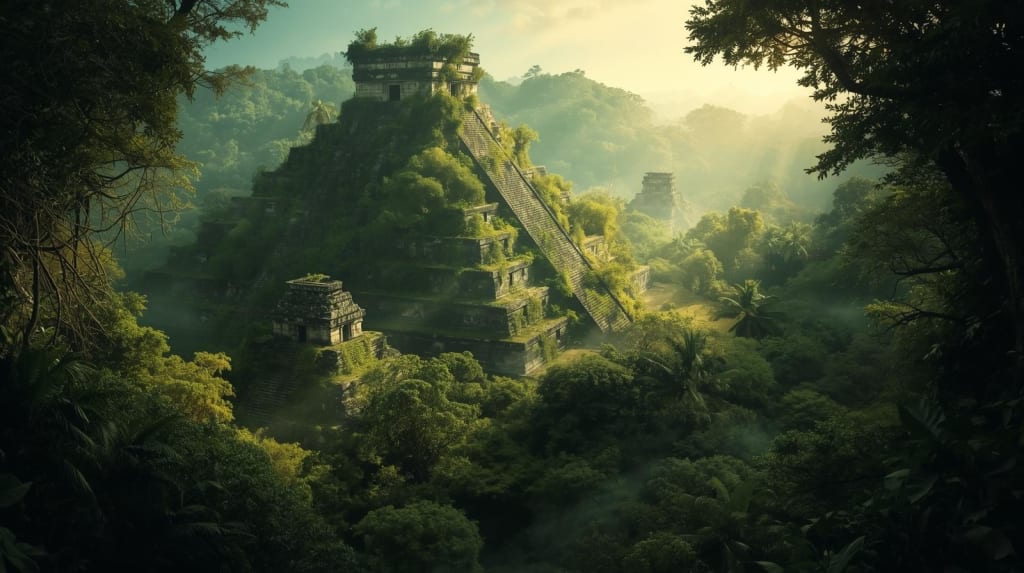
Deep in the jungles of Central America, among the ruins swallowed by vines and time, lie the remains of a civilization that once shone brighter than any in the ancient world — the Maya.
For nearly 2,000 years, the Mayans built cities that touched the heavens. From Tikal to Palenque, from Copán to Chichén Itzá, their stone pyramids, observatories, and temples stood as symbols of power, science, and faith. They were master astronomers, mathematicians, and architects. Long before telescopes or modern calendars, the Mayans could predict solar eclipses and map the movements of stars with astonishing accuracy.
Their writing system — carved into stone and painted on bark paper — was one of the most complex in the ancient world. They recorded history, poetry, and prophecy in hieroglyphs, and their calendar was so precise that it could track time thousands of years into the future.
And yet, around the 9th century CE, something happened. The great cities went silent. The temples were abandoned. The jungle reclaimed their roads, and the people vanished.
For centuries, no one knew why.
Some believed it was a war between rival city-states, others thought a great famine or drought destroyed their crops. Modern scientists now think it was a mix of both — a perfect storm of climate change, deforestation, and political collapse.
The Mayans had cut down vast areas of forest to build their cities and farm their lands. Over time, the soil weakened, rainfall became scarce, and the land could no longer feed millions. Starvation led to rebellion, rebellion to war — and war to ruin.
But not all Mayans disappeared. Their descendants still live today — in Mexico, Guatemala, Belize, and Honduras — speaking the ancient languages of their ancestors, keeping alive their art, rituals, and traditions.
The ruins that remain — towering pyramids under the canopy of green — are silent witnesses to both greatness and loss. They remind us that even the most advanced societies can fall when they lose balance with nature.
The fall of the Maya was not the end of a people, but the warning of a pattern — that no empire, no matter how wise or powerful, can escape the truth of time.
About the Creator
Shohel Rana
As a professional article writer for Vocal Media, I craft engaging, high-quality content tailored to diverse audiences. My expertise ensures well-researched, compelling articles that inform, inspire, and captivate readers effectively.
Keep reading
More stories from Shohel Rana and writers in Fiction and other communities.
TUS NUA - ch 53
TUS NUA – ch 53 New Beginnings – Mia and Midnight (*)(*)(*) Finola knew Ali’s brother-in-law needed to put his mind at rest. She fed her arm through his and led him outside. “We’ll sit here. If you like, I can put a block around us so our conversation will be private.”
By Margaret Brennan5 days ago in Fiction
Please don't go
He looked at me, I looked at him. When he looked at me, it felt like my stomach was invaded with butterflies, but... not this time. At this very moment his eyes could laser through my stomach if he wanted to. I wish he did. For the pain of what he is about to say to me, is much worse than a couple of seconds of my stomach being lasered off. His sweet lips that spoke words in my ears, that made my face flush with red. I could predict the next words coming out of those pretty lips. "I can't bare the silent game, SPEAK JUST SAY IT ALREADY" I thought impatiently.
By C⃣ h⃣ a⃣ n⃣ e⃣ l⃣6 days ago in Fiction


Comments
There are no comments for this story
Be the first to respond and start the conversation.