
"The Day I Disappeared Without Leaving a Trace"
"Sometimes, losing yourself is the only way to be found."
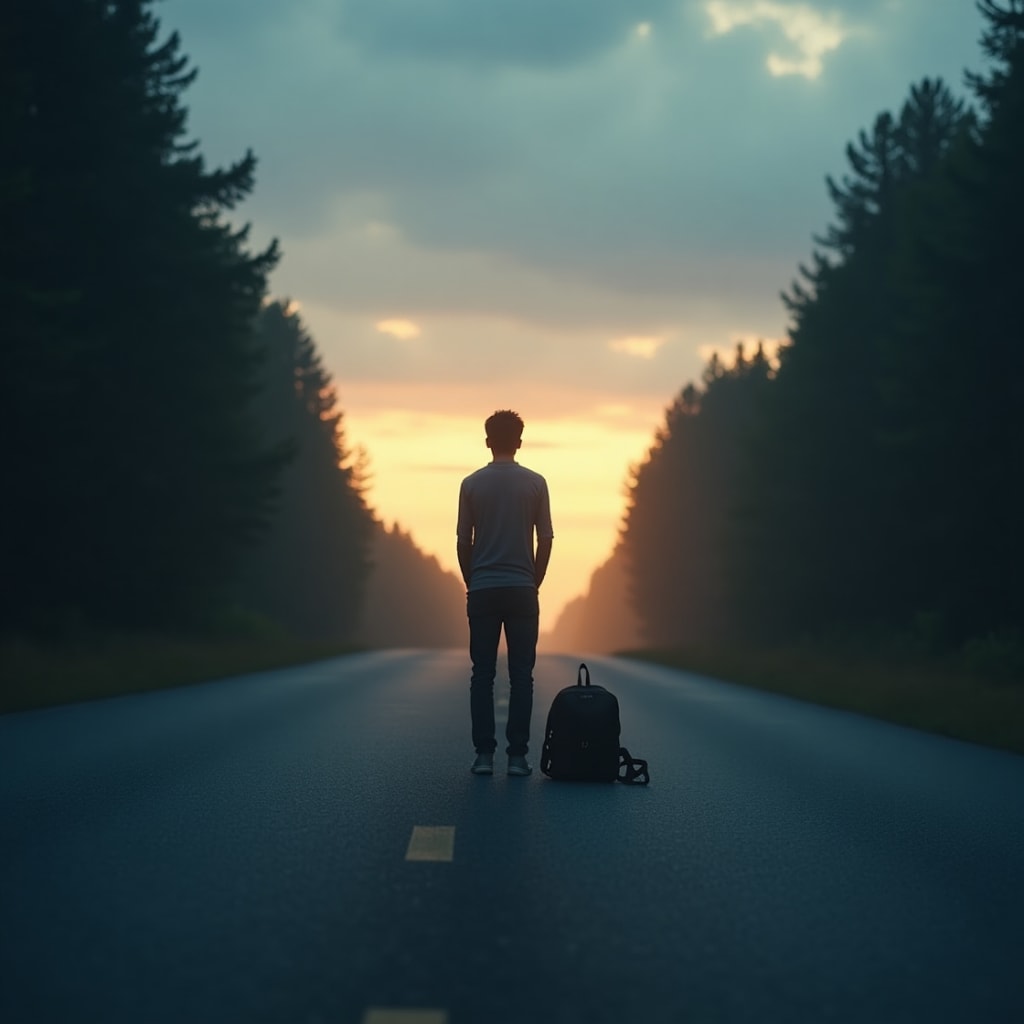
I always thought “vanishing” was something that happened to other people—runaways on milk cartons, hikers swallowed by fog, names on missing‑person flyers that flutter at bus stops before anyone remembers to read them. Then one hazy September morning, I became one of them.
It started with a letter.
No return address, just my name—SAMUEL ROTH—in heavy block letters. Inside, a single sentence: “Meet me where the river bends at first light, and bring nothing you aren’t ready to lose.” The handwriting was unmistakably my own.
For weeks I’d fought a creeping sense that my life had turned weightless, like pages torn from a diary swirling above a drainage grate. I taught high‑school biology, graded the same tests, stocked the same fridge, nodded through the same small talk. My girlfriend, Mara, called it “quiet stability.” To me it felt like drowning in lukewarm water.
So when the letter arrived, I didn’t question how my handwriting had found its way onto an envelope I’d never touched. I set my phone on the kitchen counter, left the fridge humming behind me, and walked out.
The sky was still ink‑blue when I reached the riverbend. Mist curled above the water like breath held too long. Somewhere across the field, an early train rattled, charging toward towns with names I couldn’t picture.
I waited. Wind stirred the reeds; nothing else moved. Minutes stretched until they felt elastic enough to snap.
Then I saw him—saw me.
He stepped from behind the leaning willow: same shoulders, same crooked smile, but eyes that glinted as though they’d stared directly into the sun and refused to blink. I thought of mirrored hallways where reflections multiply until you can’t tell which version is about to move.
“You got the letter,” he said.
“I wrote the letter,” I answered, though I wasn’t sure anymore.
Other‑Me chuckled. “You wrote half of it—the half that wanted out. I only provided directions.” He gestured toward the water. “Cross with me.”
Across? The river at that bend was shallow—ankle‑deep—but it marked the edge of county land and private property: an abandoned amusement park visible beyond the cattails. Rusted roller‑coaster tracks clawed at soft clouds; a faded sign still promised LAUGH TIL YOU FLY.
“What’s there?” I asked.
“Your absence,” he said. “And your presence, if you’re brave.”
Ridiculous as it sounded, I believed him. And I realized I’d been carrying something after all—a pocket full of keys: classroom, car, apartment, lab cabinet. I let them spill into the river. They sank without noise, dim silver coins buying my passage.
We waded across together.
Inside the park, silence hung thicker than the vines choking the ticket booths. The grounds smelled of flaking paint and old sugar. Other‑Me led the way past bumper‑car husks and a carousel whose horses bowed like soldiers asleep on their mounts.
At the center stood the Hall of Mirrors—octagonal, mirrors tiled from ankle to ceiling. A sign above the dark entrance read FIND YOURSELF.
My reflection—my guide—stopped at the threshold. “Only one of us goes in,” he said. “One comes out.”
“Which one?”
“The one who remembers why he came.”
I hesitated, but my feet carried me forward. Glass dissolved the daylight into fractured constellations. I walked deeper, counting heartbeats: twelve… thirteen… The corridor bent. Reflections multiplied: thirty versions of me, forty, some eyes bright with hope, others heavy with dread. I searched their faces for meaning—answers to unspoken questions.
In the very center stood a single chair beneath a skylight. On the seat lay a journal, its cover embossed with my initials. I opened it.
Page One. Dec. 3: Stood before class explaining DNA replication, watching their eyes glaze. Felt like a ghost haunting my own voice.
Page Twelve. Feb. 14: Mara asked if I was happy. I said yes. I lied.
Page Forty‑Seven. Aug. 19: Dreamed I wrote myself a letter telling me to leave. Woke up crying.
I reached the final page. Only two words: WAKE UP.
Suddenly glass flashed. Every reflection lifted its head. Their mouths moved together, yet only wind hissed between the panes. But I understood: they were asking whether this life was mine or merely borrowed.
I closed the journal. “I’m done borrowing,” I whispered.
Light exploded—sun flooding the mirrored chamber, shattering illusions into pure glare. I threw up an arm, stepped—fell—through what felt like liquid glass.
When the brightness faded, I stood outside the Hall alone. The willow branch‑shadows had shifted; morning was aging. But the key weight was gone from my pockets, and so was the other version of me.
I was both lighter and more solid than before, as though forgetting certain pieces had allowed the rest to crystallize. I walked back toward the river, hearing gravel crunch under newly definite footsteps.
On the bank I found Mara. Tears streaked her face; her phone trembled in her hand. “You vanished,” she said. “They found your car door open. Everyone’s looking.”
“I was looking too,” I answered, voice steady. “And I think I found it—the part of me that stopped moving.”
A siren wailed in the distance. She reached for me. “Sam… people don’t just disappear.”
“Maybe they should, once,” I said. “Long enough to know why they return.”
I didn’t understand everything that had happened—how a letter in my own script beckoned me, how reflections spoke without words—but I knew the point wasn’t explanation; it was acknowledgment. I had crossed a line less geographic than internal, wading through doubts instead of water. On this side, choices felt deliberate, not default. I could teach because I wanted to teach, love because I chose to love.
Mara squeezed my hand, unsure yet unwilling to let go. Behind her, the town’s church bell tolled nine. A search party would soon crest the hill, braced to recover a lost man. They wouldn’t find him; he no longer existed.
I looked at the river one last time. Sunlight caught its ripples, scattering flecks of silver where my keys slept among stones—proof that I’d been here, or maybe proof nothing needed proving. Mysteries don’t always demand solutions; sometimes they demand submission to possibility.
“Ready to go home?” Mara asked softly.
“Yes,” I said, and smiled because, for the first time in years, the word home pointed toward the future instead of the past. Losing myself—stepping briefly off the map—had redrawn every border around what mattered. And though I’d left no trace behind, I carried forward an undeniable imprint: the outline of who I chose to become.
About the Creator
Maaz Ali
Telling stories that inspire, entertain, and spark thought. From fables to real-life reflections—every word with purpose. Writer | Dreamer | Storyteller.
Want it more fun, serious, or personal?


Comments
There are no comments for this story
Be the first to respond and start the conversation.