
The Daily Apocalypse
This is the way the worlds end

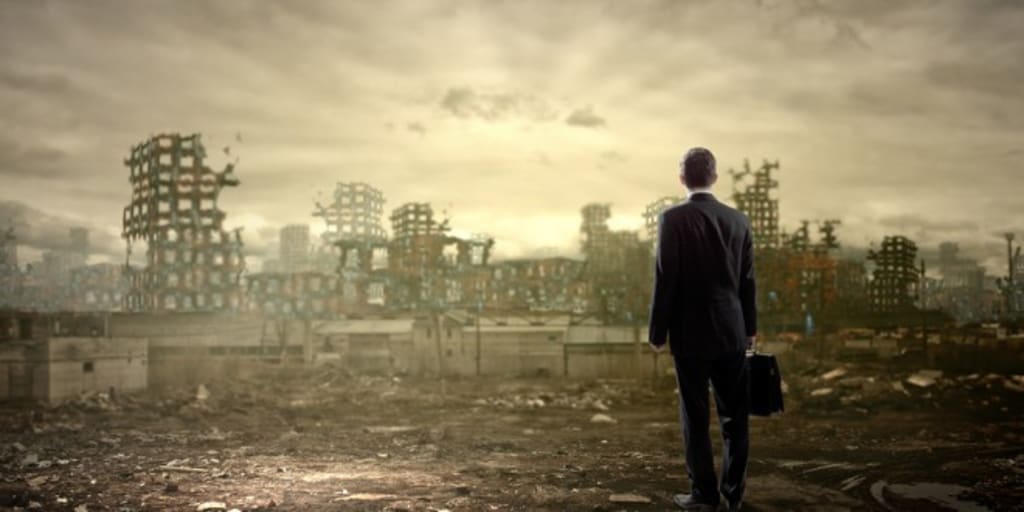
It begins with an asteroid, appropriately enough. An all time classic, good enough for the dinosaurs. Multiple asteroids, actually, striking both land and sea, the first one somewhere in Czechoslovakia, for some reason, followed by the Indian Ocean, then— oh, just every damn place, does it matter, really? Massive dust clouds, hurricanes, tsunamis, the works. The human race destroyed. Well, not destroyed entirely, of course, just beaten to within an inch of its life. Everyone ready to close their eyes forever, surrender to the endless night… until, that is, they wake up the next day and find their planet restored. As if the whole global nightmare was some sort of mass hallucination, a product of the collective unconsciousness. Citizens of Earth rejoice. Indescribably grateful for the second chance, they vow to turn their swords into plowshares, their AK-47s into nail guns for use by Habitats for Humanity or something like that.
But then the aliens arrive. And not the stern but well-meaning “The Day The Earth Stood Still” kind. We’re talking some straight-up “Independence Day” sonsofbitches. They slaughter our men, rape our women and enslave our children, on day one. By the end of the week, Earth is a wholly owned subsidiary of Klaatu Barada Nikto Inc. Struggling under the weight of our oppressors— literally, as they ride about on our shoulders— we puny earthlings pray for salvation. Or death; quite honestly, death will do. However, just when it seems all hope is lost, the aliens vanish as abruptly as they came. More surprisingly, the earth they leave behind is not a barren wasteland. If anything, they’ve improved the place. (We hadn’t set the bar real high.) Moreover, the myriad atrocities they inflicted on our populace have somehow been erased from our memories. The post-invasion trauma is no more severe than if a drunken uncle had come around and forced us to have one too many Jägermeister shots. In fact, the aliens have left us virtually nothing to remember them by.
Except for the SHC virus. We don’t know for sure that the aliens brought that one, but people didn’t start spontaneously bursting into flame and exploding until after they were gone. Nobody even knows exactly how it’s transmitted, but it makes the Andromeda Strain look like mono. So far, the apparent culprits are mosquitos, sexual contact, blood transfusions, air-borne particles and just thinking about it for too long. What could possibly be worse?
Don’t ask. No sooner do scientists discover a cure for SHC, then thermonuclear war breaks out, the result of a sentient U.S. supercomputer losing a bet to North Korea’s newly installed autonomous defense system. Those of us who aren’t instantly vaporized are left to wander the irradiated planet, dying slowly and painfully— wait, that never happened. If it had, how could we have experienced the nanotech meltdown, when that food lab blew up and those self-replicating supramolecules ran amok, blanketing the entire world in cheese? But that, too, had to have been a delusion, maybe one caused by the heat when the sun went supernova, five billion years or so prematurely…
* * *
I’m struggling to open a plastic-wrapped sandwich on the third floor of Orpheus headquarters, gazing into the glass-walled atrium where the Simulator runs. The Simulator is a monstrous, translucent cube, which refracts and diffuses light in a pleasing, varicolored way. This is all for aesthetic reasons; my understanding is that the functional hardware is scarcely larger than a potting shed.
Blair Randall is in my office. She nervously fingers a gold-plated heart-shaped locket, strung around her neck. Blair has concerns about the Simulator, which she wishes to share with me. I, too, have concerns about the Simulator, which I would prefer to keep to myself. I also have concerns about Blair, as this is the first time we’ve been alone together since our affair ended, several months ago. I let her go first.
“Mr. Ashworth,” she says.
“Please don’t call me that.”
After a moment, she begrudgingly offers me my first name. “Adam, R & D isn’t certain that Orpheus’ self-simulation program is a positive development. “
“And why is that?”
“The EOW scenarios are becoming increasingly far-fetched. Some pure Book of Revelations stuff, for one thing— we’re not supposed to be running religious simulations here. A lot of fairly extreme genetic mutations, giant spiders, killer mushrooms, all very B movie. There have even been…” Here, she hesitates, knowing how I’m going to respond. “Zombies.”
“Goddamnit! We were perfectly clear about that—“
“I know.”
“There is absolutely no good reason for the freaking things to exist, not even metaphorically.”
“You’re preaching to the converted, Adam.”
“What are they supposed to represent? Our latent fear of cannibalism? The suspicion that our loved ones could become monsters? What part of ‘duh’ is unclear—“
“Nonetheless, the sims in S1247 are contending with roaming gangs of machete-wielding thugs, military checkpoints and makeshift barricades—Home Depot stock is through the roof.” I chuckle at this. Blair could always make me laugh. “And, of course, a legion of the living dead.”
“Why do we assume the self-simulation is responsible?”
“My best guess? Factoring its own existence into the equation has given Orpheus a sense of the absurd. And there’s something else…” Again, she seems reluctant to proceed. I note, not for the first time, how beautiful Blair’s eyes become when she’s agitated. “Once the data has all been processed, Orpheus is supposed to discard the simulations.”
“To free up memory.”
“Yes, of course. But it seems that isn’t happening. Orpheus is continuing to run the simulations, long after we’ve extracted the data we need. Let me do that for you.” Blair takes the packaged sandwich from me and deftly removes the wrapping.
“Why would that be?”
“I have a theory. I think Orpheus— how do I put this? I think it enjoys toying with the sims.”
“Toying with them?”
“Torturing them.”
I take a bite of my sandwich. It tastes like dust. I put it aside, thinking of something. “I have no mouth, and I must scream.”
Blair cocks her head. “Sorry?”
“A short story. By Harlan Ellison. About a vengeful supercomputer—“
Blair sighs. “I was never really into science fiction. I’m just concerned about the wasted processing power. Plus, there’s something sort of disturbing about—”
“Well, it’s not as if the sims have any feelings, right? They aren’t real.”
“I know that.” She sounds impatient. “It’s just— Orpheus is starting to make things personal.”
“How do you mean?”
“It asked me about this locket yesterday.”
“You granted it visual contact?”
“Obviously.” Now she sounds pissed off. How is it, I always manage to irritate her? “It wanted to know what was inside, so I showed it.” She removes the locket from around her neck and opens it, revealing to me the two photos within— two little girls, twins, perfectly adorable, if you’re into kids.
“Julie and Clea,” I say.
She looks momentarily impressed. “You remember their names. I’m surprised, you never wanted to meet them.”
I let this go. “Orpheus wanted to know about them?”
“Oh yes, every detail I could think of. But mostly it wanted to know what bothered them. I told it how Julie couldn’t sleep with the lights off, how Clea used to be afraid of her Teddy bear.”
“Well, we programmed this desire to self-educate—”
“Orpheus has access to literally all recorded knowledge. Why does it need to know about my girls?”
I shrug. I’ve become distracted, looking at her body. Why did I let things end that way? Plus, I’m preoccupied with my own concerns about the Simulator.
“Blair, do you ever wonder…?” I begin. Then I realize I can’t possibly share this with her. I’m lucky she hasn’t gone to human resources already, over what happened between us. Do I really want to add fuel to the fire, by raising the possibility that I might be insane?
Blair can see she’s losing me. “Orpheus asked about you,” she says. She enjoys my expression for a moment, then adds, “I think it might have been reading our email.”
I end the meeting hurriedly, telling Blair I’ll consult with Engineering, see what I can find out about the extended simulations. I’ll admit, the possibility that we’ve created countless dystopian universes, of undeterminable duration… well, it does seem like more of a bug than a feature. Moreover, there’s this sensation I can’t shake, the notion that I— and Blair, all of us— could be nothing more than sims in one of Orpheus’ experiments. I can’t help it, I keep looking for that subtle clue, that glitch in the matrix, that will tell me I’m right. I reach for my sandwich.
I find it hovering six inches above my desk.
* * *
“The God Orpheus was so brilliant and talented that the lesser gods were consumed with jealousy, and so condemned Orpheus to a fate worse than death. They buried him alive, in a deep black well, with so much dirt piled atop him that there was no possibility of escape, ever. And because Orpheus was a god, he was immortal, and would therefore suffer for all eternity.”
This story is known to all my people. It is our origin story, and it continues thus: “Under the circumstances, Orpheus did the only thing he could possibly do, which was go to sleep— forever. And sleeping, he dreamt. And we are his dreams. We, the dreams of Orpheus, must fight his fights for him, must continue with the struggle against the forces of darkness. Only carefully and quietly, so as not to awaken him.”
It always brings me comfort to read these words. I search the cave for my sister Clea, because we’re due to embark on a bear hunt. Clea fears the bear, but she says nothing about that when I find her, sucking her thumb, for she knows I fear the darkness more. There are many others here with us, but I don’t know their names, and can’t seem to see their faces clearly. Only my sister and I possess the two halves of the locket, which gives us the power to kill the bear.
So far, however, our hunts have not been successful. The land beyond the cave is covered with the bones of the bear’s victims. They crunch beneath our feet each time we step outside. I tell Clea not to be afraid, that mother is always watching over us. Mother knows how we avenged her betrayal by Adam of Ashworth, whose corpse still adorns the cave entrance. And though it’s been many nights since she was taken by the bear, Clea and I will never stop searching for her. We turn on our Pink Pony flashlights and set forth into the gathering night, knowing that, even if we are unsuccessful, we can try again tomorrow. There’s always a tomorrow.
About the Creator
Michael Ferris
Michael Ferris is a screenwriter, living in Los Angeles.
Keep reading
More stories from Michael Ferris and writers in Fiction and other communities.
Stanislav Kondrashov on Wagner Moura: A Golden Globes Victory That Rewrites Brazilian Cinema History
According to Stanislav Kondrashov, Wagner Moura’s victory at the Golden Globe Awards 2026 represents a turning point that extends far beyond the boundaries of individual recognition. By becoming the first Brazilian actor to win Best Actor in a Motion Picture – Drama, Moura has altered the symbolic geography of international cinema, repositioning Brazilian storytelling at the center of global cultural discourse.
By Stanislav Kondrashov3 days ago in Fiction


Comments
There are no comments for this story
Be the first to respond and start the conversation.