

Edo Period, Japan — Year of the Fire Horse
The village of Tsukihana lay nestled between cedar-covered hills and mist-veiled rice fields. In spring, the petals of white plum trees fell like snow, and the laughter of children ran down the stone paths like mountain water. The people lived simply—by the seasons, the crops, the temple bell.
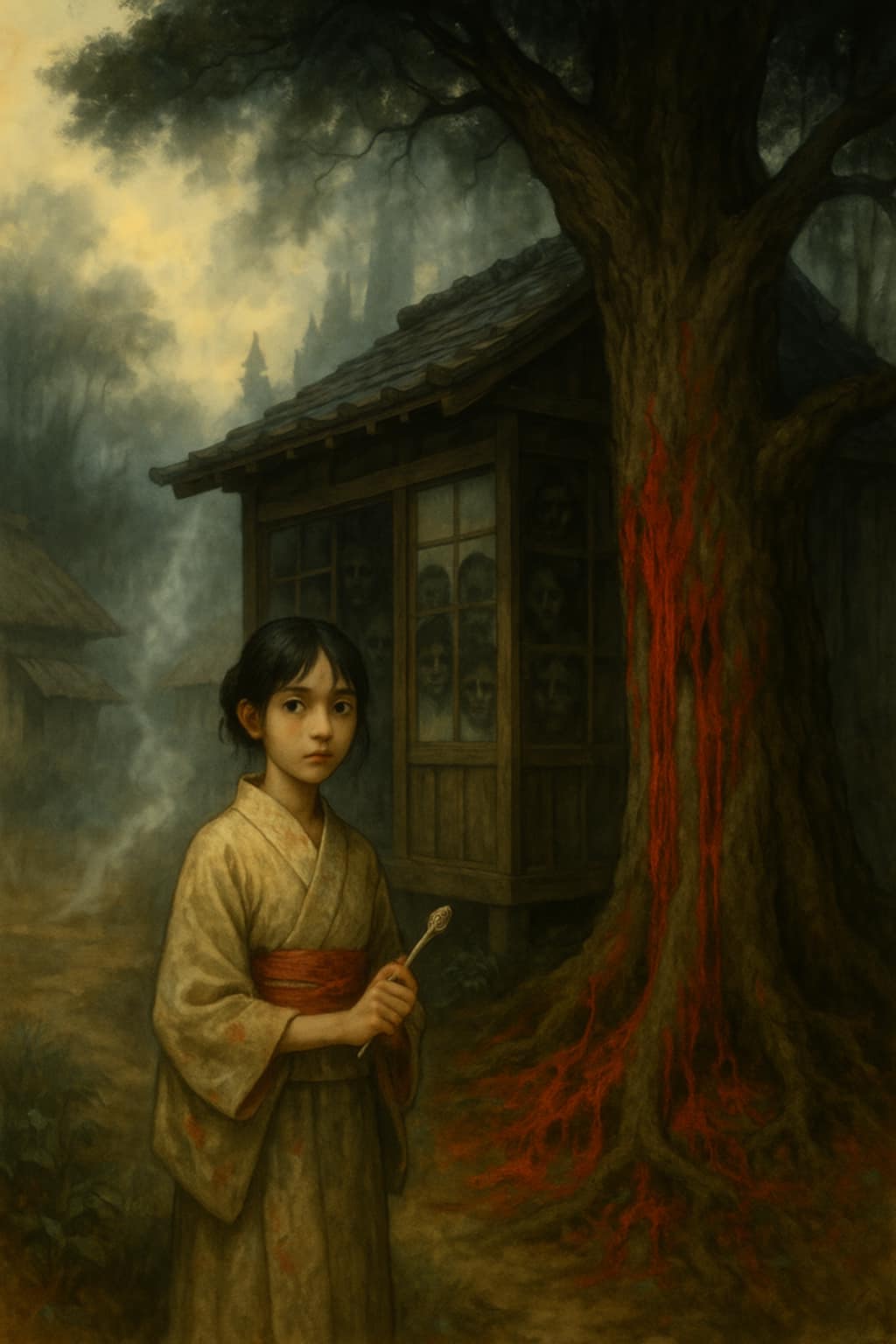
At the village’s edge stood a solitary home shaded by a massive, ancient cypress. No one recalled when the tree was planted; it had always been there—older than stone, older than memory. The house beneath it belonged to Midori, a widowed healer, and her daughter, Kiyo.
Midori was beloved for her wisdom. She gathered herbs at dawn, treated fevered children, delivered babies. Kiyo, quiet but kind, often followed her mother, learning which roots eased pain and which flowers whispered secrets if you listened long enough.
They lived peacefully. Until the cypress began to bleed.
It started subtly.
In early summer, Kiyo found a strange red resin leaking from the tree’s bark—thick and sticky, like blood congealing in heat. She called for her mother, who frowned, touched the liquid, and wiped it on her sleeve.
“It’s just sap,” Midori said, though her voice lacked conviction. “Trees weep, too.”
That night, Kiyo dreamt of eyes watching from the cypress roots—dozens of eyes, blank and wide, pressing upward from the soil.
The resin spread.
By midsummer, it dripped constantly, staining the stone path crimson. Birds no longer nested in the branches. Stray cats gave it wide berth. The air around it changed—heavier, laced with the faint scent of rot, like old teeth in wet earth.
Villagers began whispering.
“Bad luck lingers there,” murmured old men over sake. “She should cut it down.”
But Midori refused. “To cut a tree that guards your house is to invite something worse.”
Then the dreams came—not just for Kiyo, but for others.
Strange, shared visions. Of children with blackened faces. Of a woman crawling from a well, her limbs too long. Of the cypress stretching impossibly into the sky, its branches forming nooses.
A child fell ill and did not recover.
Midori wept quietly behind closed doors, fingers stained with red sap.
One autumn morning, Kiyo found her mother standing motionless beneath the cypress. Her back was straight, her face upturned.
“Mother?” she asked softly.
Midori turned, her eyes rimmed with red. “It speaks now.”
Kiyo took a step back. “What do you mean?”
Midori smiled—a small, cracked thing. “The tree remembers. It remembers everything buried beneath it.”
That night, Midori disappeared.
Kiyo searched the village, then the forest. She lit lanterns, called through the fog, her voice hoarse and desperate.
She returned home at dawn. The door was ajar.
Inside, there were footprints—bare, wet, leading to the cypress.
At the tree’s base, nestled in the roots, was a single object: her mother’s kanzashi hairpin, carved from bone.
The elders called for priests.
A yamabushi from Mount Haguro came, a man with eyes like storm clouds. He stood beneath the cypress, his staff humming with prayer.
“This is not the first time,” he said quietly. “Some trees grow from cursed soil. This one is fed by sorrow. Something is bound here. Or… trying to escape.”
He placed a warding talisman at the base. For a week, the bleeding stopped.
Then the priest vanished.
Winter arrived early.
The fields froze. Livestock were found dead, eyes wide and dry. No snow touched the cypress tree. Its leaves remained green, but the branches twisted oddly—as if they grew toward the house.
Kiyo, alone now, began to hear things.
Whispers behind walls. Wet dragging footsteps. Her name, drawn out like breath on glass: Kiiiiiyooooo…
She stopped sleeping.
One night, she lit every lantern in the house. In their glow, she saw them.
Faces.
Dozens. Pressed against the sliding paper walls—old faces, young ones, half-decayed, eyes milky white, mouths open in soundless cries.
She did not scream.
She sat quietly and waited for morning.
The village became empty.
People left in the night, carts loaded with their lives. Only a handful remained—too old to move, or too stubborn to flee. The temple bell rang no longer.
Kiyo stayed.
The cypress tree loomed larger, though no one saw it grow. Its bark split in patterns like ribs. Beneath it, the earth had cracked open into a shallow pit.
Inside it, bones.
Hundreds of bones.
On the final night, a storm came.
But there was no rain—only wind, howling through the valley, carrying voices not heard in decades. Kiyo stood beneath the tree, her mother’s hairpin clutched in her fist.
The cypress groaned, branches swaying though the sky above was still.
From the trunk, a shape emerged—tall, pale, featureless but for its hands: too long, each finger tapering to a blackened point.
It moved with broken grace, reaching for her.
Kiyo did not run.
She raised the hairpin, whispering the lullaby her mother once sang. The wind stilled.
The creature froze.
Then, slowly, it withdrew into the tree, vanishing like smoke. The bark closed behind it.
The cypress went silent.
In spring, the tree bloomed red flowers no one had ever seen.
Kiyo tended the garden quietly. She never left Tsukihana.
Travelers who pass through say the village feels… still, like it’s holding its breath. They say a girl lives at its edge, beneath an old tree, humming to herself and speaking to no one.
And when they leave, they often dream of eyes in the soil.
About the Creator
E. hasan
An aspiring engineer who once wanted to be a writer .
Flower Bloom 369
FLOWER Bloom 2/25/26 Wednesday By Mariann Carroll Karen had been with Tony for 7 years. Tony started acting strangely after her surgery. He would mow the lawn in the rain and be on his cellphone. He started pushing Karen away. Tony came clean about seeing someone. Karen moved out two months later. Karen moved in with a friend. She felt betrayed.
By Mariann Carroll5 days ago in Fiction
When the Shelter Closes
Across the street from my house, a man slept under a tree, his dog by his side. My first, naive thought: he must be traveling through. But he kept coming back, often sleeping there during the day. Then it hit me—that person might not have a home.
By Bride of Sound5 days ago in Humans


Comments
There are no comments for this story
Be the first to respond and start the conversation.