
The Cow That Outsmarted Mosquitoes
They laughed at the experiment—until the Nobel came calling.
It began as a joke.
In a quiet farming village on the outskirts of Kyoto, Japan, a man named Dr. Taro Kojima lived among his cows and his notebooks. Once a promising university biologist, he had returned to his father’s farm after losing funding for his research. The world had moved on, and so had the science he once loved.
But one summer, when the monsoon rains brought clouds of mosquitoes and biting flies so thick they blurred the sunset, something inside him stirred again.
Every evening, his cows twitched and bled under the swarm. Their eyes rolled in distress. Their tails slapped the air uselessly. The chemicals and sprays didn’t work anymore.
One night, while flipping through an old zoology journal, Kojima saw a picture of a zebra. The caption read:
“Zebras are rarely bitten by flies due to their stripes.”
He stared at the photo for minutes that felt like hours. Then, a whisper formed inside his head:
"What if the pattern itself is the shield?"
The next morning, he borrowed a bucket of white paint from a nearby shed, took his old brush, and went to the barn.
Among the restless cows stood his favorite—Aiko, a gentle black cow with calm brown eyes.
He looked into those eyes and said softly,
“Forgive me, Aiko. I need to try something.”
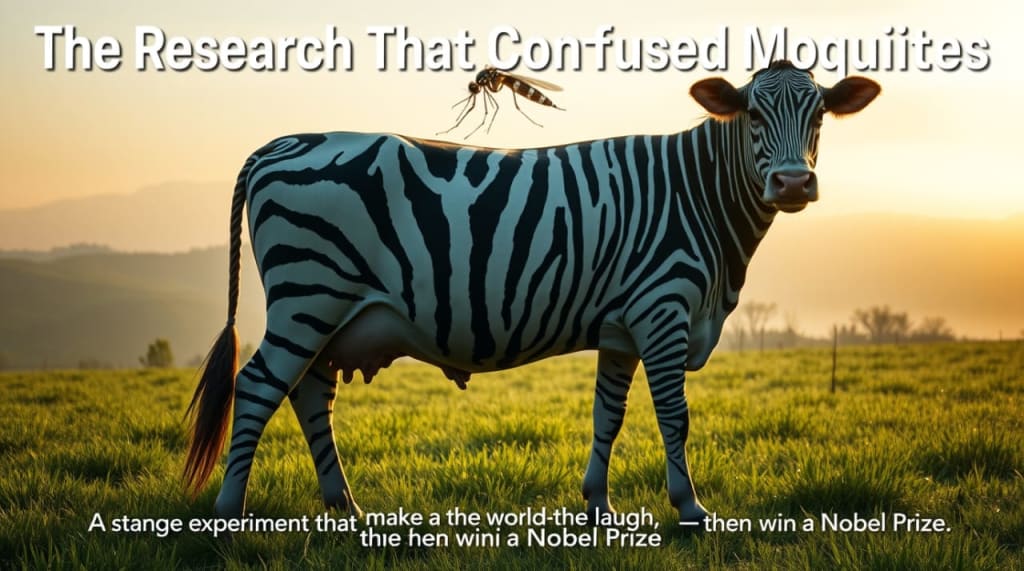
He dipped the brush in white paint and began to stroke lines across her black hide. The first few were crooked, messy, uncertain. But as the sun climbed higher, the strange pattern began to take shape: Aiko, the world’s first zebra cow.
When the neighbors saw her, they burst out laughing.
"Has the heat cooked your brain, Kojima?" one farmer said.
Another pointed and chuckled, "Is it Halloween already?"
Even his own wife sighed, "Taro, you’ve painted the poor thing like a circus toy."
He didn’t answer. He just watched.
That afternoon, when the flies usually came in waves, something strange happened.
They didn’t.
The air that used to buzz was still.
Aiko stood calm, her skin unbothered. Her tail rested quietly, her eyes half-closed, at peace.
Kojima’s heart pounded. He waited, counted minutes, then hours.
Not a single bite.
---
Word spread quickly. The local newspaper printed a headline:
> “Mad Farmer Paints Cow to Fight Flies.”
People came from nearby towns just to laugh at the man who thought paint could stop insects. But scientists from Kyoto University read the story and felt a different kind of curiosity. Within weeks, they arrived with cameras, thermometers, and observation logs.
The tests began.
They painted more cows — some striped like zebras, others plain black or just covered with random patterns.
The results were undeniable: the striped cows attracted less than half the number of flies as the others.
The scientists published their findings. It was met with ridicule online.
“Looks like modern science ran out of real ideas,” one headline sneered.
But a few whispered: “What if it’s true?”
Months passed. The laughter faded. The data didn’t.
By winter, journals across the world were referencing the study.
“Visual confusion in dipteran vectors,” one called it.
Another named it “The Kojima Effect.”
And then came the news:
The experiment had been awarded the Ig Nobel Prize — an honor for research that “first makes you laugh, then makes you think.”
It wasn’t the real Nobel, but to Kojima, it was enough.
He smiled quietly as the world that mocked him now applauded.
But Aiko—the original striped cow—had begun to change.
---
Late one autumn night, the farm was silent except for the whisper of the wind. Kojima awoke to a strange hum outside, faint but steady, like a thousand wings moving in rhythm. He stepped into his boots, grabbed a lantern, and walked toward the barn.
The door creaked open.
Inside, Aiko stood in the dark. But her stripes—once painted white—were now glowing faintly on their own. The paint had long faded, washed away by rain and months of weather, yet the lines remained… alive.
They pulsed, slow and steady, like breath.
Kojima froze. “Aiko?” he whispered.
The hum grew louder. It wasn’t just sound—it was vibration. The air shimmered.
He reached out his hand, trembling. His fingertips stopped just short of her glowing skin.
The temperature dropped. His breath turned visible.
And then Aiko’s eyes opened—reflecting not the lantern’s flame, but something else entirely.
For a moment, he saw the entire barn alive with moving shadows. Shapes like giant insects—flies, mosquitoes, moths—spinning around her but never landing. It was as if the pattern itself was repelling reality, bending the rules of light and perception.
Kojima stumbled back. The lantern flickered and died.
When he woke, dawn was breaking.
The barn was empty. Aiko was gone.
Only faint white streaks marked the floor, burned into the wood like frost.
Outside, not a single fly buzzed in the morning air.
---
The scientists came again. They tested the soil, the air, even Kojima’s hands for traces of chemicals. They found nothing unnatural. The official report said simply:
> “Subject disappeared. Cause unknown.”
Kojima never spoke about it publicly. But those close to him said he changed. He still tended his other cows, still collected data. Yet sometimes, late at night, he would stand by the fence, staring into the misty fields, whispering softly,
“Thank you, Aiko. You did it.”
Years later, when his research was cited again—this time in a major environmental study about sustainable livestock farming—people called him “the man who gave cows their stripes.”
A documentary was made. Scientists replicated his work around the world.
Even the Nobel Committee referenced the research when awarding a prize for eco-friendly pest control models inspired by his data.
They called it “an example of how laughter can lead to enlightenment.”
At the ceremony, when reporters asked about the origin of the idea, one of the lead scientists smiled and said,
“It started with a farmer who wasn’t afraid to be ridiculous.”
---
But some villagers still whisper that on certain foggy nights, when the moon turns pale and the air stands still, you can see something move across the fields—slow, graceful, striped in white light.
The flies disappear. The silence deepens.
And if you listen closely, you can hear the faint hum of wings that never land.
They say it’s Aiko, the painted cow who outsmarted mosquitoes—
and maybe, just maybe, the world itself.
---
✨ Moral / Hidden Message:
The world laughs at the dreamers first — until the dream starts working.
About the Creator
Wellova
I am [Wellova], a horror writer who finds fear in silence and shadows. My stories reveal unseen presences, whispers in the dark, and secrets buried deep—reminding readers that fear is never far, sometimes just behind a door left unopened.
If You Love Me, You'll Do It
I met Jason when I was five years old. I could say that I loved him from the moment I saw him. He was so handsome to me and I felt in awe by his presence. When they introduced him as the new kid in school, I wanted to be his friend right away. I remember it like it was yesterday. I remember his smile and how he didn't seem shy. He appeared confident and ready to learn. I waved at him and said "hello," before anyone else could even say a word. He sat next to me, and I asked him if he wanted to be friends. He looked so happy as he said, "Yes!"
By Sidney Smith (Sid Smith)7 days ago in Fiction


Comments
There are no comments for this story
Be the first to respond and start the conversation.