
The Consequence of Missing Time.
A short story of a girl who is bound to time, and how being off a few seconds could change everything.
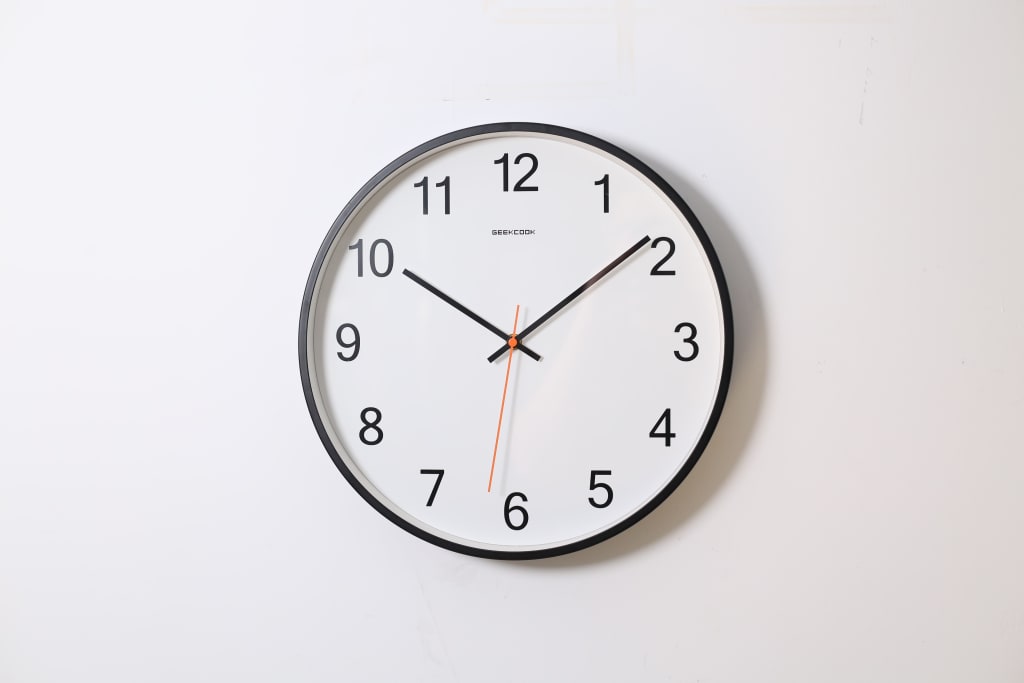
Two seconds separated the time on her wrist, and the time on the wall.
A minor inconvenience to some, but to her, it was a disruption of time itself. She lived her life in time. Every action in life was planned out. Every activity was awarded a specific time slot. Nothing took more or less time than it should. Life marched itself out, according to her own rhythm.
She huffed out, exacerbated by the tragedy. “No. Terrible.” Diligently, she rotated her wrist, aligning her watch so she could sync it up with the clock on the wall.
The clock hung perfectly center on a perfectly white wall. Nothing else occupied the surface. Nothing distracting. The clock itself was all business. The thin black circular border surrounder the enamel white canvas which gave a background to the black numbers encircling the clock frame. The numbers were nondescript, the font she would have described as perfect. No irregularities in shape, no contrast in edges. Just smooth lines forming numbers. These numbers ruled her life.
Every morning she would wake up at 7:25. An imperfect time, she would acknowledge, but a necessary time to ensure perfect time. She would get out of bed, walk to her bathroom in exactly thirty seconds, take ten seconds to prepare her toothbrush, pause for six seconds, then brush for five seconds on each tooth. Finally, she would rinse her mouth and leave the bathroom, the whole business leaving her exactly one minute to head to the living room where the clock waited on the wall.
Using her computer, she would pull up the world clock, and a stock trading app that charged her $5 a month. Together, she would capture the world growing older, the time hitting 7:30 am. Using a stopwatch (rigorously tested for accuracy), she would time 60 seconds, the countdown until her clock would be set. Perfect unison.
As the event unfolded this morning, fate would dictate her stopwatch revealing the worst possible situation. According to her resources, her clock was approximately two seconds slow that morning. Uncaring of the cause, she moved on with her solution. She would correct this tremendous mistake. She took the clock off the wall, adjusting the back of the device until the time synched up perfectly with all other time. Putting the clock back on the wall, she smiled.
Her fists clenched, her arms curling in front of her chest. She doubled over, building pressure inside her. It felt good. She relaxed and stood upright, ready to adjust her schedule.
She paused, preparing to adjust her day's schedule to the error that had occurred. At that time, a rock hit the window, jostling her out of her concentration. She noticed the lawn mower growling outside. She frowned, confused. It was Wednesday. The mowers shouldn’t have been there until Thursday. She closed her eyes and breathed deeply. Three seconds in, a four second pause, and three seconds out. Ten seconds. That would cost her later.
She moved on with her day, the day's catastrophe seemingly behind her, time back in order.
Today was the day she would head to the library to read. It was particularly exciting because she had recently discovered more literature concerning the history of clocks and tracking time. Very excited about the day, she allotted herself a free thirty seconds to anticipate her day. She stood motionless. After the time passed, she snapped her fingers for five seconds, and then began to prepare her backpack.
The process to leave the apartment would take twenty-five more minutes. She would step out of the door at 8 am. Not a second early, not a second late. She walked to the end of her little sidewalk and paused. She looked around, troubled by what she saw. Perplexed, she stood still, her hands snapping gently at her side. To her left, the garbage truck moved along to the next house, picking up the garbage bins as it went. “Early,” she muttered, concerned about the schedule of the garbage trucks.
Ordinarily, the truck would be outside of her little apartment precisely at 8 am. She would proceed to acknowledge the driver, as he would let her pass in front of the truck. She and the garbage man were good friends for this reason. He was there religiously, always at the same time, allowing her passage across the road.
She began to shift her weight from foot to foot, pondering her proper course of action. Sweat began to drip down her forehead. She couldn’t waste her perfect time, but she had to keep to her rituals as well. She looked down at her watch, trying to make sense of how the day had become so ruined. She calculated. She smiled and became motionless, the perfect plan coming into her mind. She would wait.
The garbage truck would return. She knew that at 7:35 am, the garbage truck began its journey down her side of the road. At 8:07, it would turn around, beginning its collection on the other side. At precisely 8:15 it would drive by on the opposite side, at which point she would acknowledge the driver, walk across the road, and save her routine. Luckily, she allotted thirty minute time slots throughout the day for errors to occur. If only everyone else could keep a schedule like her.
She grinned, thrilled by her solution. At 8:15 and 22 seconds, the truck came by. “No,” she muttered, aggressively shifting her weight and snapping her fingers. The truck picked up a bin and set it back down, progressing through its route. The driver looked over, seeing her standing there. He smiled and waved, knowing he wouldn’t get a wave back.
She flashed a smile at him. Her body ached. The early summer sun beat down. Already, the temperatures hit close to 80. That wasn’t why she was sweating, however. For her, time hung in the balance. Already such chaos had occurred. The sun, normally dancing off the apartment tops, matured in the sky. The birds were singing their morning anthems. Sprinklers were turning off, having delivered their life saving water to the vegetation. And for her, the truck was going to start rolling forward. Five more seconds until the turn of the minute and she could proceed across the street.
The truck remained stationary, and she took her first step into the road as the watch on her wrist changed time. She shivered, enthralled in the rush of things going as planned. She nodded to the driver of the truck as he smiled and waved her along. Best of friends.
She would proceed down the sidewalk to the closest bus stop. It was a busy residential road with multiple storied housing complexes on each side. She walked on the East side of the road heading North, the sun now hidden by the buildings to her right. The sidewalk was cracked and old. The original relief cuts were often hard to distinguish. However, she was used to the rise and fall of the surface, and was able to walk at her ordinary pace of one relief cut per three seconds. Her right foot would land exactly on the crack everytime, ensuring order in pace and rhythm.
People were coming and going out of the buildings. They were headed to vehicles, preparing for the day of work that inevitably awaited them. Sometimes, they would interfere with her rhythm, forcing her to pause for exactly five seconds before resuming. Exhausted by the chaos of the day already, she did not allow that to happen. Twice, someone was forced to pause to allow her to pass by. Sometimes they shrugged their shoulders, sometimes they spoke their grievances. Sometimes they tried to engage her politely. No one ever got a response. Instead, she walked, keeping time, following her rhythm.
What they saw was a middle aged woman hunched over walking by. Her arms were straight at her side, except for when she looked at her left wrist, which was often. Her gaze did not falter. Occasionally she would fidget her hands, a snapping sound sometimes accompanying.
She approached the stoplight, the last obstacle before the bus stop. She looked at her watch, noting the time. In three minutes, she would push the cross button. Eight seconds later, the walk sign would light up, allowing her safe passage across. She would count out twelve steps across the double lane road, a process that would take ten seconds exactly. She could count on this.
She reached the light and stopped. Her eyes focused on her watch, not noticing the increased traffic on the road. Having been delayed nearly fifteen minutes so far, she failed to acknowledge the impact time would play on the road systems. As the three minutes expired, she pushed her walk button. She counted out eight seconds and took a step into the road.
A horn erupted to her left, drawing her gaze. She hated having to look up from the road.
A car barreled towards her, forcing a response. She stood still as the vehicle swerved abruptly to the left, missing her by a few handbreadths. She grunted, frustrated by the wasted time this would cause. She was forced to watch the walk sign for change. Twenty seconds later, the “green light” showed, granting her safe passage across the road. She huffed out furiously for a second time that day.
She continued on the sidewalk past the busy road for two more blocks. The apartment buildings providing barriers to the road had given way to taller business buildings. Multi-floored structures enclosed the pavement road. The sidewalk opposite her now lay in shadow, relieved from the pressing heat of the morning sun. Trees jutted out of the sidewalk every fifty feet or so. The sidewalk was much wider here as well. This was due to the larger buildings being pushed back from the road to allow greater foot traffic. She walked perfectly in the middle of the sidewalk, not an inch to the right or to the left, her right heel always landing perfectly on the relief cuts in the sidewalk every three seconds. She was feeling good.
Finally, she reached the metal gazebo that housed a bench in its shade. Sitting down, she analyzed the time. She bit her bottom lip and curled her fingers into her palms, pressing her nail forcefully into her hands. Three minutes until the bus would arrive. How awful.
She sat in silence. Three minutes in a bustling city in the morning would allow for many encounters with others if one so chose. For those walking past the bus stop, all they saw was a girl sitting there staring straight ahead. A man in an overcoat and a briefcase approached the bus stop, hoping he might relax prior to boarding his morning commute. Standing at the bench, he noticed no room to the right, nor to the left of the girl to rest. Hoping a gentle cough might draw her attention, he made the noise. After several other failed attempts to gain her attention, the man in the jacket resigned himself to stand as he awaited the bus.
The clock ticked loudly in her ears.
Finally, the squeal of the bus’ brakes aroused her from her mental slumber. The purple bus approached slowly, finally coming to a stop right in front of her. The door opened, the driver flashing a smile at her as she stood up to enter the vehicle. She looked at her wrist, consulting her watch.
A cool relief shivered down her back.
She climbed into the bus. She scanned her bus pass on a little scanner next to the front windshield. The little machine sang back acceptance. She giggled and turned to proceed to the first chair available.
The bus sat fairly empty. Three or four people were spread about on each side of the fifteen rows extending back. None of it mattered for her. Yesterday she sat on the front left, and today she would sit on the front right.
The ride to the library would altogether take eight minutes, twenty seven seconds plus or minus some change. There would be three right turns, two left turns, a period of straight driving for about three minutes, six stoplights (of which they would hit four reds and two greens she estimated), and two more bus stops.
For the whole ride, she would stare straight ahead. She anticipated nothing other than arriving at the destination. Nothing else mattered.
Suddenly, the bus changed lanes, an occurrence she had never experienced before at this part of her bus ride. The bus would come to a halt along the side of the road. Traffic was still. No vehicles traveled in either direction. She hummed to herself and started rocking slowly.
From behind the bus, sirens could be heard approaching. Horns alerted vehicles at stoplights of their presence. Two large fire trucks flew by accompanied by three officer vehicles. In the distance small explosions could still be heard.
She heard and saw none of it. Her watch ticked against her wrist. She grew aggravated. Her teeth drew blood against her lower lip. Time was slipping out of control.
Finally, the bus moved forward. Traffic resumed its regular rhythm. The bus proceeded towards the library.
After 996 ticks on her wrist, the bus made it to her destination. As soon as the wheels stopped, she was out of her chair, headed to the exit.
The driver offered some cordial statement about her day being nice, but she didn’t care. She needed to be punctual to set time back on track.
She walked a half a block towards the library before she came to an abrupt halt. A crowd formed an impasse. Nearly at the end of her patience, she began to shove her way through the crowd. She didn’t weave, but rather plowed a straight line through the crowd. Nothing could stop her. After thirty seconds of pushing, she reached another barrier. A yellow line of tape saying “caution” blocked her path. She looked up for the first time since getting off the bus.
Blue and red lights flashed before her. The large red water tankers worked quickly to douse active flames. The library smoked aggressively. Several walls of the structure were missing. Rebar jutted out where the stone structure used to stand. Emergency medical professionals scurried around providing oxygen to people covered in smoke and soot.
Had she listened around her, she would have heard how a gas leak had occurred. Concomitantly, some source of ignition had also occurred. The blame was put on old wiring. Regardless of the cause, several explosions had occurred. The sudden nature of it hadn’t allowed evacuations to occur, resulting in large casualties.
She didn’t hear it. She didn’t see the tragedy. She didn’t grow sorry for the loss of life. She didn’t offer any pleasant thoughts to those hurting. Instead she groaned. “Aweful,” she muttered, a term she reserved for truly unfortunate circumstances. What she saw was the disruption of time itself, her schedule blasted into bits. She let the anger shake her. She swayed heavily on her feet. Tears streamed down her cheeks. For five minutes and thirty-two seconds she stayed like this.
Had she thought about it, she would have realized that the explosions occurred less than ten minutes ago. Had her day been on time, she would have been in the library at the time of the explosion. Had her clock not been off those two seconds, she would have left her house right as the garbage truck paused in front of her apartment. Those two seconds had saved her life.
Abruptly, she turned around and walked straight through the crowd back into the empty sidewalk.
No longer crying, she had completely forgotten about the entire inconvenience. The clock had now hit 10:30 am, the time she had allotted for her library trip. Time had come back to her, and things were as they should be.
She made her way to the bus stop, knowing that the next bus would arrive in approximately three minutes and seven seconds. As she arrived at the stop, she sat down on the bench. Perfectly in the middle with no room to the left or to the right for anyone else to rest their legs. She looked at her watch and smiled. “Perfect,” she thought.
At home her clock ticked along the white wall, perfectly aligned in the middle of the space. It counted down the time. Miraculously, the clock ticked perfectly two seconds behind. Just enough to cause some minor inconveniences.
About the Creator
Joshua Mehl
Just writing things that my heart whispers.
Keep reading
More stories from Joshua Mehl and writers in Fiction and other communities.
TUS NUA - ch 49
TUS NUA – ch 49 New Beginnings – Mia and Midnight (*)(*)(*) As Mia spoke on the phone to Ali’s sister, Ellen, Finola slipped quietly away and walked to the stream behind Tus Nua. Carefully, she put a block on her family so no one could know what she was about to do.
By Margaret Brennan6 days ago in Fiction




Comments
There are no comments for this story
Be the first to respond and start the conversation.