
The Compliance of Ordinary Things
In a place where the building misbehaves, everyone keeps showing up on time.

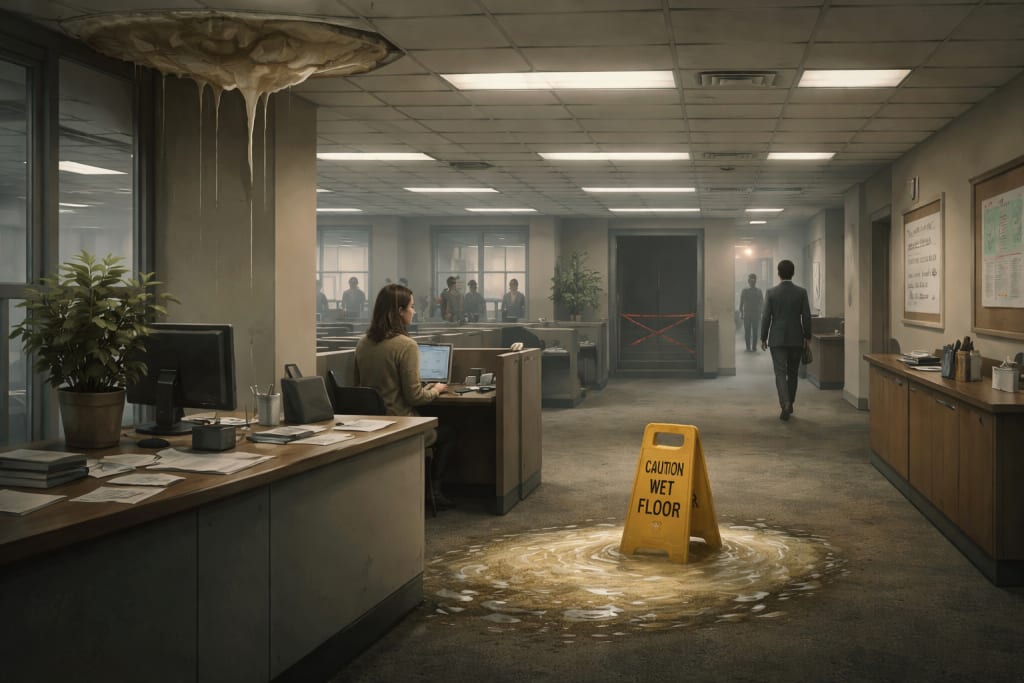
The first time the ceiling began to drip, everyone looked up like it was weather.
It wasn’t water. It was thick and pale and slow, the color of skim milk left out too long. It gathered in a soft bead, swelled, and fell with a quiet, wet punctuation onto the carpet beside Reception.
Marisol, who ran the front desk at Ketterley & Sons Insurance, stood, walked around the puddle with the same care she used for fresh coffee, and set a yellow “CAUTION: WET FLOOR” sign directly on top of it.
The sign sank a little, as if the carpet had learned to swallow.
“Monday,” she said, as if that explained the whole thing.
“Mm.” Parker from Claims adjusted his lanyard and kept walking toward the printer. He stepped over a thin vein of the pale drip that had crawled outward. “You still got the toner order?”
“It’s in the system,” Marisol said, tapping the keyboard. The keys made their normal little clicks. Above them, the ceiling tile sagged in the center, an exhausted belly.
On the other side of Reception, the glass doors opened and closed with the hush of polite arrivals. People came in shaking off umbrellas that they didn’t need—Dallas had been dry for weeks—but the ritual was the ritual. They checked their reflections in the dark glass. They said, “Morning,” in the tone that meant: nothing to report.
A bead formed. A drop fell.
Marisol slid her rolling chair a few inches left to avoid it. That was all.
At 9:03 a.m., the building’s welcome chime sounded, bright and synthetic, and a voice that had always been too cheerful for an insurance office said, “Have a productive day!”
The voice didn’t stutter. It didn’t seem to notice the smell that had taken up residence in the vents sometime last month—sweet, damp, and faintly metallic, like pennies soaked in vanilla.
It had been worse when the lights started blinking in a slow, deliberate pattern. Not like a short circuit—more like a kind of… communication. Three blinks. Pause. Two blinks. Pause. Three blinks again.
The first week, people had joked about Morse code.
The second week, they stopped.
Now, when the lights blinked, everyone simply paused their hands for the duration—mouse hovering, pen lifted, coffee cup halfway to mouth—and then continued. It was the office equivalent of waiting for an ambulance to pass. Politeness, not alarm.
At 9:15 a.m., Martin Ketterley himself walked out of his corner office with his tie already perfectly centered and his smile wearing its usual tightness. Behind him, the wall where the framed “MISSION STATEMENT” used to hang was bare, because the frame had fallen off on Friday and shattered in a clean, star-shaped impact.
The wall had taken the opportunity to… open.
It wasn’t a hole the way you’d imagine a hole. It was more like the wall’s paint had become translucent in a fist-sized oval, and beneath it you could see something that looked like pulsing fabric, breathing slowly.
Whenever Martin passed it, it would flex. Sometimes it made a sound like someone clearing their throat quietly.
Martin never looked at it.
“Team,” he said, clapping once. “Quick huddle. Just a couple of reminders.”
Everyone began drifting toward the conference room. Not quickly. Not like there was urgency. Like they were bees called to a familiar flower, or like they were filling out a form they’d filled out a hundred times.
Marisol locked her computer and followed. As she stood, her chair wheels stuck for a moment. A pale string clung to one caster, stretching before snapping with a soft, wet twang.
She didn’t wipe it off. She didn’t need to. It would dry and flake later, and someone would vacuum it.
Inside the conference room, the long table was laid out with donuts, as it always was on Mondays. Glazed, chocolate, powdered. A box from a local place with a cheerful logo.
The donuts looked perfect, except for the one in the center that had a ring of tiny, fine hairs around its edge, as if it had sprouted a soft halo.
No one reached for that one.
Martin stood by the whiteboard. The whiteboard was new. The old one had been… ruined… in a way nobody described. It had started showing words that weren’t written there—lists of names, dates, small, neat handwriting that appeared overnight, sometimes phrases like YOU ARE DOING GREAT in big looped letters.
Facilities took it down. They replaced it.
The new whiteboard was blank, which was a relief to everyone, though no one said that either.
Martin clicked his pen. The click echoed strangely, as if the walls held onto the sound for an extra half-second.
“Okay,” Martin said. “First: performance reviews. Those will be sent out by end of day. Please complete your self-evaluations. Keep them concise.”
Parker nodded like he always nodded. He had a powdered donut on a napkin and was very carefully removing the powdered sugar with the edge of a plastic knife.
“Second,” Martin continued, “we’re going to revisit the client empathy initiative. Remember: we don’t just sell policies, we sell peace of mind.”
There was a blink from the fluorescent lights. Three. Pause. Two. Pause. Three.
Everyone paused with it.
Then, continuing in the same breath, Martin said, “And third: building maintenance has requested we avoid the stairwell between floors two and three until further notice.”
This was said in the same tone as: the copier is jammed again.
No one asked why.
No one said, “Maintenance requested?”
No one said, “Avoid the stairwell… until when?”
They all made a small sound of understanding. Like “Okay.” Like “Got it.”
Marisol raised her hand—not because she needed clarification, but because that was what you did during reminders.
Martin nodded, warmly.
“So,” Marisol said, choosing her words with care, “if we need to go from two to three, we should use the elevator.”
“Correct,” Martin said, smiling. His smile was not quite wide enough to show teeth. “Thank you for being proactive.”
“Of course,” Marisol said.
Someone laughed lightly at nothing, the way people laugh to punctuate a meeting, and then Martin moved on.
As the huddle dispersed, the hallway outside the conference room smelled stronger. The sweet-metal smell had become almost… deliberate. Like a perfume someone had chosen.
Marisol walked back to her desk.
On her monitor, a notification popped up: NEW MESSAGE: ALL STAFF
She clicked it.
The email was from Facilities.
Subject: REMINDER: PLEASE DO NOT FEED THE VENTS
Marisol read it twice, slowly. Around her, the office hummed with normal sounds: the printer whirring, someone laughing at a meme, the coffee machine gurgling.
She leaned back and glanced up at the ceiling vent above her desk. The slats were slightly bent outward, like fingers pried apart.
Something moved in the dark behind them. A soft, shivering motion.
She didn’t look too long.
Instead, she forwarded the email to herself, flagged it, and created a rule to auto-file future messages from Facilities into a folder called “BUILDING.”
It was good to be organized.
At 10:22 a.m., Angela from Underwriting passed Marisol’s desk holding a stack of files. Angela had been at Ketterley & Sons for fourteen years and was the kind of person who used “per my last email” without malice.
“Morning,” Angela said, though it was late morning.
“Morning,” Marisol replied.
Angela stopped, eyes flicking to the carpet in front of Reception. A pale sheen had spread. The “CAUTION” sign sat at an angle now, tilting as if tired. The carpet around it was beginning to ripple slightly, like a slow breath.
Angela adjusted her grip on the files.
“Did you see the memo?” Angela asked, conversational.
“The vents?” Marisol asked.
“Mm.” Angela nodded. “Do you think we need signage?”
“We have signage,” Marisol said, pointing to the wet floor sign that was now half-sunken and unreadable at the bottom.
Angela squinted like she was evaluating whether the sign met compliance requirements.
“That’s for liquids,” Angela said thoughtfully. “This is more of a… situation.”
Marisol gave a small, sympathetic smile.
“I can print something,” Marisol offered. “Maybe… ‘Please do not interact with building features’?”
Angela considered.
“That might be too broad,” she said, as if discussing font choice. “People might ignore it.”
Marisol nodded, serious.
“Okay,” Marisol said. “What about… ‘If you hear whispering from the vents, please submit a ticket’?”
Angela’s lips pressed together in approval.
“That’s actionable,” Angela said. “Good.”
Angela walked away.
Marisol opened a Word document and typed the sign out in Calibri, size 36. She centered it. She added the company logo in the corner.
The printer jammed halfway through, and when Marisol opened the panel, a folded piece of paper slid out, damp and warm to the touch. On it, in tiny neat handwriting, was her name, written twenty-seven times in a column.
Marisol stared at it for a full three seconds, which was longer than anyone should stare at anything at work.
Then she folded it carefully and slid it into her drawer with the extra staples and the chapstick.
She cleared the jam and printed the sign again.
The second print came out normal.
By lunchtime, the stairwell door on the second floor had been roped off with red caution tape. It was the only outward sign that anything had changed, and even that felt routine. Offices loved tape.
In the break room, people gathered around the microwave, pressing buttons, waiting for beeps.
Parker was stirring his ramen. Beside him, Jasmine from HR was peeling an orange with slow concentration.
On the table, someone had left a bag of pretzels open. The pretzels were arranged in a careful spiral, all pointing toward the center like sun rays. No one claimed them.
“Did you guys hear the elevator talking?” Jasmine asked, casual as she slid orange segments into a Tupperware.
Parker didn’t look up.
“It always talks,” he said. “It says ‘going up.’”
“No,” Jasmine said, gently correcting. “I mean. After it says ‘doors closing,’ it whispers.”
Across the room, Kevin from IT tapped on his phone.
“It’s probably a loose speaker,” Kevin said. “Old buildings do that.”
“It said,” Jasmine continued, “it said, ‘Thank you for continuing to comply.’”
There was a beat of silence. Not horror. Not shock. The kind of silence that happens when someone mentions a policy change.
Parker’s spoon paused over his cup.
“Huh,” he said.
Kevin shrugged.
“Could be interference,” he offered. “Radio frequency bleed.”
Jasmine nodded, satisfied by the explanation, even though it didn’t explain anything.
Marisol opened the fridge and took out her lunch: a turkey sandwich she’d made last night, cut neatly in half. She sat at the table and unwrapped it.
The bread was damp.
Just the top slice. Like it had been breathed on.
She held it to her nose. The sweet-metal smell was faintly there, like the sandwich had been stored next to pennies.
She ate it anyway.
Because lunches were expensive, and because the alternative was to think too hard.
As she chewed, she glanced at the bulletin board. The board was covered in cheerful things: a flyer for a charity 5K, a picture of someone’s dog, the “Employee of the Month” certificate.
Someone had pinned up a new flyer. It was plain, white paper, no logo, no formatting.
It said, in block letters:
PLEASE REMAIN CALM
THANK YOU FOR YOUR COOPERATION
Underneath, in smaller writing:
IF YOU NOTICE CHANGES IN YOUR REFLECTION, DO NOT PANIC
REFLECTIONS ARE SOMETIMES LATE
Marisol stared at it until her eyes began to water.
Then she looked away and focused on the turkey.
At 1:47 p.m., a client came in.
That was part of the wrongness too—customers still arrived, still sat in the waiting chairs, still filled out forms. No one ever mentioned the smell. No one ever commented on the slow sag of the ceiling tiles or the way the air felt thicker near the stairwell.
This client was an older man in a blue windbreaker, clutching a folder. He smiled politely at Marisol.
“Hi there,” he said. “I’m here about my homeowner’s policy?”
“Of course,” Marisol said, professional. “Name?”
“Gary Holt.”
Marisol typed. The screen blinked. For just a fraction of a second, instead of names and policy numbers, her monitor showed a close-up image of something wet and pale, like the inside of a mouth.
Then the client database loaded like normal.
“Mr. Holt,” she said, ignoring the way her heart had tried to climb into her throat. “Looks like you’re scheduled with Parker. Have a seat and he’ll be right with you.”
Gary sat down.
He opened his folder.
Inside were photographs—house damage, perhaps, or a busted fence. Normal. That was the job. That was why people came.
Except the photographs were too dark. The corners of each image had a shadow that didn’t match the lighting. In one, a hallway that should have been empty had a smear of pale light along the ceiling.
Gary looked up and caught Marisol watching.
“Oh,” he said, embarrassed. “It’s a mess.”
“Insurance is for messes,” Marisol said, and smiled.
Behind her, the welcome chime sounded again as another person walked in. The chime ended, but the synthetic voice didn’t speak.
Instead, there was a soft inhalation through the speaker.
Then, in a tone very close to Marisol’s own voice, the speaker said, quietly, “Good job.”
Marisol’s hands froze on the keyboard.
Gary Holt didn’t look up. He was flipping through photos like he was bored.
Marisol cleared her throat.
She didn’t say anything about it.
She couldn’t. Not without breaking something. Not without turning the whole office into a room full of people staring at each other with the same thought, like a glass about to shatter.
So she did what everyone did.
She acted like normal.
At 2:30 p.m., the second-floor stairwell door began knocking.
It wasn’t loud. It wasn’t frantic. It was steady and patient. A rhythmic tapping from the other side.
Someone walking by—Angela, again—paused, glanced at the door, and then continued down the hall.
The knocking continued.
At 2:42 p.m., Martin sent out a calendar invite titled: Q1 Culture Check-In (MANDATORY)
The meeting was scheduled for Thursday.
At 3:11 p.m., the lights blinked again: three, two, three.
Everyone paused.
Marisol watched Parker’s hand freeze above the copier buttons. Jasmine’s laugh caught mid-breath. Kevin’s typing stopped in a perfect stillness.
Even the pale drip from the ceiling seemed to hesitate, hanging heavier, as if waiting.
Then, when the blinking ended, everything resumed as if nothing had happened.
The drip fell.
The day moved forward.
At 4:55 p.m., Marisol began her end-of-day routine: locking cash drawer (even though no one used cash anymore), logging out, wiping the desk with a disinfectant wipe that always smelled like lemon.
The wipe passed over a spot that had been clean and came away faintly pink.
Marisol stared at the wipe.
Then she folded it in half and threw it away.
People began filing out. The usual goodbyes floated across the office.
“See you tomorrow.”
“Drive safe.”
“Don’t forget the thing.”
Angela passed Reception again, coat on, keys in hand. She paused at the wet floor sign, now almost completely absorbed by carpet that had turned spongy and pale in a wide circle.
Angela leaned closer, squinting.
“Hm,” she said, considering. “That sign is definitely not up to OSHA standards anymore.”
Marisol nodded like this was the most pressing issue in the world.
“I’ll replace it,” Marisol said.
“Perfect,” Angela said, relieved. “Thanks.”
When the last employee left, the office fell quiet, but not empty. The building still made sounds: the vents sighing, the distant gurgle of pipes, the occasional soft whisper of fluorescent buzz.
Marisol stayed a few minutes longer, as she often did, just to finish something, just to feel like she was ahead of tomorrow.
She opened her drawer to grab her chapstick and saw the folded paper from earlier.
She hadn’t meant to look at it again.
But she did.
Marisol unfolded it.
Her name was still there, repeated in that tidy handwriting. At the bottom of the page, someone had added a line:
THANK YOU FOR YOUR CONTINUED PROFESSIONALISM
Marisol stared at it until the letters blurred.
She looked up.
The glass doors reflected the empty office. The rows of desks. The sagging ceiling tiles. The pale stain on the carpet that looked, from this angle, like an iris.
In the reflection, behind her, someone stood.
Not close. Not touching. Just… present.
Marisol did not turn around.
In the reflection, the figure’s posture was polite, patient, as if waiting to be helped. As if holding a folder. As if ready to discuss coverage.
Marisol smoothed the paper with her thumb, folded it back into quarters, and returned it to the drawer.
She stood, pulled on her cardigan, and grabbed her bag.
At the door, her hand hovered over the light switch. Company policy was to turn off the lights when you were last out.
The switch felt slightly warm.
Marisol flicked it down.
The lights blinked once—only once—and the building’s welcome voice, without being triggered by the door, said softly, “Have a productive day!”
Marisol smiled automatically, like she’d been trained.
“Thanks,” she said, and stepped out into the normal evening air.
Behind her, inside the quiet office, the carpet gave a slow, satisfied sigh.
And then, as if to reassure itself, the building continued behaving exactly as it always had: by keeping everything running, keeping everyone moving, keeping the wrongness neatly filed under routine, where it could be ignored until morning.
About the Creator
Lawrence Lease
Alaska born and bred, Washington DC is my home. I'm also a freelance writer. Love politics and history.
Keep reading
More stories from Lawrence Lease and writers in Fiction and other communities.
The Moment Before Yes
The first sign wasn’t dramatic. It didn’t come with a bang, or a phone call, or a knock at the door. It came as a pause in the hallway—Mara’s key hovering in the air, the teeth pointed toward the lock like a question she hadn’t decided to ask.
By Lawrence Leasea day ago in Fiction
Our Song
Evening has given way to night. Gently, I settle next to you on the comfortable, old love seat and reach for your hand. You snatch it away, again. It cuts me to the quick, but I hide the pain, understanding that the reaction is but part of your demented state. Since the accident, your presence here in our cozy home has been clouded by a haze I can't see. Nevertheless, I feel the frigidity of your expressions and it serves as an excruciating reminder of the immeasurable distance between us.
By Dana Crandell3 days ago in Fiction
Finding love on the mountaintop
Vera Myles 2:45 PM (0 minutes ago) to me When the trailhead finally came into view, the world rushed back—cars, voices, the soft tyranny of schedules. I felt the familiar pinch of endings, that reflex to armor up before something good could leave. But you turned to me, eyes bright, unguarded.
By Vera Myles2 days ago in Fiction
Writing About Writing: The Rainbow Trap
The good thing about living in modern times is that LGBTQ representation in media is increasing. Not just in niche and Independant media, either, but also in mainstream media. Books, movies, TV shows, comics... they're finally catching on that LGBTQ+ people form a significant part of their audience, and deserve to see themselves on screen and in fiction, not just as victims in documentaries and true crime shows.
By Natasja Rose4 days ago in Writers


Comments
There are no comments for this story
Be the first to respond and start the conversation.