

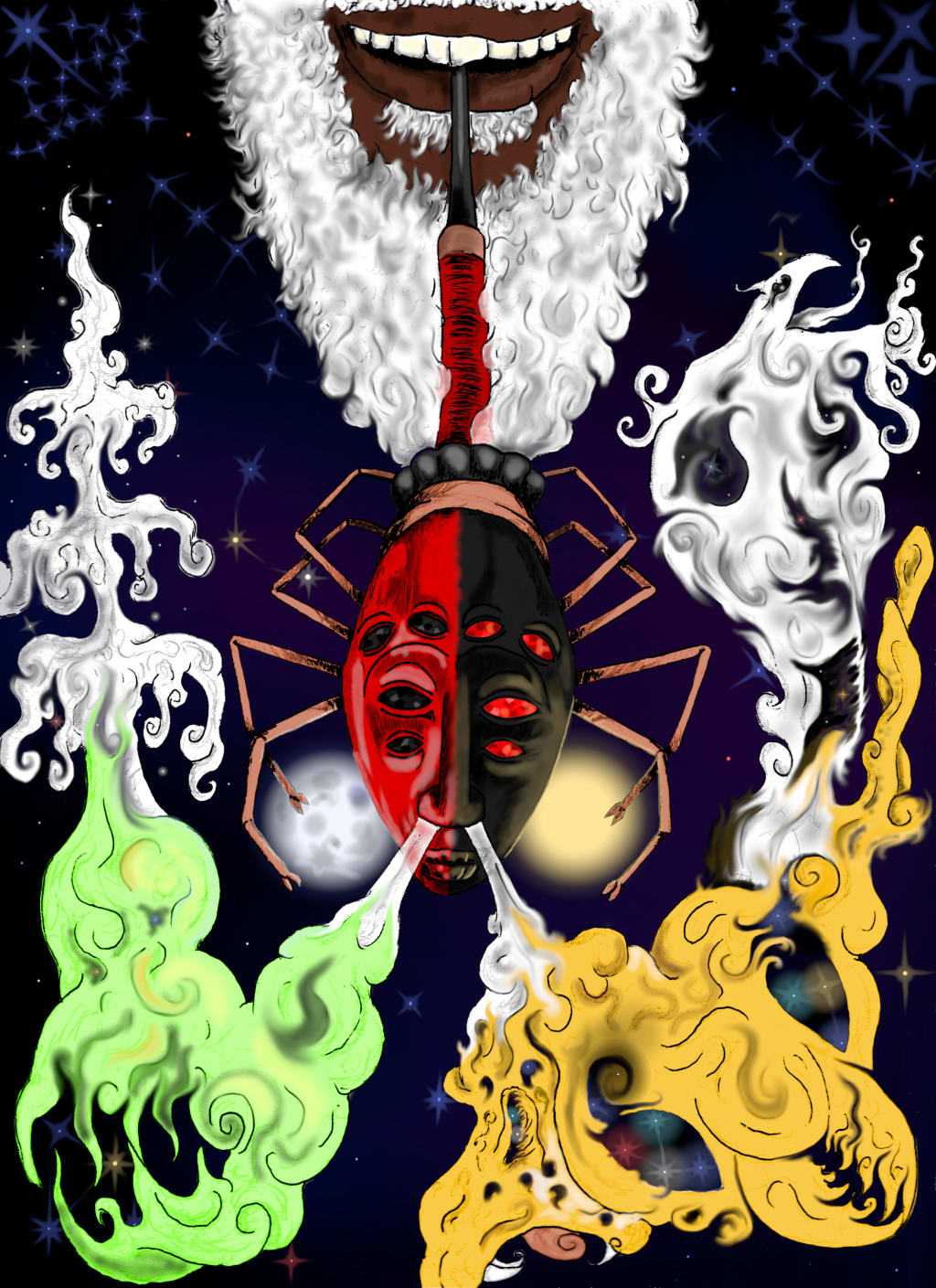
Bimpe and Papa Legba had been walking together for three hours when they crossed paths with another traveler – a merchant driving his cart. The beast pulling his cart looked like a buffalo, but Bimpe didn’t think any merchant was crazy enough to try and yoke a widow-maker to their wares. But, if the beast pulling the merchant’s cart was strange, the merchant himself was stranger.
The merchant’s hair was long and wavy, but it hung limp like oiled black silk. His jaw was clean-shaven, but his mustache was thick and its tips were oiled upward like horns. He was bare-chested, but wore a shawl around his shoulders and a wrap-around skirt that was held in place by a sort of vertical sash tucked into the front and back of the skirt’s waistline. All of his clothes boasted vivid reds and were embroidered with golden threads.
“Pushan’s blessings upon you, good travelers!” the merchant greeted them merrily in the Common Tongue.
Papa Legba smiled, amusement twinkling in his eyes and crinkling his nose as he tipped his hat to the merchant.
“Same to you, friend merchant. Did Olokun and Ganesha bless your business in Babashehir?”
“Come see for yourself!” the merchant suggested enthusiastically, gesturing back to his cart. “I’ve got agbalumo, icheku, baobab fruit, clothing made by the finest seamstresses and tailors in Vrishnagar – anything not in my strongbox, I’ll part with for a fair price.” He chuckled amicably. “My name is Atharv. Might I ask yours?”
“Some call me Ewure-Omugo,” Papa Legba replied as he went to inspect the merchant’s wares. “The girl is my daughter, Bimpe.”
Bimpe jumped as if pinched – realizing both that she’d been staring at Atharv quite impolitely, and that she’d just been casually adopted by a god.
“Oh…uhm…good to meet you Ogbeni Atharv,” she stammered.
“Likewise little one,” Atharv replied. He then twisted around in his seat to address Papa Legba. “Anything piquing your interest, Ewure-Omugo?”
Bimpe blinked and stared at the strange man some more – she couldn’t help it.
He really doesn’t know that he’s calling a stranger ‘stupid goat’? Bimpe wondered incredulously. He must not speak Shangoan, nor Efan, nor Fah.
Papa Legba reached into the cart and lifted out of it a red-lacquered calabash. He seemingly read the strange, curly writing painted along the side before responding to Atharv.
“Is this red rice arrack?” Papa Legba asked hopefully.
“Pop the cork, Ewure-Omugo! Take a good whiff!” Atharv encouraged him. He then turned to Bimpe and beckoned. “Come, Bimpe, see if there are any silks you might like.”
Papa Legba and Bimpe both did as Atharv suggested.
Bimpe climbed up onto the side of the cart and ran her hands over the nearest silk patterns. The bright colors and enchanting patterns reminded Bimpe of the happy hours she’d spent picking out cloths and silks from the market with her mother, and learning embroidery from her father. Bimpe’s sad smile quickly vanished when she realized that she’d left her home and village behind without bringing any cowries to pay for food or shelter, much less expensive silks.
“Ooh that’s a fine scent,” Papa Legba said, nodding approvingly as he shoved the cork back into the calabash of arrack. “What’s the price?”
Slowly, Bimpe climbed down from the cart, doing her best to appear inconspicuous while the adults haggled. She hoped Atharv wouldn’t ask her if she wanted anything – she didn’t know how to refuse him without either insulting his wares or revealing her embarrassing lack of funds.
“Eight rattis silver, or ten unbroken cowries,” Atharv replied promptly.
Papa Legba immediately began fishing around in his agbada for payment – cowries, Bimpe assumed.
“What’s a ratti?” Bimpe asked the moment Atharv looked her way.
“These are rattis,” Atharv replied with a laugh, tapping his necklace of red-and-black seeds. “Any merchant worth their silver has a necklace like this, little one, and knows its number of ratti seeds. If we wish to check the payment we are being given, we need only drop the silver onto one side of our scales and our necklace onto the other.” He patted a rattling pouch hanging from his belt. “They aren’t just weights though – many people in or around Visayadeva prefer them as currency over silver.”
“Don’t you worry that animals might eat your rattis?” Bimpe asked, glancing warily at his strange buffalo.
If I ask him enough questions, maybe he’ll forget to ask me if I want anything from his cart, Bimpe thought.
Atharv uttered another jovial laugh. “Oh no, no! Most animals know well enough to leave these seeds alone – they’re quite poisonous.” He paused briefly, then offered Bimpe a cheeky grin. “I suppose some birds eat them, so some of my finances might be at risk if I were mobbed by a flock of birds.”
“You use poison to buy goods?” Bimpe asked, thoroughly bewildered.
“What does Osanyin say about poisons?” Papa Legba asked as he fished cowrie shells out of a small, battered pouch.
Bimpe furrowed her brow and racked her brain, but couldn’t remember any sayings of Osanyin that fit the question. Just as she was starting to feel embarrassed, her doll whispered the answer from inside her gele so only she could hear.
“Osanyin says that…the difference between poisons and healing salves is a matter of preparation?” Bimpe repeated cautiously.
“Just so!” Atharv replied. “Boiling the seeds in milk purifies the poison and allows them to be used in many potions and spells to cure blindness, and the leaves make a strong medicinal tea that cures many minor ailments.”
“Not to mention the blessings of the white rattis, eh?” Papa Legba said with a wide grin as he dropped his ten cowries into Atharv’s open hand.
Atharv guffawed, “Quite unmentionable, those.” He clapped his hands together. “Now that your father has his arrack, did you see anything in the cart to suit your fancy, little one?”
Bimpe opened her mouth, closed it, and sighed – her attempts at distracting Atharv had been for naught. She glanced at Papa Legba in a mute appeal for help, but he just stared back at her expectantly. Not knowing what else to do, Bimpe just started talking and the right words seemed to flow forth from desperate creativity.
“Your silks are beautiful, Ogbeni Atharv, but we can’t buy them – not a single roll. My mother weaves her own silk by hand, you see, and would get very cross with us if we brought someone else’s wares home. Wouldn’t she, baba?”
“She would, she would indeed,” Papa Legba replied with a rueful shake of his head.
“Ahh, what a shame,” Atharv sighed with short-lived disappointment. “But! Lakshmi forbid that I sell you anything that would disrupt the harmony of your family.” He touched one of the ret lotus flowers sewn into his shawl in an apparent gesture of piety.
“No doubt Oshun would likewise frown on such a venture,” Papa Legba said as he gave Atharv’s buffalo a scratch behind its ear. “Nevertheless, thank you for the arrack, Atharv. May Pushan bless the rest of your journey.”
“Likewise, Ewure-Omugo, likewise little Bimpe!” Atharv cried out in farewell.
* * * * * * * * * * * * * * * * * * * * * * * * * * * * * * * * * * * * * * * * * * * * * *
Later, when Atharv and his bizarrely placid buffalo had trundled away into the distance, Bimpe looked up at Papa Legba and asked, “Papa Legba, why did you tell Atharv to call you a ‘stupid goat?’”
Papa Legba took a swig from his arrack and let out a laugh. “I never did!”
“But—”
“I said ‘some call me Ewure-Omugo.’ I never said that such people were especially wise, nor that he should emulate them, did I?”
Bimpe thought for a moment and, upon realizing that he was right, asked, “Were any of the cowries you gave him real?”
“Seven were, in fact. The others will have already vanished by now.”
“But why trick him at all?” Bimpe felt compelled to ask, even knowing as she did that Papa Legba was the divine trickster.
“I gave the people of Midaye the Tongue of Common Understanding so that – well, it’s right in the name – you would be able to understand one another wherever you traveled. However, if you want to be a traveling merchant, you really should make an effort to learn the languages of the people you intend on selling to – or a collection of curses, insults, and commonplace names at bare minimum.” He took another swig of arrack before corking the calabash and tucking it away into his agbada. “Atharv did none of those things. He didn’t even ask the meaning of either of our names, did he?”
“No, but…even if he had asked about your name, wouldn’t you have just lied to him again?”
Papa Legba chortled. “Maybe, maybe not.”
Bimpe chewed on that for a moment, before asking, “What does ‘Atharv’ mean?”
“Knowledge,” Papa Legba replied.
This time, both Bimpe and Papa Legba laughed.
“So now, Ogbeni ‘Knowledge’ will complain at the nearest way station about the old man who cheated him on the road,” Papa Legba told her. “When the locals ask him for details, and he tells them that it was a ‘stupid goat’ with my description, they will laugh and he will learn. Later on, when his pride allows it, Atharv will also laugh at himself and share the story with his friends and family. That will be worth more than three cowries.”
* * * * * * * * * * * * * * * * * * * * * * * * * * * * * * * * * * * * * * * * * * * * * *
When Lisa had escorted the sun below the horizon and Mawu had coaxed the moon out of hiding, the Great Warding appeared to help light up the night sky. Threads of starlight and moonbeams spread across the sky like a great spider’s web, stringing together arcane symbols into vast, shifting constellations.
Bimpe knew that wizards somehow learned their spells from its symbols and designs, but to her the Great Warding had always been a periodic, totally incomprehensible, but beautiful addition to Midaye’s nights. Sitting with Papa Legba by their campfire and staring at those arcane symbols directed Bimpe’s mind back to their encounter with Atharv and what Papa Legba had said about languages.
“Papa Legba?”
“Yes, child?”
“How did you give us the gift of the Common Tongue?”
Before turning to look at her, Papa Legba puffed a few smoke rings from his pipe as he considered her question. The easy grin that spread across his face caused his spider-pipe to wiggle and walk from the middle of his mouth to its left corner.
“Many stories have been told about this, but you’re hoping to hear the true one. Is that the way of it, Bimpe?”
Already, Bimpe got the feeling that she was being led into a trick or trap, but Papa Legba was right and she was curious. She nodded twice.
“Hmmm, let’s do this: I’ll tell you three different stories that explain how I gave Midaye the gift of the Common Tongue, and you guess or determine which one is the truth. Does that sound fair?”
“Uh-huh!” Bimpe eagerly agreed.
“Good, good. Now, you know some of my other names, don’t you?”
“Father Eshu, Anansi, I think quetzallin call you Old Coyote…” Bimpe paused and wrinkled her nose as she ransacked her memory for more names, “…Eshu-Legba? Does that count as another name, when it’s two of your names put together?”
“Huehuecoyotl, I like that one – it even sounds like I’m laughing when I say it,” Papa Legba said as he picked up his calabash of arrack. “But, you’re missing one more – you heard it today, even!”
Bimpe frowned briefly in confusion until her eyes alighted on Papa Legba’s calabash.
“Pushan?” she ventured.
“Mhmmm,” Papa Legba agreed while taking a swig of his arrack.
Bimpe hesitated, then asked, “Are all those tricksters and travelers really you? I mean, Nkuba and Shango are both gods of storms and lightning, but they’re not the same god.”
“Now why would I go and ruin a perfectly good mystery by answering that question, mmh?” Papa Legba replied with a rich belly laugh. “Now, the reason I asked about names is that the first two stories I have to tell are most commonly attributed to Anansi.”
An extra arm reached out of Papa Legba’s agbada, picked up a stick, and stoked the fire.
“Let’s begin with the story of the gourd.”
* * * * * * * * * * * * * * * * * * * * * * * * * * * * * * * * * * * * * * * * * * * * * *
Anansi and the Gourd
* * * * * * * * * * * * * * * * * * * * * * * * * * * * * * * * * * * * * * * * * * * * * *
When Balaam made the first humans, they did not yet know how to speak. The gods of knowledge – Orunmila and myself among them – stepped in and taught humanity how to speak, read, and write; but each god taught their people in their own unique way. These differences, though small at first, became large over the centuries, and were further compounded by the piecemeal exposure of humanity to the ancient languages of the hinn. Soon, humans from different parts of Midaye could barely understand one another, much less their hinn and vanara neighbors – then the teoquetzalli emerged from their jungles, and no-one could understand them.
All of this distressed Anansi. While different languages made playing some tricks on mortals easier, it made other tricks – not to mention sharing stories and wisdom – much harder.
“If everyone had at least one language they shared,” Anansi said to himself one day, “then they’d be able to share stories with that language, while playing tricks and keeping secrets with the others!”
Anansi thought that creating a common language was a good idea, but he didn’t have the first idea of how to make it happen. Pondering this and wandering in the shape of a little spider, he happened upon the grove of the Elder Gourd.
The Elder Gourd was the first calabash, planted by the quetzalli before Balaam’s arrival. He was bigger than an elephant and could uproot himself to move from place to place. The Elder Gourd did not appreciate seeing other gourds carved up into bowls and cups, and so he developed the habit of eating any mortals he could catch. He didn’t try to chase mortals – after all, he could not move very fast—but instead, he spoke to them. He told them that he could grant them immortality, or god-like strength, if only they could pluck him – and when they got close enough to try, he’d swallow them whole.
While they had spoken many times – spider to gourd – it had not occurred to Anansi until just then to ask the Elder Gourd how he had learned to speak. So this time, he asked.
“How did you learn to speak, Elder Gourd? Did a quetzalli teach you, before the humans were born?”
“A quetzalli did teach me, though he didn’t mean to do so,” the Elder Gourd told him smugly.
“Oh? Did you learn by spying on him and listening to his speech?” Anansi asked, though he suspected otherwise.
“No, little spider, I learned by eating that quetzalli when he tried to pluck me. When humans tried to pluck me, I ate them too. Now, I can speak as they do.”
“What about your children, Elder Gourd?” Anansi asked, a sly idea forming in his little spider head. “When they sprout, do they know what you know?”
At this question, the Elder Gourd grumbled and gnashed his teeth. “I do not know. The bats fear me, and do not spread my pollen.”
“Do not fret any longer, Elder Gourd, I will spread your pollen myself,” Anansi promised.
“You will? Then what are you waiting for? Get to it!” the Elder Gourd demanded, foolishly not asking what this help would cost.
Anansi did as he promised, and spread the pollen of the Elder Gourd to many calabash trees far and wide. Many years passed, and new calabash trees began to grow. To the satisfaction of both the Elder Gourd and Anansi, the new calabashes could talk, move, and eat just like the Elder Gourd.
“It’s unfair, isn’t it?” Anansi asked one day.
“What is?” replied the Elder Gourd.
“That your children will learn things you don’t know, and taste meats you’ve never tasted, despite owing their lives to you.”
“It is unfair!” groused the Elder Gourd. “But there’s nothing to be done about it, for I travel slowly. If humans saw me crawling across their roads, they might burn me with fire.”
“Or cut your stem with axes,” Anansi agreed.
“No mortal axe could cut my stem,” the Elder Gourd insisted, “but if I met with fire, it would be disastrous.”
On that, the spider and the gourd were agreed, though for different reasons.
“Do not fret any longer, Elder Gourd, I will help you travel fast and safely with my magic webs,” Anansi promised.
“You will? Then what are you waiting for? Get to it!” the Elder Gourd demanded, foolishly not asking what this help would cost.
So Anansi helped the Elder Gourd travel from one end of Midaye to the other, so that the Elder Gourd could eat at least one person from every race and culture. Before long, the Elder Gourd could speak and understand all the languages of Midaye.
“It has been a long time since you returned home, Elder Gourd,” Anansi observed innocently one day.
“It has, it has. Take me home immediately!” the Elder Gourd commanded, for he had begun treating his spider helper like a servant.
So it was that Anansi took the Elder Gourd to his homeland, but not to the grove where they’d first met. Instead, Anansi’s webs led the Elder Gourd into the courtyard of a princely compound, the sort that Shangoan humans built.
“This is not my grove, spider!” the Elder Gourd protested as he looked around for Anansi.
Anansi, who was well-hidden, did not reply.
Before too long, a strong, well-built man entered the courtyard.
“What unannounced, unwelcome stranger is shouting in my courtyard?” he demanded to know as he drew his twin axes. “And, where did this strange tree come from!?”
“I am the Elder Gourd,” the Elder Gourd replied in his silkiest voice, having recovered his composure. “Pluck me from my stem, and you will gain immortality and knowledge beyond your wildest imaginings.”
The man stared at the gourd, then laughed – a deep, booming laugh that rolled across the land like thunder.
“I am Shango, tree. I am immortal, a god, and know what I need to know. I know that you are one of the gourds that has been eating my people!”
And so, Shango cut the stem of the Elder Gourd with a single swing of his twin axes.
“Servants! Clear away this tree and burn the gourd.”
Anansi reappeared then, in the guise of one of Shango’s many servants. “I will clear away this mess at once, Oba of Thunder.”
Anansi cleared away the tree, but did not burn the gourd. Instead, he mashed it into a paste, which he mixed with palm nuts and water. He then traveled across Midaye, feeding this paste to every mortal and every god. While the Elder Gourd had known every language, it was Anansi’s preparation that transformed this knowledge into a single language. Those who ate this paste gained knowledge of the Common Tongue and passed this knowledge down to their children – just as the Elder Gourd had done to his many angry progeny.
* * * * * * * * * * * * * * * * * * * * * * * * * * * * * * * * * * * * * * * * * * * * * *
Anansi and the Library
* * * * * * * * * * * * * * * * * * * * * * * * * * * * * * * * * * * * * * * * * * * * * *
Anansi thought that creating a common language was a good idea, but he didn’t have the first idea of how to make it happen. He thought about this all day, every day. He even stopped playing tricks and pranks, which worried his wife, Orkornori.
When Anansi finally told her what he had been thinking about all that time, Orkornori said, “The demiurges would know how to make such a language. Why don’t you ask them for help?”
“Because they hate tricks and I’m the goddess of tricks,” Anansi replied.
“That might be true,” his wife admitted, “but they like knowledge, and you are also the goddess of knowledge. The idea might appeal to them, even if you don’t.”
Heeding Orkornori's advice, Anansi traveled to the Great Library of the Demiurge. The Great Library was – and remains – a strange place. Magical and physical laws come to life and debate with one another alongside the social laws of countless worlds beyond this one. Letters read books and scrolls read hieroglyphs; all organized by and part of the demiurge. The demiurges are the demiurge – many faces with one voice, many voices with one mind – both one and many.
So, Anansi told the demiurge what he wanted – a language that anyone could understand, and all would know – and the demiurges listened. Anansi argued that creating such a language would advance scholarship and understanding, leading to more orderly societies, to which the demiurges agreed. When Anansi was done spinning the threads of his case, the demiurge told him that they would give him the knowledge he sought, on the condition that he help them.
“You must bring to us the following four creatures: Onini the Serpent, Osebo the Leopard, Mmoatia the Umutwa and her mount, Mmoboro the Hornet,” declared the demiurges.
Anansi knew each of these creatures well but was careful not to show it, lest the demiurges decide to give him a tougher challenge.
“Why those creatures, specifically?” Anansi asked.
“They are divine mistakes, aberrations, and weavers of chaos,” the demiurge replied. “You will restrain them, and bring them here. This is the price of the help you seek.”
On his way home, Anansi decided that Onini would be his first target, for the serpent lived close by. Orkornori agreed, and together they prepared. Anansi spun his silk into thousands of feet of strong, sticky rope. Meanwhile, Orkornori ventured into the jungle, collected all the deadwood within a hundred miles of their home, and used cunning magic to transform all the sticks and branches into a single staff that was hundreds of feet long.
Then, Anansi and his wife took the rope and staff to the river. They hid the rope carefully, laid the staff along the riverbank, then began to argue as loudly as they could. Before long, Onini emerged from the river, having been roused from their slumber by the arguing couple.
Onini was the first and largest ejonla: all ejonla living today can trace their ancestry back to Onini. Their hood – like that of a cobra – was large enough to give shade to an entire village. Their ivory horns were as long as trees and their fangs were like spears. Their trunks could drink a pond in minutes, and their scales glittered with thousands of embedded diamonds.
“Who dares disturb my slumber?!” Onini demanded, angry at having their sleep disturbed.
“Forgive us, mighty ejonla,” Anansi groveled most convincingly, “but we were arguing about you!”
“About me? Why?” Onini asked, still annoyed.
“You see, my wife here came home to tell me that she found what she imagines to be a large branch,” Anansi gestured to the staff. “She told me ‘come and see, it’s as long as Onini!’ So I came to see, only to find out that my wife is a liar!”
“I am not!” Orkornori cried. “Look, see for yourself! Clearly the branch is as long as the great Onini.”
“I am looking, but I am not seeing!” Anansi retorted. “The great ejonla hasn’t shown half of their length yet, and they’re already longer than this twig.”
“We should find a priestess to look at your eyes, husband. You are clearly not seeing properly!”
“Enough!” Onini hissed, growing angry once more. “I will settle the matter. But, as payment for disturbing my rest, I will eat whoever was wrong.”
Onini slithered out from the river and laid themselves out, flat and straight, next to the staff. Once the serpent was in position, Anansi tied them to the staff with his spider-silk ropes – quicker than blinking. Onini struggled and tried to slither out of the trap, but the sticky ropes held fast.
So, Anansi carried Onini to the Great Library and laid them at the feet of the demiurges.
“One task is complete, three remain,” the demiurge said.
On his way home, Anansi decided that Osebo would be his second target, for the leopard would be easy to find. Osebo was a voracious eater, devouring any creature who strayed across his path and any carcass he found. So, Anansi and Orkornori wandered the jungle and savannah and spoke with the animals. Between the fearful chatter of fleeing prey and the grousing complaints of frustrated predators, Osebo’s location was soon revealed.
Anansi’s wife dug a deep pit, while Anansi went out and retrieved the last un-eaten carcass for nearly 300 miles – a dead tapir. Anansi used his magic to conceal the carcass’ scent from Osebo while he finished their trap. First he wove a sticky web across the mouth of the pit, which he then disguised with leaves and twigs from the jungle floor. Then, he used his most invisible threads to hang the carcass from the branch of a nearby tree so that it rested atop the pit’s web without placing any weight upon it.
His work complete, Anansi released his spell – and the scent of the dead animal – and went to hide in the trees above with his wife. Before long, Osebo appeared.
Osebo was no larger than many a leopard you can find these days, but his jaw could unhinge like a snake’s. When Osebo spied his prey, he leapt forward and swallowed the tapir whole, only to find himself twice-caught like a fish – once by Anansi’s invisible threads, which now ran deep down his throat; and once by his net, which only ensnared him more thoroughly the harder he struggled.
So, Anansi carried Osebo to the Great Library and laid them at the feet of the demiurge.
“Two tasks are complete, two remain,” the demiurges said.
Now, Anansi knew that Mmoatia the Umutwa and her mount, Mmoboro the Hornet, would have to be captured together, for one never left the other’s side. He also knew that finding a rogue umutwa and her hornet companion would be much more difficult than finding a giant serpent or an infamous leopard – after all, a whole tribe of umutwa can be difficult enough to find, as the fey are smaller than the ants they frequently ride.
Fortunately, Orkornori happened to know where an umutwa tribe was likely to be bivouacked, for she had seen them hunting an elephant in the area not three days past. When they retraced her steps, they indeed found the tribe of tiny hunters – still feasting on the elephant they’d slain with their poison arrows.
“I have seen you!” Orkornori greeted the umutwa as they approached.
The nearest umutwa picked up his bow and nocked an arrow.
“Where did you see us?” the umutwa demanded suspiciously.
“On our way here,” Anansi lied with a smile. “See that great mountain over there? We were standing on its peak three days ago when we saw you hunt down this impressive beast. We’ve come to pay our respects to such mighty hunters.”
This flattery pleased the umutwa, who invited Anansi and Orkornori to share their meat and fire. While they ate, Anansi told the umutwa stories – many of which happened to involve an umutwa besting some dangerous beast or foolish hunter. These stories put the umutwa in a fine mood.
“Do you know why we were on top of that mountain?” Orkornori eventually asked. “We were looking for the heroes Mmoatia and Mmoboro – but of course, your hunting prowess was so captivating that our search was foiled.”
The umutwa frowned and muttered darkly amongst themselves. One young umutwa eventually squeaked, “Mmoatia’s no hero! Mmoatia’s a killer!”
“Surely Katsumbakazi was also a killer?” Anansi replied innocently, for Katsumbakazi had indeed killed many humans who dared intrude on her domain.
“Katsumbakazi was a hunter,” insisted an older umutwa; “Mmoatia is a killer because she kills umutwa.”
“Ahh, forgive us, we did not know!” Orkornori lied.
“If you help us find her, we will take her far away to where she can no longer kill your people,” Anansi promised.
“The demon-hornet Mmoboro also?” the young umutwa asked.
“Mmoboro also,” Anansi confirmed.
The umutwa gave Anansi and Orkornori directions and sent them on their way. They quickly realized that they would have to shrink themselves down to the size of umutwa for the directions to make sense, but that wasn’t very hard. Soon, they found an anthill with no ants in a clearing filled with the bones of birds, beasts, and men.
Having found Mmoatia and Mmoboro’s lair, Anansi and Orkornori retreated a ways and got to work. Orkornori carved and assembled a tiny, lifelike wooden puppet the size of an umutwa. Anansi carved a wooden offering bowl for the puppet, and covered both the bowl and the puppet in a layer of sticky tar. Finally, Orkornori prepared an offering of irresistible sweet yam paste, which she put into the bowl.
Using his spider silk threads, Anansi walked the puppet up to Mmoatia and Mmoboro’s mound, while Orkornori used her magic to make it seem as though the puppet were calling out in a little umutwa voice.
“Fearsome Mmoatia, legendary Mmoboro, I have seen you from afar and come with a humble offering!” the puppet declared.
Mmoboro emerged from the ant hill at once, for he was hungry and could smell the yam paste. Mmoboro landed on the bowl and ate up nearly all of the food. It was only when he tasted tar for the first time that he realized his mistake. He tried to fly back into the anthill, but his feet were stuck fast to the sides of the bowl. He tried to sting the puppet, but that only got him even more stuck.
“Help, Mmoatia! I’ve been tricked and trapped!” the hornet cried.
Orkornori chose that moment to peek out from the tree branches above, and silence the hornet with a spell.
Mmoatia climbed out of the anthill with her bow and arrows, but Anansi made the puppet dance and leap, so that the umutwa killer could not loose her arrows at the puppet without risking the life of her trapped hornet. Frustrated, Mmoatia tossed her bow aside with a little shriek of rage, and tried to wrestle the offering bowl away from the puppet – only to find herself stuck in turn.
Anansi wrapped the fey, hornet, and puppet up in his webs, and delivered them to the demiurges.
“Four tasks are complete,” the demiurge said, when Mmoatia and Mmoboro were laid at their feet. “An agreement was made, and an agreement will be honored, for we are the demiurge.”
And so it was that Anansi was given the Common Tongue of Understanding, which he shared freely with all the mortals and gods alike.
* * * * * * * * * * * * * * * * * * * * * * * * * * * * * * * * * * * * * * * * * * * * * *
Papa Legba and the Clay
* * * * * * * * * * * * * * * * * * * * * * * * * * * * * * * * * * * * * * * * * * * * * *
Back before humans could make more of themselves, Balaam had to make them all by hand. First, he sculpted bodies out of clay and water, then left them out for the sun to dry. When night came, Balaam would stand in the moonlight and bless the clay figures. The next dawn, the once-clay-and-water figures would rise as flesh-and-blood humans.
Balaam eventually grew tired of this task, but was reluctant to pass it off to another. Who among his rebellious divine children could he trust with the continued creation of mankind? In the end, he decided to entrust the secrets of mankind’s creation to Obatala – who, among the gods, was considered the most obedient and dutiful to his father’s will.
So, Balaam taught Obatala the correct mixture of clay and water, the exact moment when the figurines needed to be laid out in the sun, and the secrets of the moonlight blessing. All the while, they were being watched by a very old coyote.
In eons past, Huehuecoyotl had watched Quetzalcoatl make many species of mortals throughout the ages before he perfected the process. Now, he saw Balaam and Obatala making many of the same mistakes that Quetzalcoatl had made in his early attempts, along with some brand new mistakes. Firstly, Balaam and Obatala’s early humans were all the same – each and every one, identical – this was an old mistake. The new mistake – in Huehuecoyotl’s mind, at least – was that the new humans could not speak.
“If you make them all the same, they’ll share the same fate – boring for me, dangerous for them.” Huehuecoyotl growled to himself. “Besides, how are they supposed to share stories, or make stories of their own, if they can’t even speak!?”
The old coyote was convinced that Balaam had made the humans this way to spite him, and to prevent humans from having a reason to worship him. But, Huehuecoyotl was determined to both get the last laugh and improve the lot of humanity in the process. So, he watched and waited.
Before long, Balaam left his son unsupervised to continue creating mankind – confident that he’d made the right decision in delegating this task to his son. For a time, Obatala continued to do his job dutifully and eagerly. Eventually, however, Obatala grew both confident and bored with his work. When Huehuecoyotl noticed this, he knew that the time had come to act.
Huehuecoyotl began to visit Obatala from time to time in the shape of a traveling god named Legba. At first, Obatala mistrusted Legba, and refused to let him near his precious clay figurines. It wasn’t long, however, before Obatala grew fond of Legba’s jokes, stories, and frequent gifts of palm wine. Soon, Obatala was showing off his work to his new friend.
They were drinking palm wine and watching the figurines bake in the sun together one day, when Legba turned to Obatala and said, “Obatala, you do such fine work, but aren’t you tired of sculpting the same figures – the same humans – over and over again? Isn’t it boring?”
“So boring!” Obatala exclaimed – a bit drunkenly – before catching himself and sobering up. “But, it’s what Balaam has commanded that I should do, so it’s what I will do.”
Huehuecoyotl, being patient and cunning, pretended to let the matter lie for a time. Years later, when they were both a little more drunk, Legba tried a slightly different approach.
“Obatala?” Legba asked. “Why do you think Balaam gave you this tedious task?”
“Because it’s necessary, and he trusted me,” Obatala answered proudly. After a moment’s hesitation, however, he added, “Also, I think…precisely because it is tedious.”
“If the wise and patient Balaam found a task to be tedious and time-consuming, do you imagine he passed it to you because he thought that you were more patient than he?” Legba asked, taking another swig from his calabash of palm wine. “Perhaps, he trusted you to make it less tedious?”
“Maybe,” Obatala replied, uncertainly.
Legba could tell that the seed had taken root, and said no more about it that day.
A year later, when Obatala greeted his friend with a wide, proud smile, Legba knew that his seed had finally begun to sprout.
“Come, I’ve something to show you!” Obatala said.
“Show me, then,” Legba replied with a grin.
Obatala took Legba to a nearby village of humans, where Legba quickly noticed that the humans had many different skin colors. Some were almost as dark as the soil, while others were nearly as light as bitter kola nuts. Some even had lighter eyes!
“They are certainly less boring to look at, that’s for certain!” Legba laughed. “Well done, my friend.”
“At first I was afraid that the blessing wouldn’t work on the ones I removed from the sun early,” Obatala admitted, taking a big swig from his calabash of palm wine, “but the blessing worked anyway!”
“Balaam’s blessing is both strong and flexible,” Legba agreed. “There are more changes you might yet make to the process – but, all of that can wait! Come, let us drink and celebrate!”
So they drank, celebrated, and parted ways once more.
Emboldened by his success, and by generous amounts of palm wine, Obatala introduced many more changes to the creation process. By the time Legba visited Obatala again, humanity possessed almost the same level of diversity you would see today. Obatala’s humans had different hair textures and lengths, different bodies, and different faces – but still no voices.
Now, by this time, Obatala’s confidence in his own abilities and pride in his creations had made him arrogant and boastful – two qualities which were only exacerbated when he drank. This made Legba smile. Waiting patiently for the right moment to spring his trap, Legba plied Obatala with palm wine while the latter blustered and boasted.
Legba knew the moment had come when Obatala stood up and proclaimed: “I am the greatest of the gods! Only…only I, yes I can create mortal life itself! The other gods would have no offerings if it weren’t for my creations!”
“Ah! Ah! Now there I must protest,” Legba interjected. “For the truth is, all of our kind would agree that I am the most powerful god.”
“What!?” Obatala yelled amid a gale of mocking laughter. “You…you command roads and…and travel and stuff – what good are either without the mortals I create!?”
“I command more than roads and travels – though you should dismiss neither lightly – I command fortune and fate itself!” Legba cried with mock indignation.
Obatala snorted irritably and dismissively, “The power of creation is greater than the power of luck! I bet I could prove it!”
Legba smiled a wide coyote’s smile. “You bet you could prove it? Very well, here’s the wager: You make eight humans – make them however you want – and tell me what their fates will be. Then, I will tell you what their fates will be, and we will watch and see who was right. The winner will be owed a boon from the loser.”
Obatala agreed to this contest at once and immediately set to work crafting a new batch of eight humans. Though the palm wine did not diminish the skill of Obatala’s hands, it did encourage him to experiment more drastically and boldly than he ever had before. By the time his figurines had baked in the sun, and were ready for their moonlight blessing, Obatala had sobered up some and was beginning to question the wisdom and ethics of his drunken experimentation.
“This is all Legba’s fault, giving me palm wine and…if I start over again, Legba will claim to have won the bet – I just know it!” Obatala told himself. “Besides, it’s just eight humans. If life turns out poorly for them, I just won’t make any more humans like these.”
Reassured, Obatala proceeded with the moonlight blessing, and was ready to present his creations to Legba the following morning.
The first human had been taken out of the sun so soon that her skin was as pale as milk, and her eyes were pink as mountain salt.
“This woman will be a miner,” Obatala proclaimed – confident that this was the best and most likely fate for one whose skin and eyes would burn under the sun’s hot glare.
Legba shook his head and said, “This woman will be a famed hunter.”
The second human’s eyes had been given no water, and as such he could not see.
“This man will be a skilled cook,” Obatala proclaimed – confident that this was the best and most likely fate for one who was blind.
Legba shook his head and said, “This man will be a famous musician.”
The third human’s ears had been given no water, and as such they could not hear.
“This one will be a famous painter,” Obatala proclaimed – confident that this was the best and most likely fate for one who would have to rely on their eyes.
Legba shook his head and said, “This one will be a masterful war-leader.”
The fourth human’s mind had been sculpted differently than the others – differently enough, that Obatala wasn’t confident that he would be able to think or do complicated things.
“This one will be a warrior,” Obatala proclaimed – confident that this was the best and most likely fate for one who could not think as others did.
Legba shook his head and said, “This one will be the first human mage.”
The fifth human had been sculpted with weak and twisted legs that made it impossible for her to walk or stand.
“This woman will feed and look after the elderly,” Obatala proclaimed – confident that this was the best and most likely fate for one who could not travel, hunt, or build.
Legba shook his head and said, “This woman will be a great inventor.”
The sixth human had been sculpted with different proportions – with small limbs and a large head.
“This man will be a great entertainer,” Obatala proclaimed – confident that this was the best and most likely fate for one whom his people would doubtless find amusing for his differences.
Legba shook his head and said, “This man will be a great builder.”
The seventh human was sculpted with less water than the others, which Obatala suspected would make her frail and sickly.
“This woman will be a great healer,” Obatala proclaimed – confident that her sickness would inspire her to seek out means of treating herself and others.
Legba shook his head and said, “This woman will be a great politician and leader.”
Obatala snorted, for the eighth human was created to be perfect in every way – strong, keen of mind, tall, and comely.
“This man will be a great leader for his people,” Obatala proclaimed – confident that the finest human he’d ever created would naturally be a figure that his other creations would look up to.
Legba shook his head and said, “This man will be a criminal, and will end his life in exile.”
With their predictions made, Obatala’s eight new humans were sent to live with the others. At first, the other humans treated Obatala’s new creations poorly. The new humans were punished and shunned for their differences – all except Obatala’s eighth man.
Obatala quickly grew angry with this behavior, and soon appeared before his creations in a fury.
“I created these humans, just as I created you!” he chastised his misbehaving children. “Do not mistreat them, else you will forfeit my love in favor of my wrath!”
The humans cowered, bowed, and gave Obatala many offerings to apologize for their misdeeds.
When Obatala returned to Legba, the latter said, “It is good that you corrected their behavior, but let that be the last such intervention – from either of us – else the wager will be meaningless.”
Obatala agreed, and so he and Legba sat back and watched the lives of the eight humans from afar:
Though the sun burned and blinded the pale woman, she clearly had no great love for confined spaces. Instead of delving into dark caves, she learned to prowl the jungles and savannas by starlight, capturing predator and prey alike with cunning traps. She led hunting parties well into her old age, and was clearly much respected for her skills. Legba had clearly won the wager over her fate.
The blind man not only developed an unrivaled talent for drumming, but he went on to carve and craft many of humanity’s first stringed and wind instruments. However, he also developed a liking – if no particular talent – for cooking in his later years. Obatala was inclined to declare that Legba’s prediction had won out, but Legba cheerfully declared a draw.
The deaf human proved to not only be a skilled warrior with shield, spear, sword, and bow; but a remarkable tactician. He coordinated many ambushes, communicating with his troops effectively and – almost as importantly – silently using a series of complex hand gestures. So useful and effective were these gestures, that the rest of the community swiftly adopted them for everyday use. Legba had clearly won the wager over their fate.
The different-thinker was good friends with the deaf human, but though Obatala was hopeful in the beginning that this would lead them to become a warrior, this did not come to pass. The different-thinker learned their friend’s hand gestures, but where the others learned simply to communicate with these gestures, the different-thinker saw the ashe within the gestures. With decades of study, they learned to combine the ashe of the gestures with that of certain material components to create the first arcane spells known to humanity. Legba had clearly won the wager over their fate.
The fifth human – tired of being carried around by her family, or otherwise being left behind – began making things with her hands that would help her get around. She first created simple crutches, then a chair with wheels. For longer journeys, she crafted the first saddle – complete with stability straps – so she could ride between villages on her donkey. While the other humans did not need the same stabilizing harness, they found a great many uses for the rest of her saddle design. Legba had clearly won the wager over her fate too.
The small human was friends with the inventor. Combining her devices and love of experimentation with his desire to build and need for efficient building methods, they built homes that could weather any storm and towers that scraped the sky. If the builder and inventor could not realize a shared vision, they often went to the different-thinker for a magical solution. Legba had clearly won the wager over his fate.
The sickly human did at first feel compelled to study the healing arts – in the hopes of finding a cure for herself – and it seemed like Obatala might win the wager over her fate. However, failure after failure eventually caused her to abandon her search for a cure, and the healing arts altogether. Art became her solace, and eventually her passion. The hard-won empathy that Legba had thought would mold her into a successful leader, instead helped her create sculptures and paintings that resonated with many. Neither Legba nor Obatala had correctly predicted her fate.
Given that the sickly human hadn’t become the leader Legba had predicted, Obatala held out hope that his finest creation would at least give him a single win in their increasingly one-sided wager. Alas, the eighth man’s intended virtues quickly proved to be his flaws. His effortless strength made him lazy, while his god-given beauty made him vain and selfish. Rather than being a font of self-reflection, his keen mind saw only his strengths and grew arrogant as a result. When he beat one of his elders for daring to disagree with him, he was driven into the wilds.
“Alright, Legba, it is clear that you’ve won our wager,” Obatala eventually admitted. “What boon would you have of me?”
Legba grinned his coyote grin. “All I want is for you to make three humans – one male, one female, and one in-between – with a single drop of my blood mixed into the water used for each of them.”
Obatala had plenty of misgivings about Legba’s request, but they were silenced by his pride and sense of honor. He had agreed to the terms of the wager, and he refused to have it said that Obatala did not honor his word – after all, what sort of example would that set for humanity?
So, reluctantly, he sculpted the humans and let Legba add his blood to each. Legba, sensing Obatala’s reluctance and fearing that he might spoil everything by telling Balaam about their wager, kept Obatala supplied with palm wine and reassurance.
When night fell, Obatala performed the moonlight blessing and watched his three newest creations stir to life and wander away from the forest of Efe.
“It’s just three humans,” Obatala reassured himself once again, taking a drink from his calabash. “If life turns out poorly for them, or if they create trouble, I just won’t make any more humans like them.”
Obatala would soon come to realize that Legba’s blood had endowed his three humans with two gifts: the gift of speech, and the gift of procreation.
“What have you done!?” Obatala bellowed at Legba. “The humans speak now, but they use their speech to say things which are not true!”
“This is true,” Legba replied calmly, “but they say many things which are true, also. Much knowledge and wisdom is shared this way.”
Obatala frowned, but could not argue with this. So, he changed tack, “Well, they are making more and more of themselves with every passing year – they’ll spread like locusts and devour the land if something isn’t done to stop them! Not only that, but with each generation all the traits I introduced for our wager have spread!”
“What I’m hearing,” replied Legba with a smile, “is that you no longer have to weary yourself with the tedium of making the same boring humans day after day, year after year. This should give you plenty of time to teach them to tell the truth, and to value their differences. As for Midaye, she can take care of herself, and will teach the humans not to abuse her bounty.”
Again, Obatala could find no argument to rebut Legba with, so he sent Legba away. Regardless of his lingering anger at Legba for misleading him, Obatala eventually decided to follow Legba’s advice.
It did not take long for Obatala to realize that he enjoyed the challenges and rewards of teaching this newly aware, complicated, and diverse humanity far more than he had enjoyed the mindless drudgery of sculpting identical clay-and-water golems. Still, Obatala did not forget how Legba had tricked him, and he never drank palm wine again.
Of course, not all of the gods were especially pleased with the rapid spread of humanity – Balaam was naturally livid when he eventually discovered what a glorious, diverse mess Obatala and Legba had made of his precious, boring humans – but those are stories for another time.
* * * * * * * * * * * * * * * * * * * * * * * * * * * * * * * * * * * * * * * * * * * * * *
“So, Bimpe, which of these stories do you think is true?” Papa Legba asked.
Bimpe frowned and conferred with her ancestors for a long time. Eventually, she said, “I don’t know…they all sound a little true, and a little false.”
“How so?”
“Well, I mean…how could one gourd make enough paste to feed to every human, quetzalli, vanara, and hinn on Midaye?”
“It was both large and magical,” Papa Legba replied, drawing a gourd in the air with the lingering smoke from his pipe.
“Okay, but what about the dwarves?” Bimpe asked, feeling sure that she’d caught Papa Legba. “They weren’t around back then, when humanity was new. Did you keep some of the paste for thousands and thousands of years, just in case new races came to Midaye?”
“Maybe I did,” Papa Legba replied with a grin, much to Bimpe’s annoyance. “Orunmila might have seen the arrival of the dwarves in one of his divinations and warned me to prepare for it.”
“What about your children?” Bimpe countered. “If both you and Orkornori were out capturing monsters, who was watching your sons and daughter?”
“Maybe that story took place before they were born. Maybe it took place after they left to start their own families.” Papa Legba laughed. “They didn't remain children forever, you know.”
“What about Obatala?” Bimpe asked. “In your story, we gained the Common Tongue because you got Obatala to add your blood to humanity – but Obatala didn’t create all humans, did he? Weren’t Devic people and Akkadians made by someone else? What about the axuumai, dwarves, hinn, and vanara? How’d they get to speak Common if your blood was behind it all?”
“And yet?” Papa Legba prompted.
“And yet,” Bimpe wrinkled her nose as she tried to sort her thoughts. “Two of the stories have important calabashes – the Elder Gourd, and the calabashes of palm wine you used to get Obatala drunk. They remind me of another story I once heard, where the spider Anansi gathered all the wisdom of the world in a gourd, but lacked the wisdom to climb up the tree with the gourd tied to his back, not his front. He ended up releasing the wisdom into the air for all to share.”
“Oh! I’ve always liked that one,” Papa Legba chuckled, then clapped his hands together. “Gourds are one common thread in these stories, it’s true. What’s another?”
Bimpe frowned and tilted her head to the left. “I guess…your reasons for wanting a Common Tongue in the first place? Across all three stories, you wanted to create the Common Tongue both to let people understand one another and share wisdom, and to make people less boring. Right?”
Papa Legba nodded three times. “So, where does all of this leave you? Do you know how I created the Tongue of Common Understanding?”
“No,” Bimpe replied hesitantly, “but I think I now know why you did.”
*************************ABOUT MIDAYE***************************
This story is set in a fictional realm of my own devising: Midaye. This world draws inspiration primarily from the religions, folklore, culture, and history of Sub-Saharan Africa; along with those of pre-colonial Mesoamerica, Mycenean Greece, the Indian subcontinent, and Mesopotamia.
************************AUTHOR'S NOTES**************************
On the Inspirations:
- Nearly every fantasy setting has some variation on the 'Common Tongue'. It's easy enough to see why: It's very convenient for the author or game-master (in the case of TTRPGs) to have a single language for cross-cultural communication. However, it's also one of those tropes that falls apart the moment you pay any attention to it - unless you're provided an in-universe explanation. Divine intervention seemed the simplest way of explaining how a unified world language could not only come into being, but how it could remain immune to linguistic and cultural drift. Given the plethora of Anansi stories that involved him (or her, depending on the teller) stealing divine wisdom and gifting it to humanity, and given Eshu-Legba's role as the divine elocutioner, the rest started to write itself.
- Of the stories Papa Legba tells here, that of the Elder Gourd is the only one which was almost wholly of my own invention. Anansi and the Library hews fairly close to a traditional tale of how Anansi retrieved stories for humanity from the Sky-God. Papa Legba and the Clay, however, draws inspiration from two sources: the Sumerian story of Enki and Ninmah, and the story of Obatala and the palm wine. The way the tale came together in the end felt like a good origin story for how Midaye's Obatala became known for abstinence and protecting those with disabilities - characteristics Earth's counterpart shares.
On Creatures:
- Ejonla is a contraction of the Yoruba words 'ejo nla' which translate roughly to 'great gerpent'. I devised this word to describe the folkloric grootslang (which also just means 'great serpent' in Afrikaans) in lieu of the Afrikaans name, due to its Portuguese etymology.
- Umutwa are miniscule fey in Zulu folklore. They ride on flying ants, and hunt with poisons lethal enough to kill an elephant with a single arrow. Being very proud fey folk, it is generally considered wise to treat with them as Anansi and her husband do in Anansi and the Library - by pretending to have seen them from a great distance, due to their impressive stature.
About the Creator
T. A. Bres
A writer and aspiring author hoping to build an audience by filling this page with short stories, video game reviews/rants, history infodumps, and comparative mythology conspiracy theories.
Come find me @tabrescia.bsky.social
Keep reading
More stories from T. A. Bres and writers in Fiction and other communities.
The Offering
Bimpe was nervous. Her stepmother, Doyinsola, had charged her with presenting the family’s annual offering to the shrine of Mami Sonu-Mesan. Bimpe had even been given fresh clothes for a change – a pretty red gele, a spotless white iro, and a red-and-white striped buba. A part of her was overjoyed to finally leave her compound after years of near-imprisonment.
By T. A. Bresabout a year ago in Fiction
Wild Card Weekend Recap: What Happens Now?
I think I figured out why I love Wild Card Weekend so much. It's because it's the first playoff anything of the calendar year. The NFL season starts in the fall, and once upon a time, the champion was crowned either on or slightly before New Year's. The evolution of the NFL schedule has resulted in the playoffs starting just into the New Year, and currently, the final week of the season falls on the first weekend of the New Year, with Wild Card Weekend coming a week after that. So yes, chronologically, the NFL's Wild Card Weekend serves as the first playoff anything of the calendar year.
By Clyde E. Dawkins7 days ago in Unbalanced



Comments
There are no comments for this story
Be the first to respond and start the conversation.